


Global Study Finds Adaptation Progress Local Not Societal
Behind the public fanfare and declarations of international climate negotiations, like the COP26 conference that just ended in Glasgow, are thousands of researchers on the Intergovernmental Panel on Climate Change (IPCC) who toil for years to summarize the science on every aspect imaginable of climate change so policymakers have the best available facts to work from. But when hundreds of scientists working on the IPCC tried to summarize the research on how humans are adapting to climate change, they ran into a big problem: nobody was keeping track.
“A lot of times they’re mapping adaptation intentions or policies, like what do governments want to do?” explains Kripa Jagannathan, a UC Berkeley scientist. “But what is actually happening … wasn’t actually mapped out.”
The resulting Global Adaptation Mapping Initiative, or GAMI, ultimately roped in more than 120 scientists from across the world, over three years, to screen nearly 50,000 scientific papers published about adaptation to climate change within the last decade. The unfunded, international effort, which Jagannathan describes as “an absolutely crazy project,” was led by Lea Berrang-Ford at the University of Leeds in the U.K. and culminated in a massive summary published in October 2021.
Analyzing the 1,682 research papers that described adaptations already underway showed that societies across the world are starting to change to better confront the climate crisis. But “responses to climate change were largely local and incremental, with limited evidence of rapid, extensive, or transformative change,” wrote the research team. And they found “negligible evidence of risk reduction, the underlying aim of adaptation.”
For example, research about building seawalls or people migrating away from a high-risk region is already skewed towards papers about the best way to do it in theory, or considerations of ethics and policies; the seawalls and people in these articles are imaginary. But even among research focusing on real-life people and places trying to be more resilient to climate change, very little addresses whether it’s working. Are the seawalls really protecting people better? Are people migrating from their homes any safer for doing so?
Avery Hill, a Stanford researcher who assisted with the scientific grunt work of organizing some of the papers, says that while the results were unsurprising, they can be powerful if used to shape future research and policy.
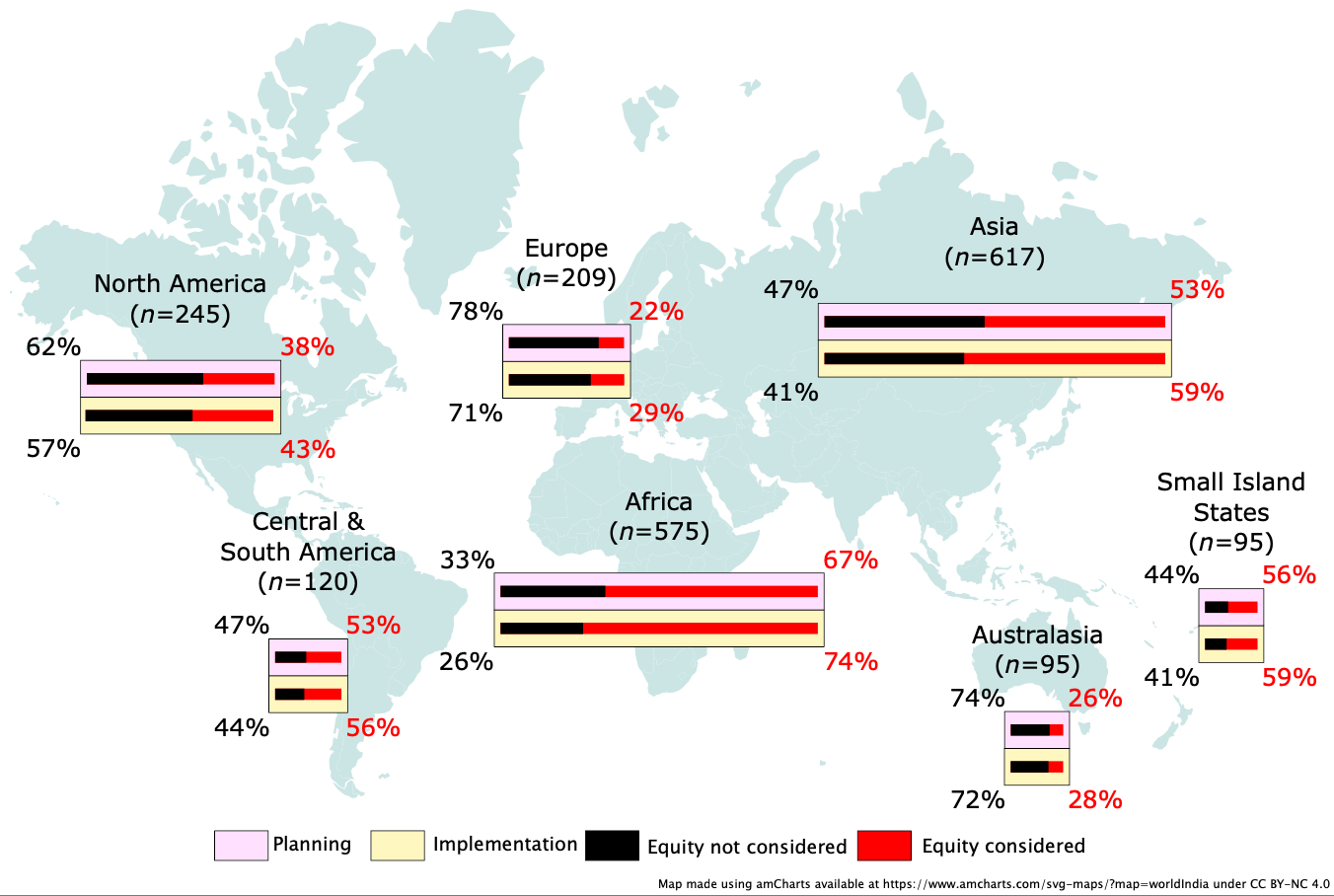
That’s already occurring to a degree. The mapping initiative inspired two dozen of the involved researchers, including Jagannathan, to launch another major analysis from the same database of scientific papers—this time, focused on equity in climate adaptation research. The team found that climate adaptation research in North America, Europe, and Australasia was unlikely to consider equity; the same went for adaptation articles about cities. The people most at risk of more extreme climate damages when equity is ignored include women, Indigenous groups, and low-income populations.
“People are responding to climate change because it’s affecting a lot of people, but it’s not enough,” says Hill. “And it’s not really happening at the right scale.”
Other Recent Posts
Can Nature Help California’s Coast Fight Fire and Floods?
Local and state leaders gather for September summit on how to mainstream nature-based infrastructure.
Guide to Nature-Based Infrastructure Around the Bay Area
Regional leaders are testing eight types of climate adaptation and shoreline flood protection projects that work with nature instead of against it. Here’s an overview.
How Can I Get Clean, Green, Climate-Forward Job Training in the Bay Area?
Looking for a hands-on job working outdoors that actually pays? Here’s a list of training programs.
Santa Rosa Residents Rethink Trees
The heat-burdened Roseland neighborhood is learning how to monitor temperatures and developing an action plan focused on tree shade.
How to Make Conservation a Career
California nonprofits are developing paid apprenticeships to prepare workers for the growing ecological restoration economy.
Raft of Resilience Initiatives Keeps Tahoe Blue
Beach robots, boat inspections, forest thinning, and wetland restoration are among the projects helping the lake confront environmental threats.
Weathering the Present While Training for the Future
A stewardship immersion experience from the School for Inclement Weather and Weaving Earth combines ecological knowledge and spiritual connection.
Feds Meddling With Protections For California Coast
NOAA is reviewing California’s Coastal Management Program in a renewed push for offshore oil and gas drilling.
New Study Shows Rain Gardens Filter Chemicals Out of Stormwater
Scientists found rain gardens dramatically reduce toxic chemicals in stormwater while providing biodiversity and cooling.
The Tricky Art of Growing Oysters in the Lab So They Can Survive in the Field
The Nature Conservancy, the Amah Mutsun Tribal Band, and others are growing oysters in the lab and planting them in the wild in estuaries around San Francisco Bay.