



My Morning Cleaning Up the Oakland Estuary
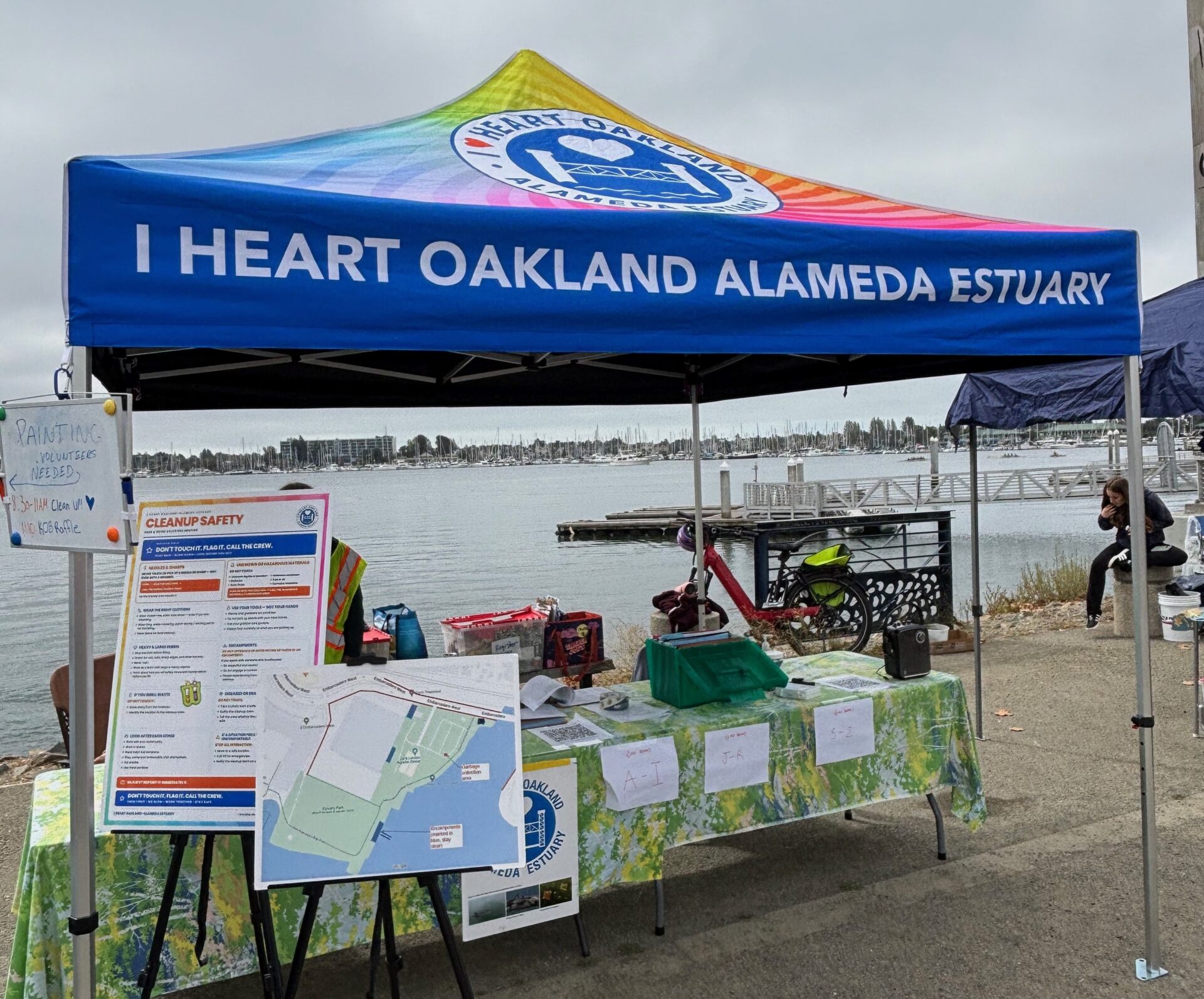
Lines of varsity rowers eight people long hoisted sleek rowing boats over their shoulders and maneuvered through a crowd of a couple dozen volunteers waiting to check into the I Heart Oakland-Alameda Estuary’s Saturday morning cleanup for the 31st annual Creek to Bay Day. I dodged a team hauling a dark blue boat into the racks at the Jack London Aquatic Center and approached a rainbow-topped tent to sign in for my first shift.
A volunteer coordinator in a highlighter yellow safety vest crossed my name off a long list and directed me to two other coordinators handing out blue work gloves, clear trash bags, and trash pickers.
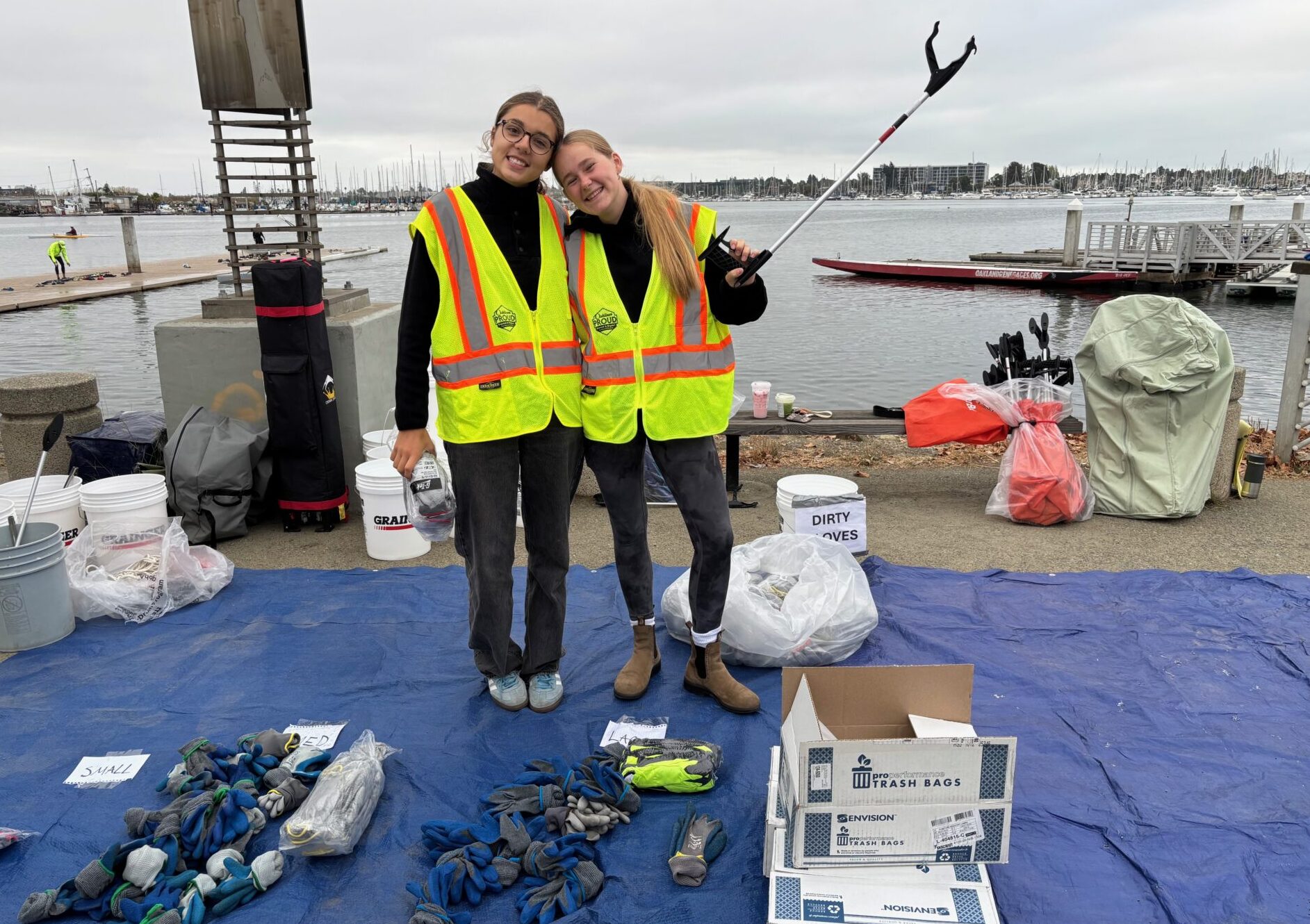
Volunteer coordinators Lila Rodent (left) and Tess Pett-Ridge Hennessy during the September 19 cleanup. Photo: Bryné Hadnott
As I juggled the cleanup supplies, my reporter’s notebook, phone, and rain jacket, I met with several other first-time volunteers gearing up for the group safety discussion. Brianna Bert mentioned that she learned about the event on Jack London Square’s Instagram page and was “excited to be a part of the community and help clean up the area.”
Gabrielle Fournier, a conservation and resource studies student at UC Berkeley, saw a flyer at her apartment complex and decided to volunteer. Jack London residents Andrew Tang and Courtney Hill wanted to help remove the trash they noticed during their frequent walks along the Bay Trail.
By the time IHOAE founder Mary Spicer started the safety talk, more than 100 people had gathered to clean the estuary. On a bluetooth microphone, Spicer announced goals for the morning, which included retrieving a couch abandoned on the shoreline. She pointed out the trained “sharps” volunteer coordinators carrying orange buckets for hazardous waste and small, red containers for used needles.
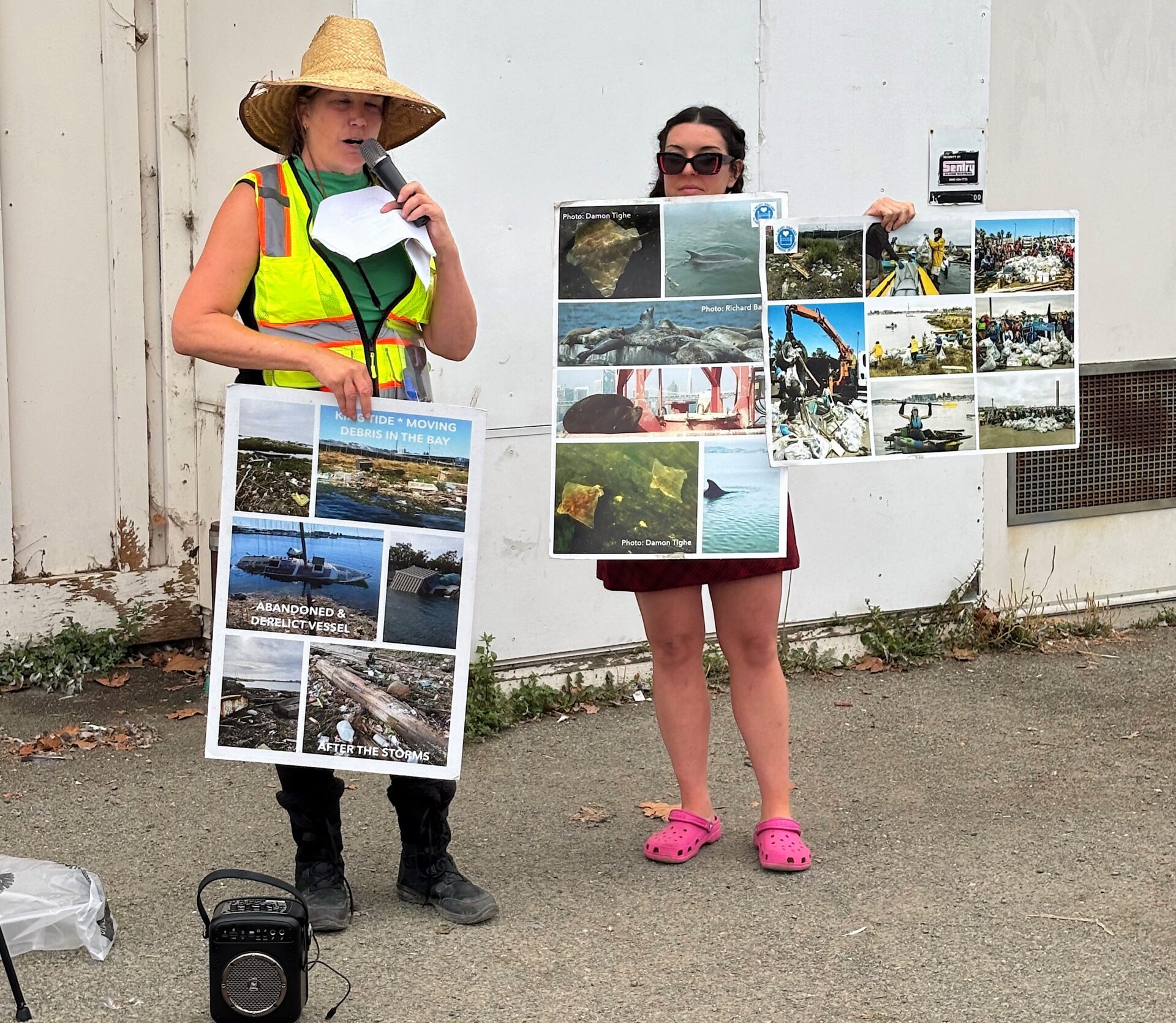
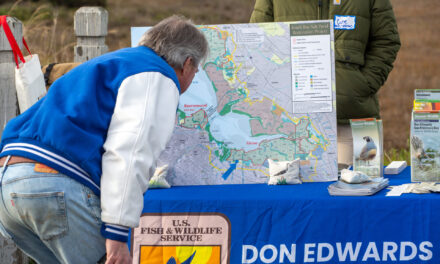
Mary Spicer and first-time volunteer Mia Renauld explain informational posters about past volunteer events. Photo: Bryné Hadnott
Spicer started the organization in 2016 with a group of fellow boaters determined to collect trash from the hard-to-reach shores they passed while paddling from Alameda’s Grand Street boat ramp. Since then, she’s hosted about 35 cleanup events that have removed up to 6,000 pounds of garbage from the estuary each year.
“The great thing about being on the estuary is there’s rowers, kayakers, canoers, dragon boat teams, whaleboat teams. I was on a whole bunch of those teams, and after years of seeing debris just sitting there, a group of aquatic athletes got together and started cleaning up the shoreline on our own,” Spicer says.
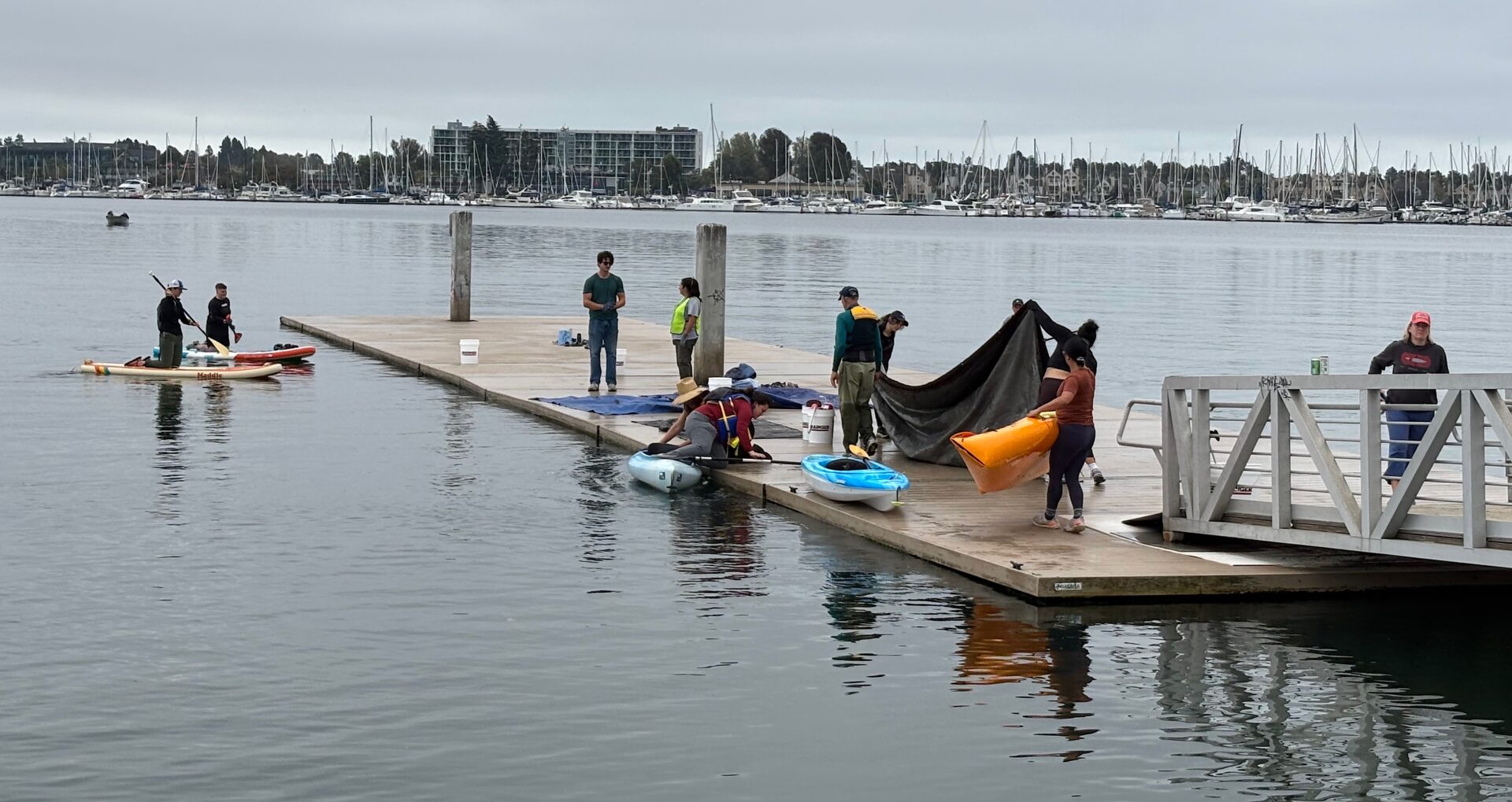
Kayakers and other aquatic athletes gather for the event. Photo: Bryné Hadnott
In 2024, the National Oceanic and Atmospheric Administration Marine Debris Program provided the city of Oakland with a $3 million grant to collaborate with IHOAE and other community partners on removing derelict vessels, large appliances, and plastic products from the Oakland Estuary. IHOAE was officially registered as a 501(c)(3) nonprofit by early 2025.
Over the past decade of cleanups, Spicer has seen harbor seals swimming in the estuary, bat rays gliding toward Lake Merritt Channel, and curious dolphins following standup paddle boarders. She sees removing trash as necessary for maintaining a healthy community for residents of the shoreline, both human and non-human.
After Spicer, Oakland’s District 2 Councilmember Charlene Wang addressed the volunteers and pledged to join the crew for 30 minutes before visiting several other sites hosting Creek to Bay Day cleanups.
“We know that Mother Earth is crying out and could use some love,” Wang said at the event.
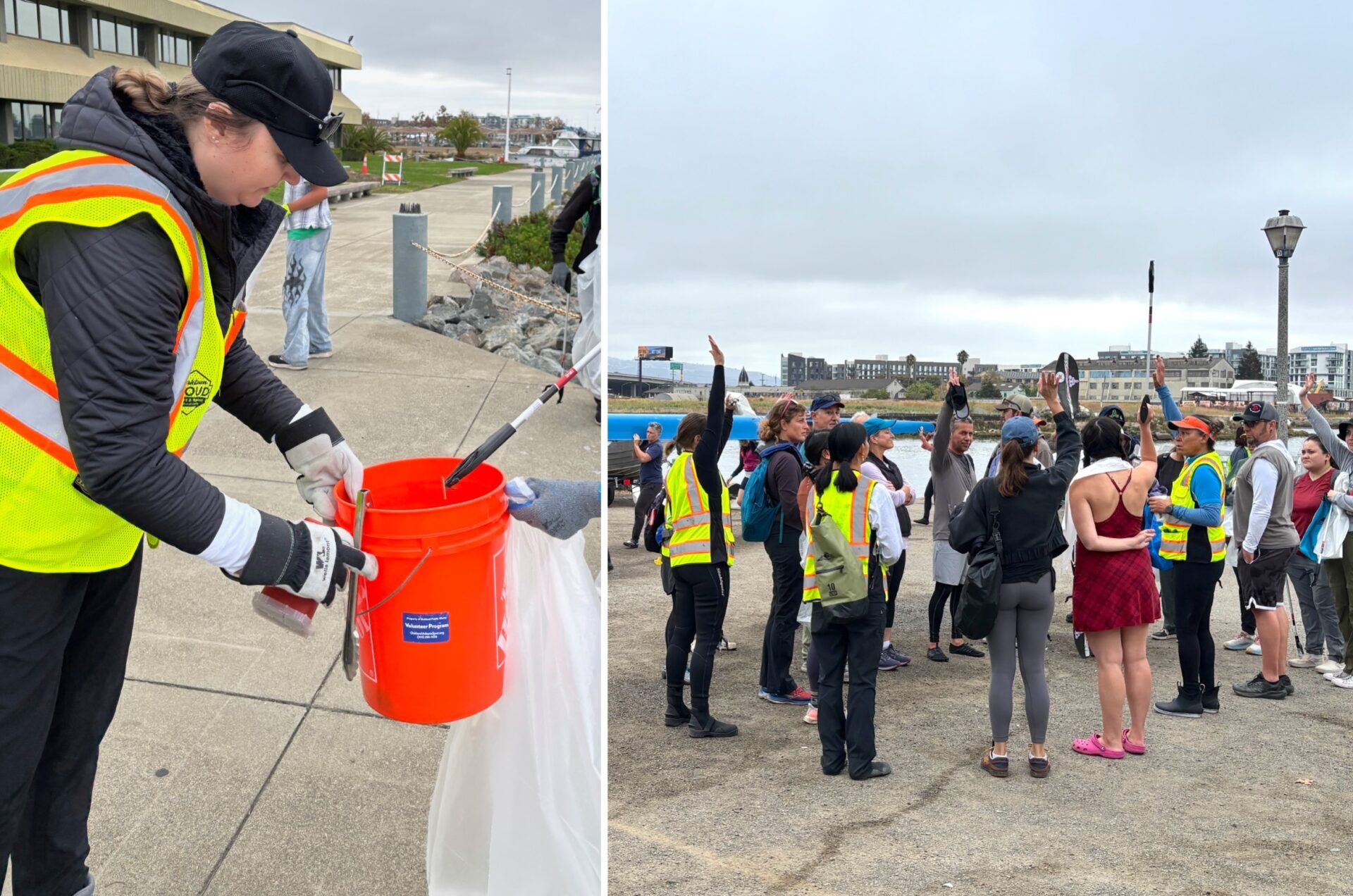
Alyssa Purslow offers an orange bucket for hazardous materials like nails, aerosol cans, and other corrosives to a volunteer. Photo: Bryné Hadnott
Spicer then invited the yellow-vested volunteer coordinators to divide the crowd into several groups that would clean along the shoreline next to the Bay Trail and under the bridge on Embarcadero West. I joined a group of 10 volunteers led by Alyssa Purslow, an enforcement analyst with the San Francisco Bay Conservation and Development Commission.
“It’s been less than a year, but this is my third cleanup and first time as a volunteer coordinator. It’s incredibly sad seeing the amount of trash and also the variety, different sizes, anywhere from a pin to a couch.” Purslow says.
Walking northwest along the Bay Trail, Purslow pointed out tiny silver fish the size of a finger leaping out of the clear water near Portobello Marina. She guided the group down a small hill to the shoreline and reminded everyone to wear their gloves, especially when handling hazardous materials.
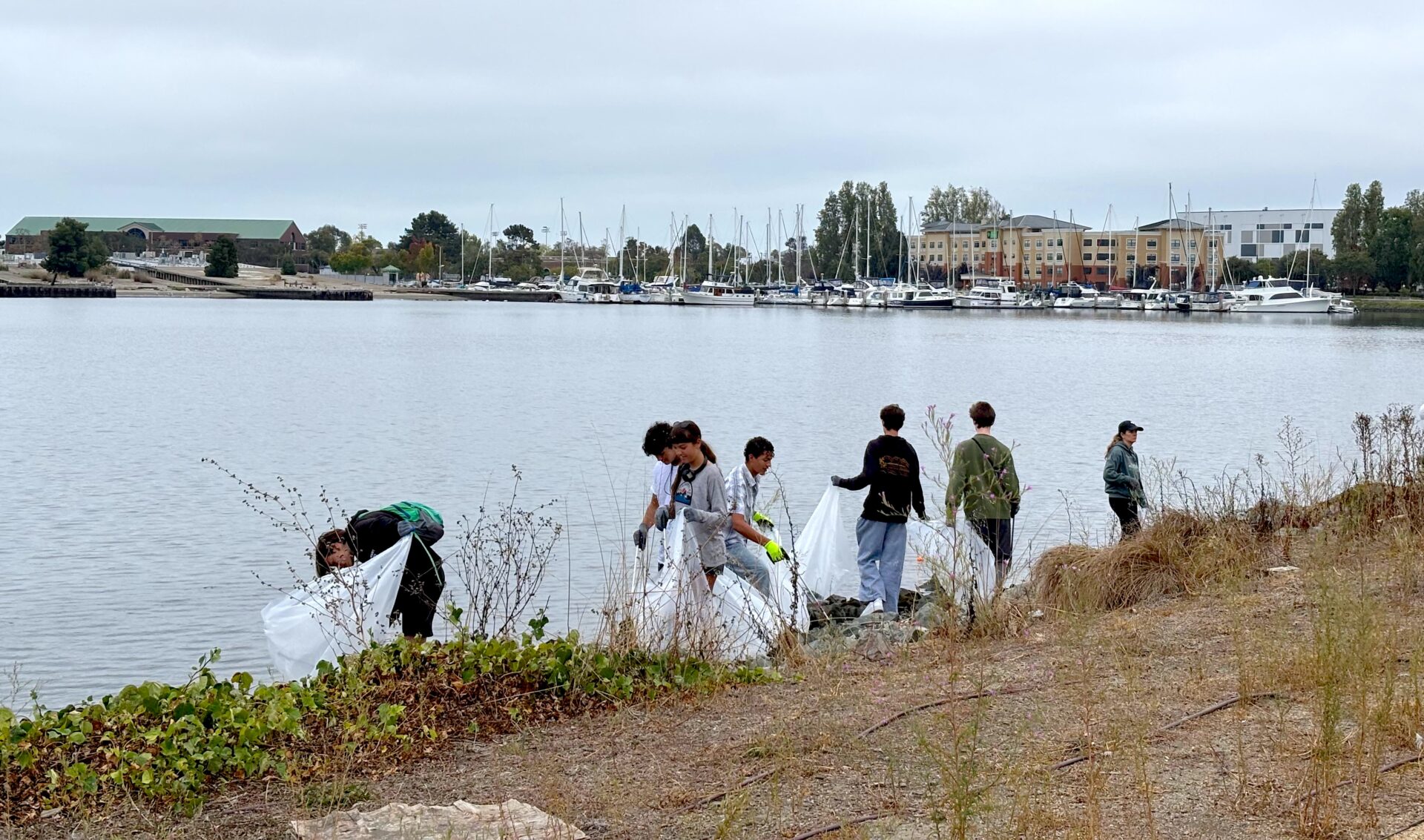
Trash pick up along the shore. Photo: Bryné Hadnott
While I grasped for a broken plastic bin with my picker, I could hear waves lapping on the rocky shore and the crackle of driftwood underfoot. Above me on the trail, runners huffed and dogs trotted in the mid-morning gloom. Periodically, someone yelled “sharps!” and Purslow rushed forward with an orange bucket already starting to fill with nails, lighters, and discarded batteries.
A gentle breeze wafted the stench of rotting seaweed into my nose, and I paused to look up from the jumble of rocks and debris toward the Alameda shore. Two standup paddle boarders came by and yelled “thank you!” to the volunteers before continuing to Brooklyn Basin.
Within an hour, my bag was almost full of mostly plastic waste. I’d discarded dozens of light pink Swisher Sweets tobacco bags, several plastic takeout containers, a few chip bags, and countless candy wrappers. Many pieces of plastic and styrofoam were too small to grab and had broken into colorful shards or coral-like fragments. Underneath the top layer of plastic bags, I found four lighters and a vaping pod that went into Purslow’s orange bucket.
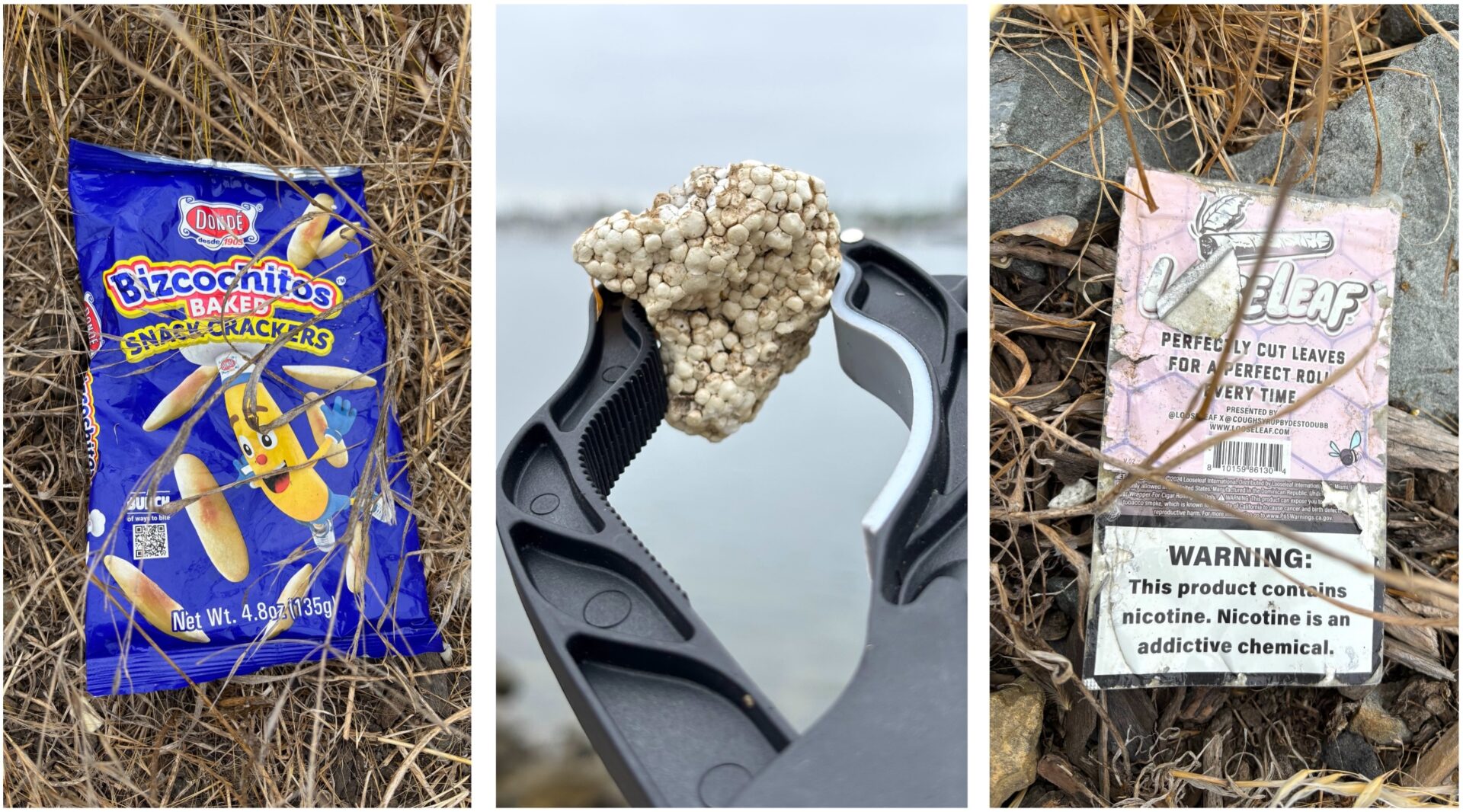
Assorted items found during the clean up. Photo: Bryné Hadnott
Just before 11 a.m., Purslow asked volunteers to walk back toward Portobello Marina and load a pickup truck with bags of trash and any larger debris. The truck belonged to Tim Phillips, a volunteer who also kindly offered to shovel bags of dog poop from an overflowing garbage can into empty trash bags.
Phillips drove his truck to a massive dumpster near the Jack London Aquatic Center parking lot, where a volunteer coordinator was recording the number of bags collected by each group. Four volunteers arrived carrying the waterlogged couch Spicer had hoped to remove and tossed it onto the trash heap.
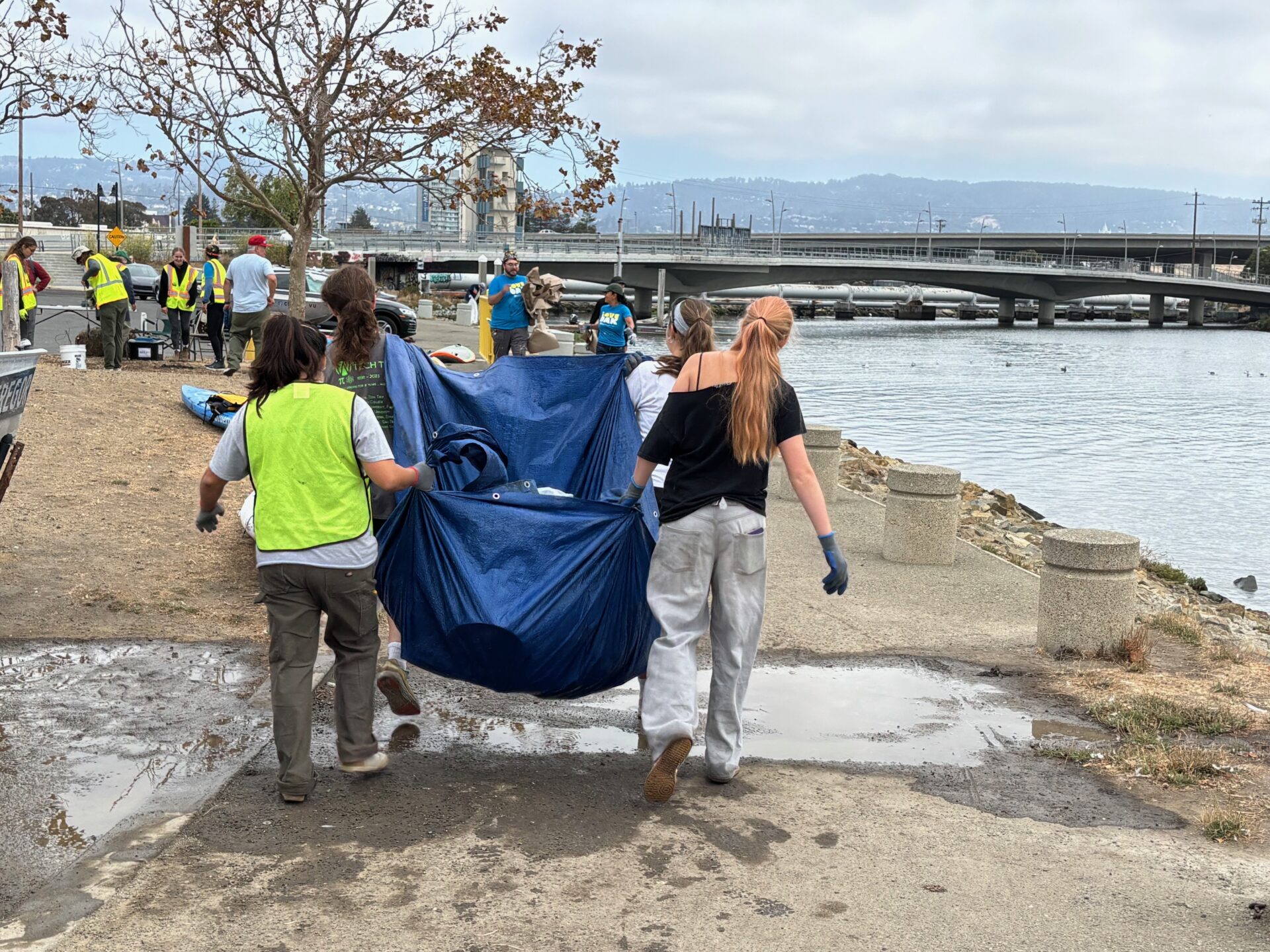
The last leg to the dumpster. Photo: Bryné Hadnott
After the dumpster was completely filled, Spicer gathered the volunteers for a short debrief. She estimated that the morning’s cleanup removed about 4,600 pounds of trash from the shoreline. Then, she invited volunteers to share the weirdest piece of trash they found.
Someone shouted, “anal lube!” Another shared finding a five-pound Costco bag of rotting meat. One volunteer uncovered a single platform stiletto heel, while another found an entire TV.
Jack Kramer, a participant of The Daily Californian’s High School Journalism Intensive, showed the crowd a near-pristine California license plate he had fished from the estuary. Mary Lukanuski, a first-time volunteer from Purslow’s group, unearthed a decaying semiquincentennial American flag.
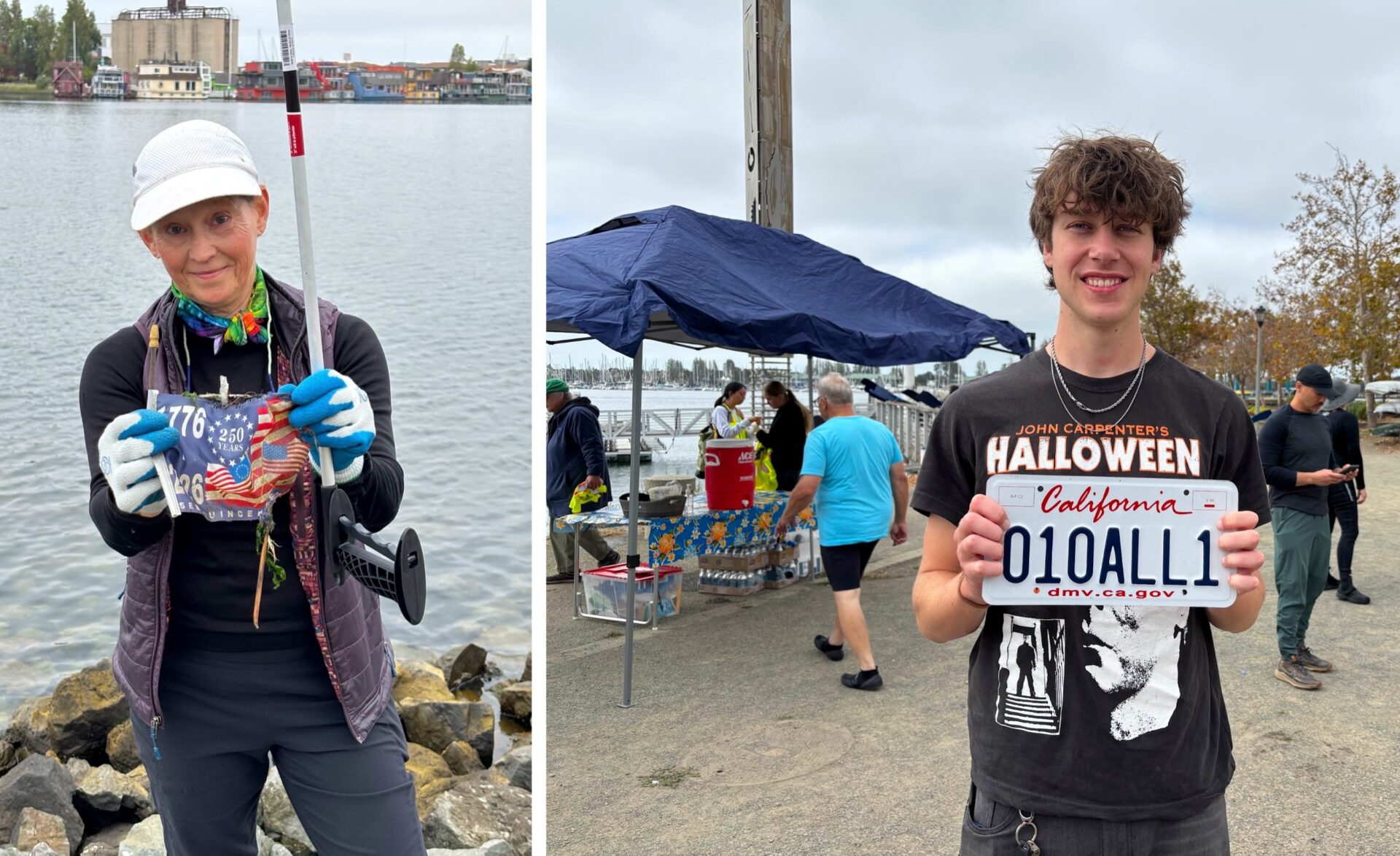
Mary Lukanuski and Jack Kramer offer two unique finds. Photos: Bryné Hadnott
“I think the plastic 250 flag was the most useless thing,” says Lukanuski. “It was cloth-like but had polyester fibers. That was a choice that someone made. You don’t need it. Just have your toddler make a paper red, white and blue flag.”
To end the morning, Spicer introduced Christina Porter, Bryan Aja, and Richie Flores from the board of directors for Keep Oakland Beautiful, a nonprofit advocating for litter-free public spaces. Flores drew 10 winning tickets for $20 to $25 gift card prizes sponsored by his employer, the Jack London Improvement District.
I didn’t end up winning a gift card, but I left the cleanup with sore legs, muddy hiking boots, and a big smile. I’m especially grateful for the Coyote Media Collective calendar where I learned about the Creek to Bay Day. In the almost four hours I spent with the volunteers at IHOAE, I met people dedicated to bringing out the best of the Bay Area’s natural beauty by cleaning up the worst of it.
“It really is about community,” Spicer says. “Our community is part of the Oakland Estuary. The aquatic athletes, but also the people that live here, the people that fish here, the businesses that are here. There’s a big call for estuary advocacy.”
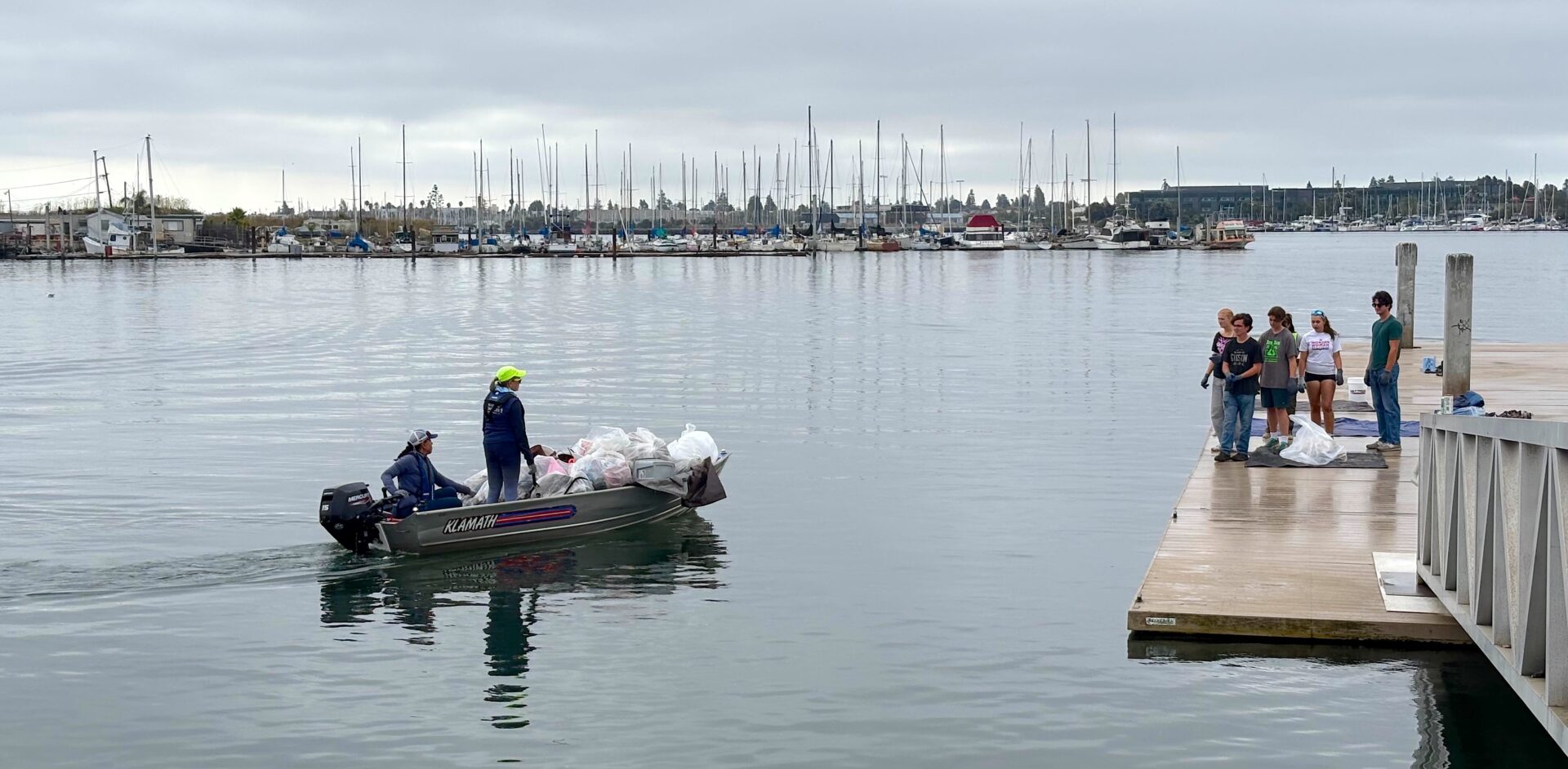
Photo: Bryné Hadnott
MORE
- Oakland Takes High Schoolers Kayaking, KneeDeep 2025
Reporting for this story was supported by a grant from the San Francisco Estuary Partnership.