



Climate Issues On Your Ballot This Fall

Graphic: Christina Alvear
As veteran California voters know, election season isn’t just about candidates running for local or state office — it’s also about dozens of ballot measures that get put to the public each year, either through citizens’ initiatives or directed by a government agency.
Unlike many other states, Californians can bypass the legislature entirely by collecting enough signatures to put constitutional amendments and new state laws directly on the ballot. Over the years, these propositions have led to some of the state’s signature policies, from property tax caps to legislative term limits and legalized recreational cannabis.
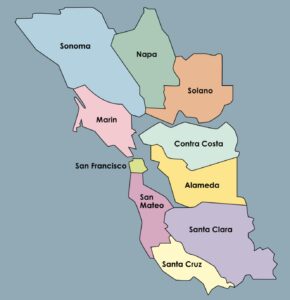
This midterm election, Bay Area voters will get the chance to weigh in on a number of new climate-related proposals — including public transit funding for the next 14 years and an amendment to the California Environmental Quality Act that would streamline environmental reviews of housing and infrastructure projects.
Collectively, $12 billion in one-time revenue for housing, climate adaptation, and infrastructure and $1.2 billion in recurring annual revenue for public transit, wildfire risk mitigation, and land stewardship are on the ballot in the Bay Area this fall.
Here’s what you need to know before you vote.
Other Recent Posts
Affordability Top of Mind For 6 Oaklanders This Election Season
KneeDeep’s Alex McCutcheon spent a recent afternoon asking passers by along Lake Merritt for their thoughts on affordability and climate change.
A Wasted Opportunity
Too many of this year’s crop of Democratic candidates are squandering the opportunity to connect the affordability crisis to the climate crisis.
The Sleepy Midterm Race with the Biggest Influence on Climate Policy
Typically an undercovered downballot race in the past, the election of California’s next insurance commissioner could reshape the state’s fire and flood coverage.
Fire Weather in the Wind
As the hot Nevada air cools every fall, it gets pushed west to lower pressure areas over the Central Valley, where the wind heats up and dries out.
My Morning Cleaning Up the Oakland Estuary
On Oakland’s Creek to Bay Day, I joined 100 volunteers for I Heart Oakland-Alameda Estuary to remove shoreline trash.
RCDs Pay Extra Attention to North Bay High Schoolers
A $13,500 grant will help three North Bay conservation districts evaluate youth education programs and prepare high school students for environmental careers.
Creeks Make Good & Bad Homes
San Jose State researcher Costanza Rampini explores why the houseless favor creek banks, and how they weather the flood risk.
HOUSING & DEVELOPMENT
California Prop 1
An $11.25 billion housing bond to fund the production and preservation of affordable housing across the state. Nearly half of that funding would go toward multifamily developments, where at least 10% of the units would be reserved for extremely low-income households. Another $1.25 billion would create a homeownership program for veterans and military families. The California Democratic Party and Gov. Gavin Newsom have endorsed it, and some Republican legislators are opposing it. San Francisco policy think tank SPUR is recommending a yes vote because “This measure is critical to expanding affordable housing opportunities for lower-income residents across California through new construction, preservation, and homebuyer assistance.” Requires a simple majority to pass.
California Prop 45
Amending the California Environmental Quality Act of 1970 to create deadlines for the completion of environmental reviews of housing and infrastructure projects, and also narrow the scope of those reviews. Prop 45 is an effort to address what proponents have called a misuse of CEQA to kill such projects, though environmental groups, the California Democratic Party, and the California Labor Federation are opposing the measure. It’s backed by the California Republican Party, the California Chamber of Commerce, and a number of housing and real estate organizations.
“CEQA creates excessive risk, cost, uncertainty, and delay and has consistently supported targeted reforms for infill housing, clean energy, and climate resilience,” SPUR wrote in issuing a neutral recommendation. “However, Prop. 45 would make broader changes that conflict with SPUR’s vision for urban growth. The measure could accelerate desirable projects, such as infill housing near transit and zero-emission energy infrastructure, but it could also streamline development that contributes to sprawl or environmental harm, including subdivisions on the urban edge and polluting energy facilities.” Requires a simple majority to pass.
TRANSPORTATION
Bay Area Prop RTM
A 1% sales tax in San Francisco and a 0.5% sales tax in Alameda, Contra Costa, Santa Clara, and San Mateo counties to fund BART, Caltrain, Muni, and AC Transit operations for the next 14 years. If it doesn’t pass, these agencies would all have to cut a significant chunk of their service and close entire lines and stations in some cases. “There’s a scenario where it’s really a question of whether it would make any sense to operate anymore, and this would be completely devastating to the region’s climate goals,” the Metropolitan Transportation Commission’s Rebecca Long told KneeDeep last fall. Requires a simple majority to pass.
San Francisco Prop H
A companion measure to Prop RTM to close Muni’s funding deficit specifically. It would create a tiered parcel tax on commercial and residential buildings (with larger commercial buildings paying the most) to generate $160 million for Muni each year. Mayor Daniel Lurie, Greenbelt Alliance, SPUR, and the San Francisco Democratic Party have all endorsed this measure, with only the San Francisco Republican Party against it. Andrew Ha, Greenbelt’s state and regional resilience senior associate, wrote in a brief that Prop H “will support the region by significantly reducing traffic congestion, reducing greenhouse gas emissions, and protecting downtown and citywide economic recovery.” Requires a simple majority to pass.
Local Infrastructure & Resilience
Alameda Measure L
A $300 million bond that would fund climate infrastructure projects across the City of Alameda. The city has identified a total of $800 million “in unfunded infrastructure and resilience needs.” According to a city spokesperson, this money would go toward “flood protection, stormwater improvements, and sea-level rise adaptation, as well as earthquake safety improvements, street and sidewalk repairs, and public safety infrastructure,” with the City Council ultimately deciding on specific projects. Requires a two-thirds majority to pass.
Berkeley Measure U
A $300 million bond to support improvements to public infrastructure and parks, seismic retrofits, climate resilience projects, and all-electric new construction (without natural gas hookups). Proponents say this money will help replace aging fire stations and protect the Berkeley shoreline from sea level rise. Others have criticized what they describe as a lack of specific project priorities for this money. Requires a two-thirds majority to pass.
East Palo Alto Measure O
A $125 million bond that would, in part, fund drinking water and stormwater infrastructure improvements, in addition to a new library, city hall, and police headquarters. Residents reported clean drinking water as a top priority in their responses to a city survey. This is East Palo Alto’s first ever bond measure in its 43 years as an incorporated city, and every member of the City Council has endorsed it. “This measure reflects priorities our residents have identified time and again —safe drinking water, a modern public library, safe spaces for youth, and infrastructure that keeps pace with the needs of our community,” City Manager Melvin Gaines said at a recent meeting. Requires a two-thirds majority to pass.
Mill Valley Measure T
Renewal of a municipal services tax to continue generating $1.9 million a year for wildfire risk mitigation (including vegetation and tree management) and street maintenance for the next decade. Requires a two-thirds majority to pass.
Napa Measure B
A half-percent sales tax for the next 18 years that would raise $23 million a year for wildfire mitigation, open space preservation, and watershed protection. Napa Firewise, Greenbelt Alliance, and a number of land stewardship groups are in support, with the Napa County Taxpayers Association against. “Napa has been making steady progress on improving our resilience to wildfire, but the grant funds available are a lottery, and they only fund new projects not maintenance,” Napa Firewise CEO Joe Nordlinger says. “This effort provides predictability so that Napan’s can continue to implement and maintain our resilience work.” Requires a simple majority to pass.
San Mateo Measure L
Officially codifies climate resilience as a priority in the county’s charter. It would not raise money or tie to a specific project, only add the following statement to the charter: “It shall be the policy of San Mateo County that long-term resilience against extreme weather events – including fire, flood, wind, rain, heat, drought, and sea level rise – is a County priority, to be undertaken collaboratively with cities, district, and other public entities.” Requires a simple majority to pass.
Sonoma Measure H
Indefinitely renewing a sales tax set to expire in 2029 that generates $15.5 million a year for park maintenance, wildfire mitigation, and other environmental projects like habitat restoration. Sonoma Land Trust, which works on land and ecosystem preservation, has endorsed the measure. The “Parks for All” program, as it’s referred to, “allows us to protect the lands and communities of our beautiful and biologically diverse county, for ourselves and future generations,” says Sonoma Land Trust Executive Director Eamon O’Byrne. Requires a two-thirds majority to pass.