



Power Down, Safety Up for Christmas Hill
When an electrical pole goes down — whether felled by a 100-mile-per hour wind as in Boulder, Colorado after Christmas, or by a tree crashing into live wires, or even too many woodpecker holes — it carries so much more of a threat in the desiccated West than it used to. As residents sue power companies and FEMA foots burgeoning bills for lost towns and subdivisions, some cities are taking the initiative to reduce risk and smooth evacuation — like the North Bay town of Corte Madera.
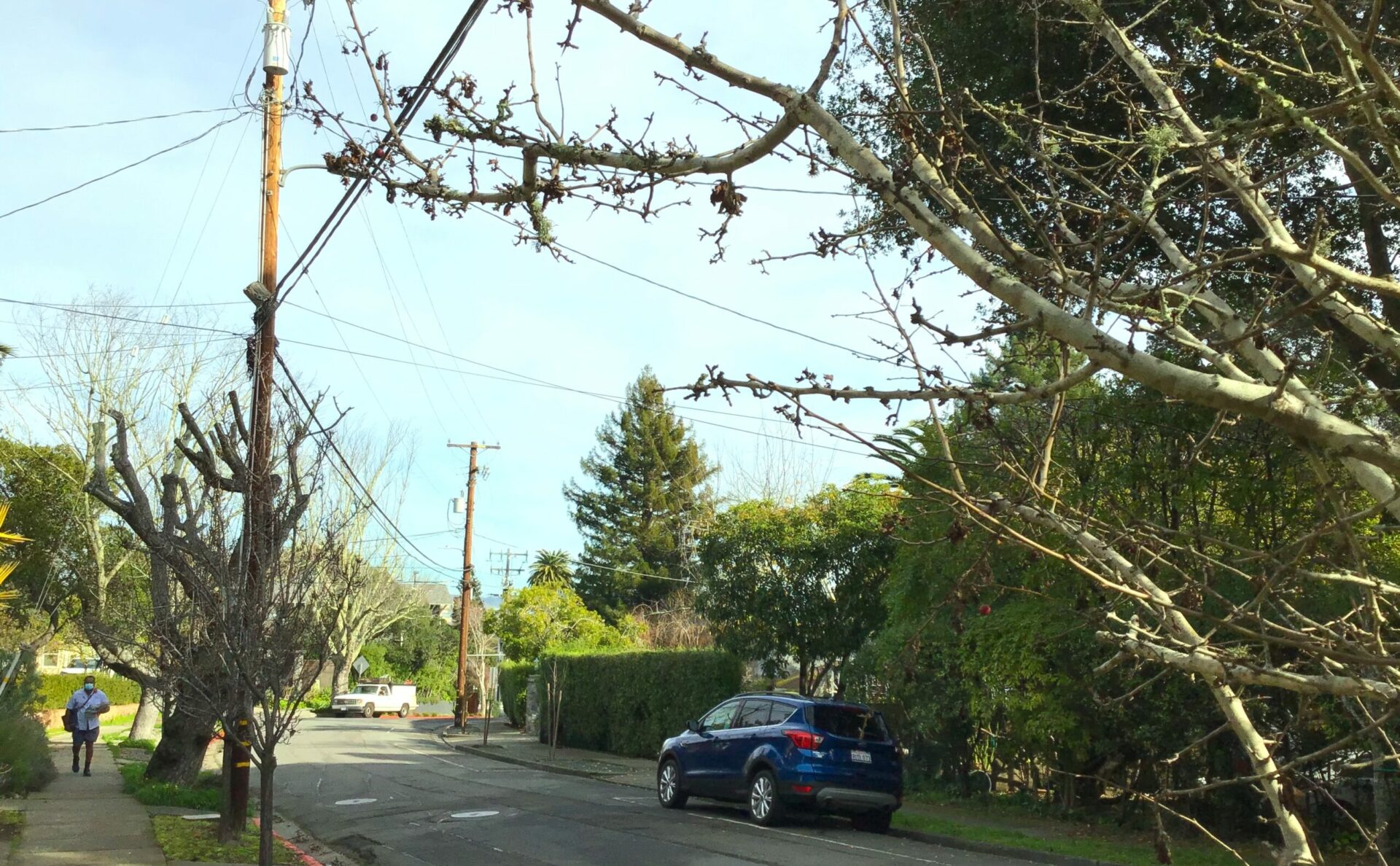
Last fall, the Corte Madera town council approved a new underground district where PG&E, phone, Internet, and other utility lines will be buried on Lower Redwood Avenue and Edison Avenue at the base of the Christmas Tree Hill neighborhood. This well-populated area lies at the edge of fire-prone wildlands and woodlands.
Burying all overhead lines in a trench could not only reduce the chances of sparks setting nearby brush and trees aflame, but also keep key evacuation and access routes open, since a downed line across lower Redwood Avenue — a street thick with poles and overhead wires — could prevent residents from escaping and fire trucks from reaching any flames in the neighborhood.
Undergrounding is expensive and doesn’t always prevent fires (Coffey Park in Santa Rosa, for example, still burned in the 2017 Tubbs Fire despite underground utilities). But Corte Madera planners, engineers, and community members identified wildfire as a particular worry, and undergrounding as a priority, in their 2021 Climate Adaptation Assessment. The town had also suffered through enough public safety power shutoffs, and seen enough shortfalls in PG&E maintenance, to push for the project.
Town leaders also wanted to ensure they could use valuable funds and credits toward the project from PG&E’s Rule 20A program, whose future has been in question. The program supports conversion to underground lines for projects that meet various criteria (such as density of overhead lines) and offer health and safety benefits, like preventing wildfire and easing evacuation.
“We’re still in the process of analyzing our other fire-prone areas of town, but based on what we already know about Christmas Tree Hill’s vulnerabilities to fire and its limited access routes, we felt it was prudent to initiate this project right away,” says Ron Suokko, Corte Madera’s director of public works.
Still in its preliminary engineering phases, the project includes about 1,200 feet of mainline plus 1,800 feet of service laterals that connect to homes. The hope is that after spending an estimated $4 million to get utilities out of the way, Christmas Hill may be more resilient the next time flames sweep through Marin.
Other Recent Posts
Fire Weather in the Wind
As the hot Nevada air cools every fall, it gets pushed west to lower pressure areas over the Central Valley, where the wind heats up and dries out.
My Morning Cleaning Up the Oakland Estuary
On Oakland’s Creek to Bay Day, I joined 100 volunteers for I Heart Oakland-Alameda Estuary to remove shoreline trash.
RCDs Pay Extra Attention to North Bay High Schoolers
A $13,500 grant will help three North Bay conservation districts evaluate youth education programs and prepare high school students for environmental careers.
Creeks Make Good & Bad Homes
San Jose State researcher Costanza Rampini explores why the houseless favor creek banks, and how they weather the flood risk.
Bay Area Braces for Record-Breaking El Niño
Record high water temperatures in the Pacific are expected to bring dangerous sea level rise, waves, and rain to the region this winter.
Regional Housing Agency Invests in Affordability
The Bay Area Housing Finance Authority is launching a loan program to support the construction of mixed-income rental properties.
The End is Coming for California’s Untouchable Grass
The law, which applies to grass that isn’t used for recreational purposes, could cut urban water use across California by more than 20% says Oakland thinktank.
Sonoma Vineyard Workers Burn toward a Better Future
A group of immigrant farmworkers are forming a worker-owned cooperative to bring back Indigenous burning practices that used to revitalize the soil.
Los trabajadores de los viñedos de Sonoma queman por un futuro mejor
Un grupo de trabajadores agrícolas inmigrantes está formando una cooperativa de propiedad de los trabajadores para recuperar las prácticas indígenas de quema que solían revitalizar el suelo año tras año.
New Voices Shape Design of Berkeley’s North Basin Strip
Twenty acres of parkland between the highway and the Berkeley shore are slated for a coast-resilient makeover, with input from locals and stakeholders.