



Warming to Managed Retreat
To own beachfront property was once a crown jewel of the California dream. Now, many homes at or near the water’s edge are doomed as sea level rises, and for residents, evacuations will be inevitable. In Pacifica, there is talk of moving an entire beachfront neighborhood, and near Bodega Bay, homes have already been abandoned, and roadway managers are breaking ground on rerouting a short but vulnerable stretch of the coastal highway. In at least two communities on San Francisco Bay, planning experts have pondered the feasibility of floating homes. Away from the coast, in populated river valleys, climate change is also forcing community restructuring in response to flooding.
Now, land use experts, stakeholders, and government agencies are thinking hard about how to guide forward these transformations as painlessly as possible. In a recent article published in the journal Science, professors Katharine J. Mach and A.R. Siders, respectively of the University of Miami and the University of Delaware, make a case for managed retreat.
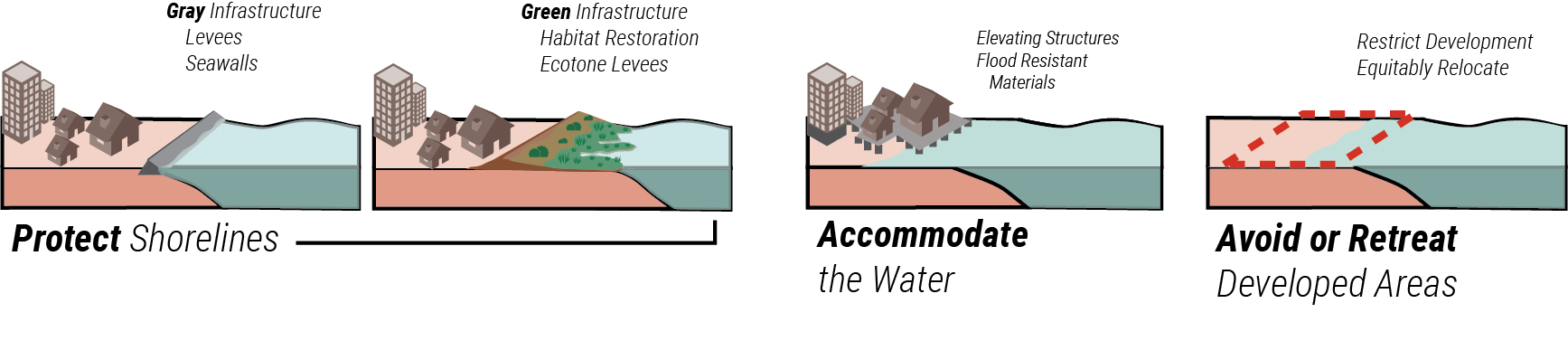
The concept is controversial. In essence, it means uprooting communities and relocating residents to higher ground. While levees can contain unruly rivers, and sea walls and other barriers can hold back the ocean, such hydraulic restraining efforts are expensive and often ultimately fail. Levees burst, and sea walls cave to the undercut-scouring of wave action. Indeed, Mach and Siders consider relocation inevitable in many places, and the key question they pose is how and when communities should make the move.
“[T]hroughout history, people have moved and retreated in response to climate,” the authors write.
Other Recent Posts
Feds Meddling With Protections For California Coast
NOAA is reviewing California’s Coastal Management Program in a renewed push for offshore oil and gas drilling.
New Study Shows Rain Gardens Filter Chemicals Out of Stormwater
Scientists found rain gardens dramatically reduce toxic chemicals in stormwater while providing biodiversity and cooling.
The Tricky Art of Growing Oysters in the Lab So They Can Survive in the Field
The Nature Conservancy, the Amah Mutsun Tribal Band, and others are growing oysters in the lab and planting them in the wild in estuaries around San Francisco Bay.
Printing Without Plastic: The Vintage Machine Winning Over Eco-Conscious Artists
This comic guide to risograph printing explains how the 1980s Japanese machine cuts energy use and avoids plastic toner.
East Bay Kids Fight Extreme Heat in their Schoolyards
Many California schools are ill-equipped to tackle heat, with many campuses lacking sufficient tree coverage. These students are fighting to change that.
How a North Bay Regional Park Helped Me Reconnect With Nature — and Myself
A young Fairfield resident reflects on how hiking during the pandemic became a refuge from digital overload and the growing realities of climate change.
Wild Pigs Rough Up Bay Area Greens
They tear up landscapes in search of food, prey on native wildlife, and damage streams, and warming could bring them closer to urban areas.
Residents Chose Different Ways to Respond to Contra Costa Flood Challenges
Graduates of a shoreline leadership program in Contra Costa County recently pitched their ideas for sea level rise education and adaptation.
Courtesy Bay-Adapt.
That process is gaining speed now, and Mach and Siders argue that guiding this migration will result in a fairer process and a more equitable distribution of planning and resources. They make the case that planned retreat – versus unplanned, spontaneous fleeing from hazard zones – is an opportunity to bolster economies, improve social equity across communities, and even beautify them with creative infrastructure.
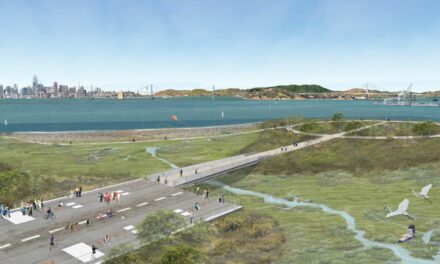
Floating towns are one possibility they describe. This idea has already been discussed in the Bay Area, with a draft plan for residential flotillas along the Oakland-San Leandro shoreline recently proposed by the All Bay Collective, a Resilient by Design project. Another Resilient by Design project, the Bionic Team, has proposed floating homes and canals for streets in the low-lying waterfront district of San Rafael.
The United States federal government is also paying attention to coastal climate adaptation and flooding. In Illinois, FEMA funded the full relocation of the town of Valmeyer to higher ground after severe flooding events in 1993. In 2016, a federal grant of $48 million funded what may be the nation’s first officially categorized climate relocation project in southern Louisiana. Here, the rising waters of the Gulf of Mexico have forced the relocation of residents of Isle de Jean Charles to the newly built town of The New Isle, about 30 miles north. More recently, Democrats in Congress allocated billions of dollars in September toward improving and updating flood-risk maps of the United States and enhancing flood insurance accessibility.
Climate-related upheaval will affect communities across the world. Precipitation patterns are shifting, causing wetter, more energy-packed storms that have overwhelmed river basins and forced valley dwellers to higher ground. Germany and China experienced highly destructive flooding in July, and the Eastern Seaboard was swamped with the rains of Hurricane Ida.
These types of events will force dramatic changes in how humans build and rebuild their communities, and for some regions, with government funding and expert input, climate change just might be an opportunity for growth.
More
- Reframing Strategic, Managed Retreat for Transformative Climate Adaptation, Mach & Siders, Science, June 2021
- Three Cities Confront Common Estuary, All Bay Collective, Resilent by Design, Estuary News June 2019
- San Rafael Elevates City & Canal, Bionic Team, Resilient by Design, Estuary News June 2019
- FEMA case study library, where you can search by location/state
- California Has a New Idea for Homes at Risk from Rising Seas, Buy, Rent, Retreat, NPR March 2021
- FEMA Flood Maps
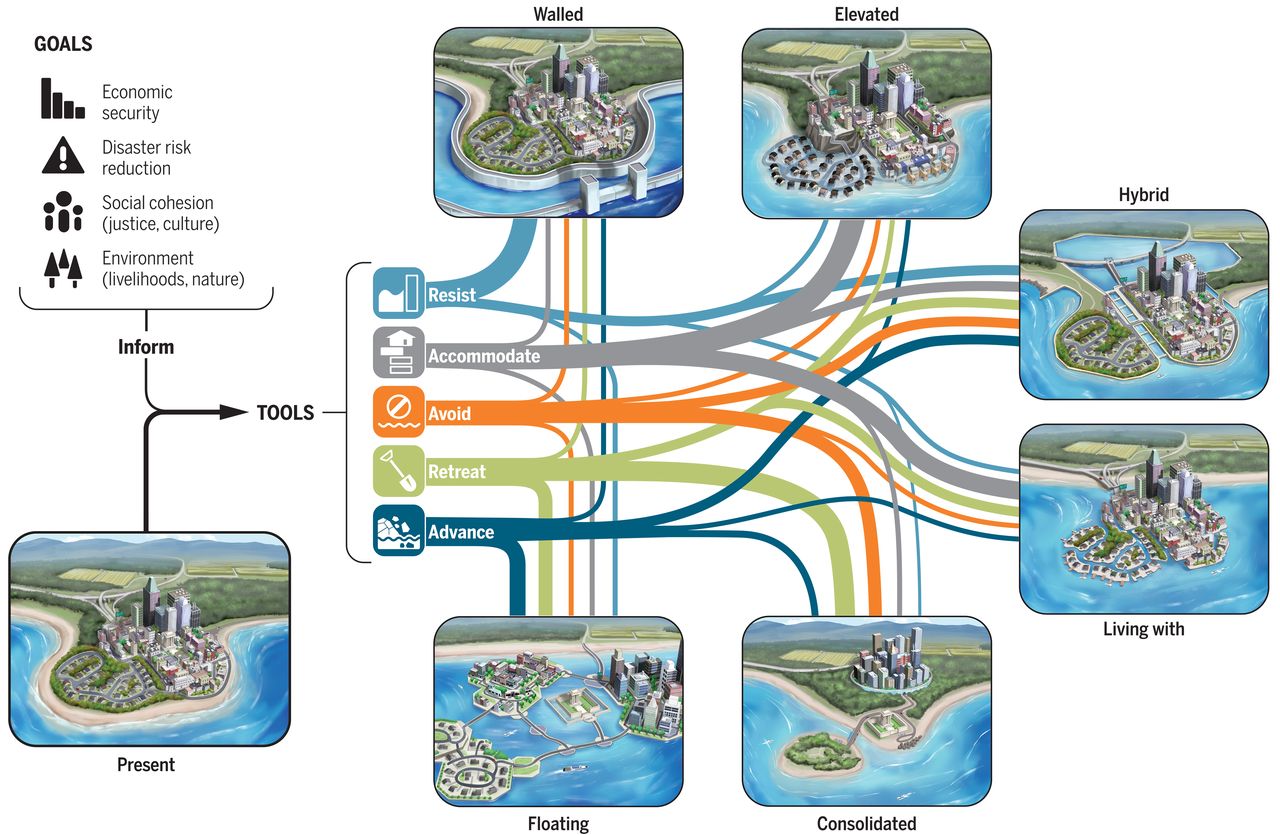
A graphic look at six possible futures, with climate-induced retreat options from Mach et al., Science 372, 1294–1299 (2021) 18 June 2021.