



Post-Election Review of Climate Results
Since the panic days of the pandemic, motorists have been banned from using JFK Drive and the Great Highway, two major roadways on the west side of San Francisco. Last week, voters chose to keep it that way. 61% voted against Proposition I, which would have required city leaders to restore motor vehicle access on JFK and the Great Highway. Proposition I would also have prevented city leaders from enacting a plan to close the Great Highway between Sloat and Skyline — part of a longer-term plan to address erosion, sand deposition, and rising sea level.
The downfall of Prop I and the passage of its competing measure, Proposition J, were just two of many climate-smart decisions made by voters on Nov. 8. The 2022 midterm election saw the passage of various measures throughout the Bay Area to protect open spaces, halt urban sprawl, promote urban housing projects and infill development, ease traffic and congestion, and advance California’s climate change mitigation and adaptation goals. In Solano County, Measure K won by a landslide, with 82% of voters approving the measure, which builds on another reform passed in 2003. That year’s Measure K prohibited urban development outside of a new urban growth boundary around the city of Benicia for 20 years. The newly passed rendition of the measure extends the extra-urban building moratorium for 20 more years.
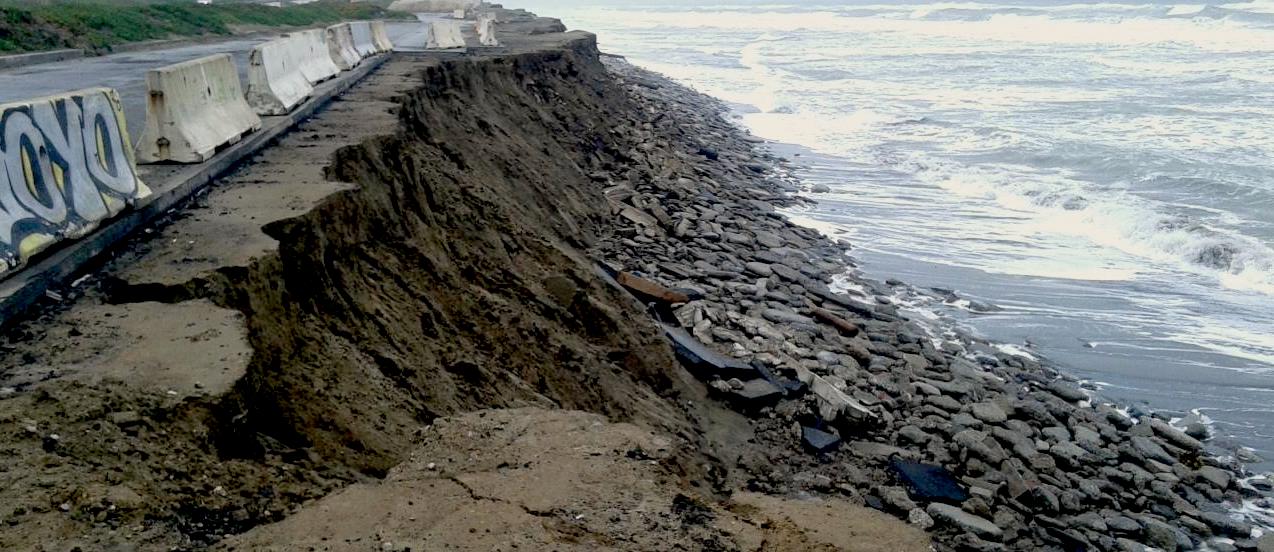
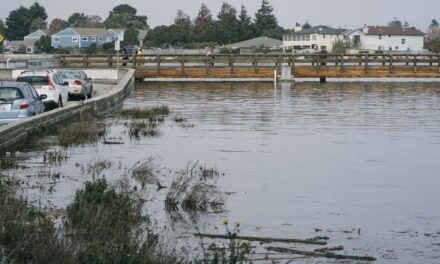
Erosion at Sloat Boulvard along Great Highway in 2016. Photo: Roger Bland.
Measure D in Alameda County also passed last week by an easy margin of 68 to 32%. The measure builds on a 2000 measure of the same name that established an urban growth boundary to prevent sprawl and development in open spaces. This year’s Measure D makes favorable changes to agricultural building codes. Notably, it increases building size limits for greenhouses and equestrian barns. Supporters of the measure endorsed it because it protects agricultural land use and encourages urban infill housing, which are both compatible with goals to reduce commute distances and transportation-related emissions of greenhouse gasses.
Yet another landslide win for Bay Area environmental interests came with Measure O, which 72% of Alameda County voters supported. The measure imposes a new tax on properties valued at more than $1 million to create a fund that will support a variety of infrastructure improvements, flood protection projects, and water quality protections. The organization Greenbelt Alliance supported the measure because, its directors wrote in a recent blog, it is likely to fund projects to build “bioswales and other vegetative stormwater treatment features,” as well as a living levee and other sea-level rise adaptation projects for the shoreline.
In Napa County, the election of several climate-friendly officials could mark a shift of public sentiment against the wine and tourism industries. Voters elected Joelle Gallager and Anne Cottrell as County Supervisors. Paul Dohring is the new Mayor of St. Helena. Each of these candidates has acknowledged climate change as a critical challenge and has demonstrated the intention of fighting it.
Another lopsided win came with the passage of Sonoma County’s Measure O, which garnered 75% of voter support and will renew a special parcel tax to fund fire protection in the city of Sonoma.
But Nov. 8 also served up some losses for conservation and climate policy advocates. In Napa County, the passage of Measure J expands American Canyon’s urban limit across 157 acres of marshland and vineyard on the shore of San Francisco Bay. Measure J makes this land available for development at a time when many environmentalists want to see permanent preservation of open spaces. The Sierra Club and Greenbelt Alliance opposed Measure J.
Measure E, in Solano County, proposed a 0.125% sales tax to fund wildfire protection programs, including rural and urban fire breaks, programs to remove flammable vegetation, hiring more firefighters and paramedics, and improving early wildfire detection systems. 54% of voters opposed the measure, though as of Nov. 14, the measure’s election status was “too close to call.”
Another upset came as 59 % of voters said no to Proposition 30, a statewide measure to help fund electric vehicle infrastructure by taxing multimillionaires. Prop 30 would have targeted Californians with an annual salary of at least $2 million, and analysts estimated that the tax proposed by Prop 30 could have generated as much as $5 billion each year. This cash pool would have been used to, among other things, subsidize electric vehicle charging stations and rebates for Californians who buy EVs. Californians have shown support for climate initiatives, clean air programs and electric vehicles in general, and Prop 30 seemed on its way to a win until Gov. Gavin Newsom appeared in an ad opposing it. He cast Prop 30 as a corporate tax grab that would benefit the rideshare company Lyft — but analysts expected the prop to benefit Californians broadly. Support for the measure crumbled, leading to its demise on Nov. 8.
Analysts have pointed out what could be a silver lining in Prop 30’s failure: Voters rejected it not because they dismiss the importance of climate change mitigation action but because they trust their governor.
Other Recent Posts
Regional Housing Agency Invests in Affordability
The Bay Area Housing Finance Authority is launching a loan program to support the construction of mixed-income rental properties.
The End is Coming for California’s Untouchable Grass
The law, which applies to grass that isn’t used for recreational purposes, could cut urban water use across California by more than 20% says Oakland thinktank.
Sonoma Vineyard Workers Burn toward a Better Future
A group of immigrant farmworkers are forming a worker-owned cooperative to bring back Indigenous burning practices that used to revitalize the soil.
Los trabajadores de los viñedos de Sonoma queman por un futuro mejor
Un grupo de trabajadores agrícolas inmigrantes está formando una cooperativa de propiedad de los trabajadores para recuperar las prácticas indígenas de quema que solían revitalizar el suelo año tras año.
New Voices Shape Design of Berkeley’s North Basin Strip
Twenty acres of parkland between the highway and the Berkeley shore are slated for a coast-resilient makeover, with input from locals and stakeholders.
It’s Always Sunny In North Fair Oaks
Residents of the unincorporated community launched their second campaign in two years to get the county to care for dying street trees.
Siempre está soleado en North Fair Oaks
Los residentes de la comunidad no incorporada lanzaron su segunda campaña en dos años para lograr que el condado se ocupe de los árboles de la calle que se están muriendo.
Can Nature Help California’s Coast Fight Fire and Floods?
Local and state leaders gather for September summit on how to mainstream nature-based infrastructure.
Guide to Nature-Based Infrastructure Around the Bay Area
Regional leaders are testing eight types of climate adaptation and shoreline flood protection projects that work with nature instead of against it. Here’s an overview.
How Can I Get Clean, Green, Climate-Forward Job Training in the Bay Area?
Looking for a hands-on job working outdoors that actually pays? Here’s a list of training programs.
Amber Manfree contributed to reporting on this story.