

Pajaro Residents Weigh In on How to Use Climate Funds
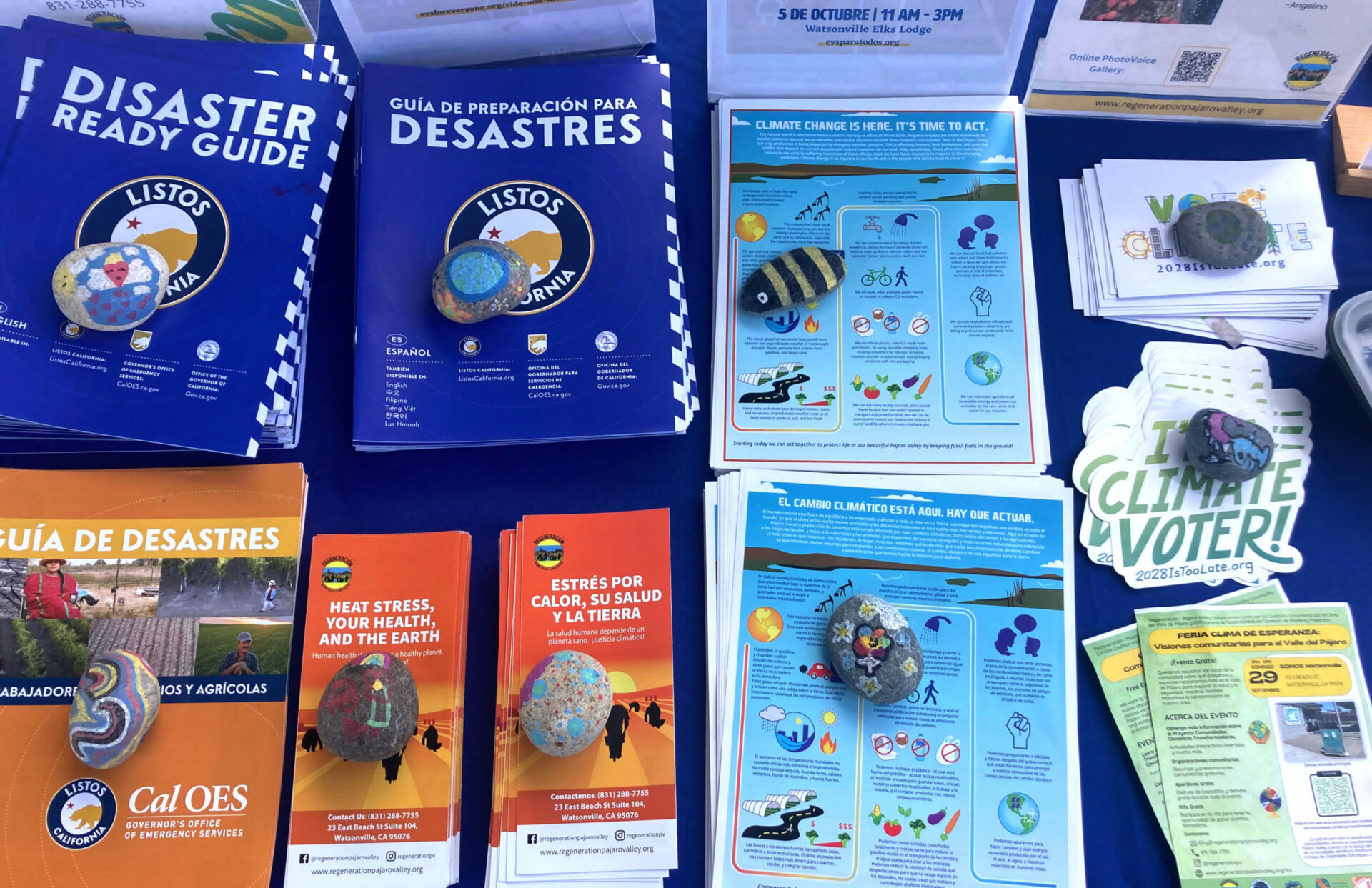
Handouts at the Climate of Hope Fair. Photo: Sierra Garcia
As his mother chats about housing costs, the stroller-bound baby watches the next table over, where a flour tortilla is folded over into a quesadilla atop an electric cookstove. They’re among the first attendees of the three-hour Climate of Hope Fair in Watsonville, an event organized by the nonprofit Regeneración Pajaro Valley in late September for the agricultural community on the Central Coast to learn and share ideas for allocating climate funds from the California Strategic Growth Council.
People filtering into the room spin a wheel which lands on one of a dozen conversation starters, from energy costs to park access to transportation. The staffer at this station takes notes on large sheets of paper taped to the walls. As the afternoon progresses, she has to add more sheets of paper as popular topics fill up. Talking to folks at the event, she often draws on examples from Mexico to help jog people’s ideas, like public combis (cheaper, van-like local buses), or mixed-use zoning where corner stores and neighborhood housing blend together.
The event is prepared to welcome everyone: a volunteer supervises children while they play and color so their parents can roam; a food stand offers complimentary potato flautas next to ruffled greens, bright and oddly shaped bell peppers, and other assorted veggies in crates, which a volunteer proudly tells me are free to take home.
Eventually, the woman and her son are directed towards tables with hand-drawn maps of both Watsonville and Pajaro, where they’re encouraged to add sticky notes to exactly where in their neighborhoods they want to see changes. Anyone who visits all the stations for discussing community climate ideas with Regeneración staff can enter a raffle, for prizes like air purifiers, electric tea kettles, spindly fruit tree saplings, and a two-burner cooktop paired with oven mitts.
“It’s not just about the climate, but also about violence,” a middle-aged man says in Spanish. He wears a Driscoll’s baseball cap and is accompanied by another man and two women, who say that the most impressive thing they’ve seen at the Climate of Hope Fair is a drone to monitor air quality in the fields in real time for farmworkers. The group says that they typically wait for a certain time interval after spraying before re-entering the fields, but that the drone’s analysis would give them more confidence that it’s really safe for them to return to work tending the strawberries and other produce the region is famous for, post-spray or when wildfire smoke clogs the air.
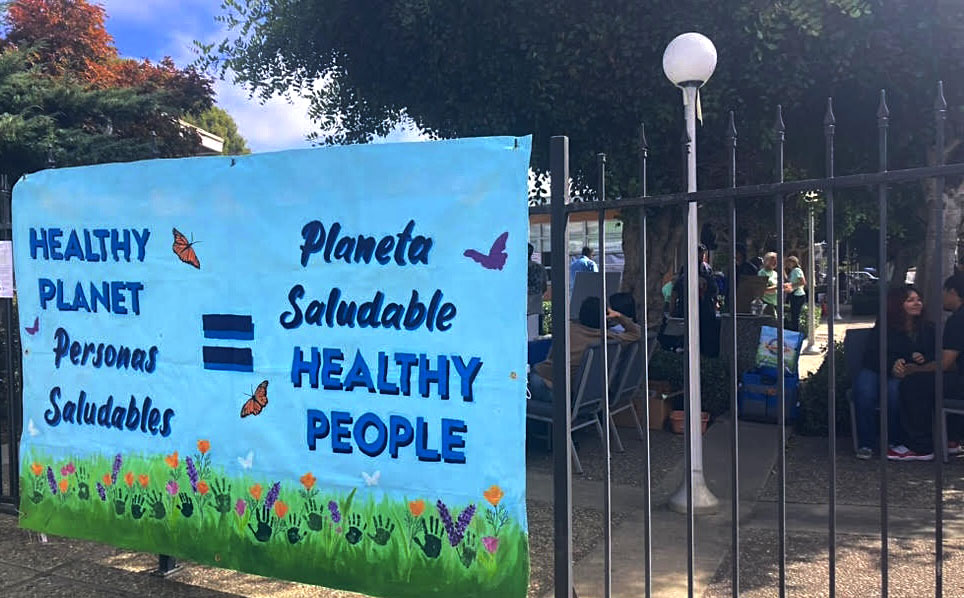
Climate Fair signage. Photo: Sierra Garcia
The event’s welcome booth, staffed by high schoolers, is adorned with dozens of professional stickers, flyers, and pamphlets, all in both English and Spanish. Many of the booths showcase connections between climate change and other issues — safety for farmworkers in the fields and kids in the streets, health, the high cost of living. Residents and workers in the area have battled through many of California’s extremes, including heat, fire, smoke, and heavy rainfall that breached a levee and flooded the town of Pajaro. But for many, more immediate needs remain top of mind.
“A lot of times, especially here in immigrant communities, we are focused on other things,” says Andrew Valepxia, a local high school senior volunteering for the event. “Like our jobs, and our relationships, and…”. He pauses, and the other volunteer, a young woman who asked not to be quoted by name, chimes in: “It [climate] isn’t a priority. There’s other struggles.”
Valepxia agrees.
In climate advocacy, “it can be sometimes very isolating, feeling like you’re the only voice,” he says. “But once you do take that first step and you see that there is this bigger community, you know that you’re being part of something. And I think that really helps.”
Regeneración plans to organize another event for community feedback in the spring, before presenting the consolidated report by the summer of 2025. The ultimate goal is for funding to go to climate projects that community members need and care about.
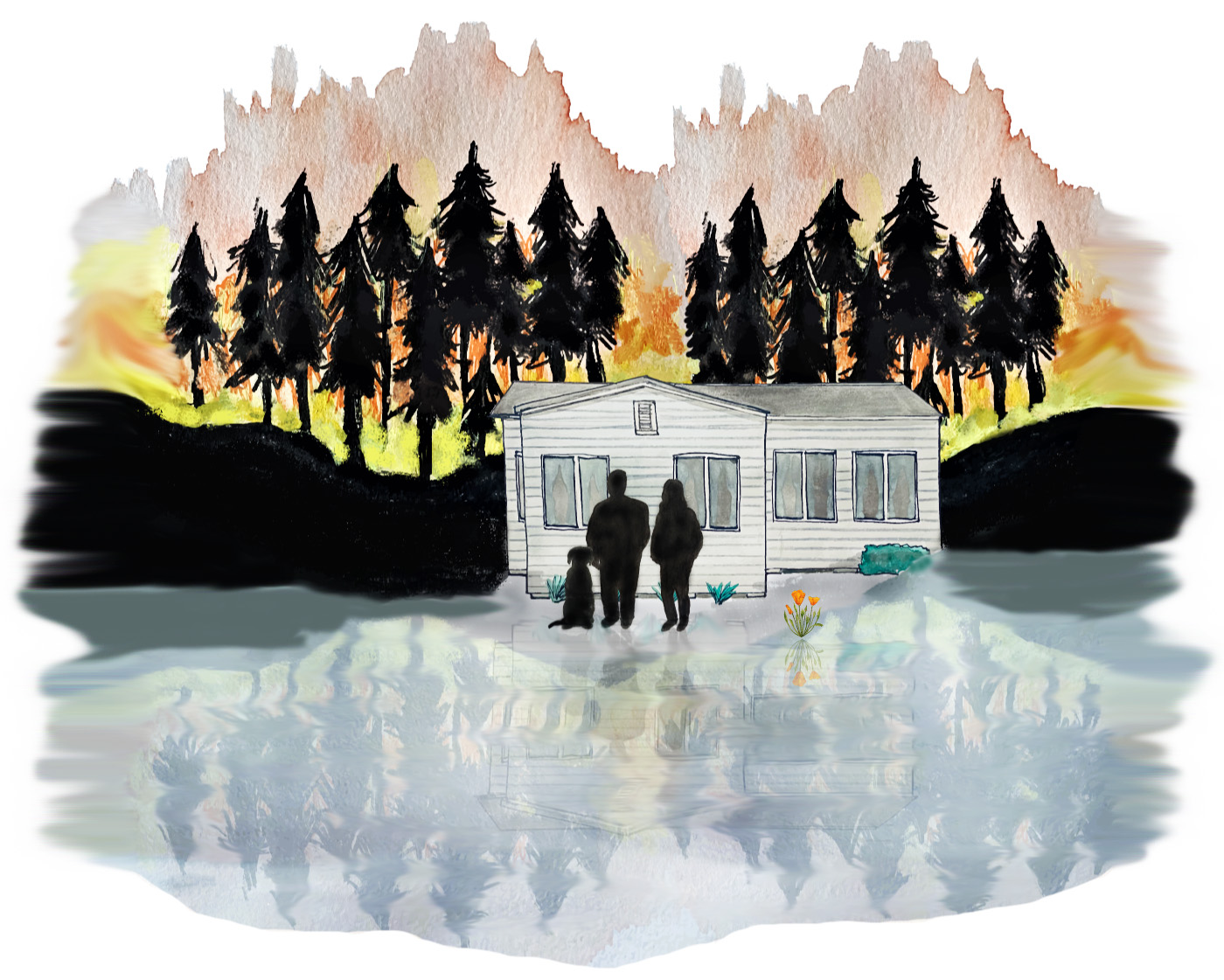 The story is a follow up to another in KneeDeep’s Extremes-In-3D series.
Series funded by the CO2 Foundation.
Other Recent Posts
Feds Meddling With Protections For California Coast
NOAA is reviewing California’s Coastal Management Program in a renewed push for offshore oil and gas drilling.
New Study Shows Rain Gardens Filter Chemicals Out of Stormwater
Scientists found rain gardens dramatically reduce toxic chemicals in stormwater while providing biodiversity and cooling.
The Tricky Art of Growing Oysters in the Lab So They Can Survive in the Field
The Nature Conservancy, the Amah Mutsun Tribal Band, and others are growing oysters in the lab and planting them in the wild in estuaries around San Francisco Bay.
Printing Without Plastic: The Vintage Machine Winning Over Eco-Conscious Artists
This comic guide to risograph printing explains how the 1980s Japanese machine cuts energy use and avoids plastic toner.
East Bay Kids Fight Extreme Heat in their Schoolyards
Many California schools are ill-equipped to tackle heat, with many campuses lacking sufficient tree coverage. These students are fighting to change that.
How a North Bay Regional Park Helped Me Reconnect With Nature — and Myself
A young Fairfield resident reflects on how hiking during the pandemic became a refuge from digital overload and the growing realities of climate change.
Wild Pigs Rough Up Bay Area Greens
They tear up landscapes in search of food, prey on native wildlife, and damage streams, and warming could bring them closer to urban areas.