



Regional Housing Agency Invests in Affordability
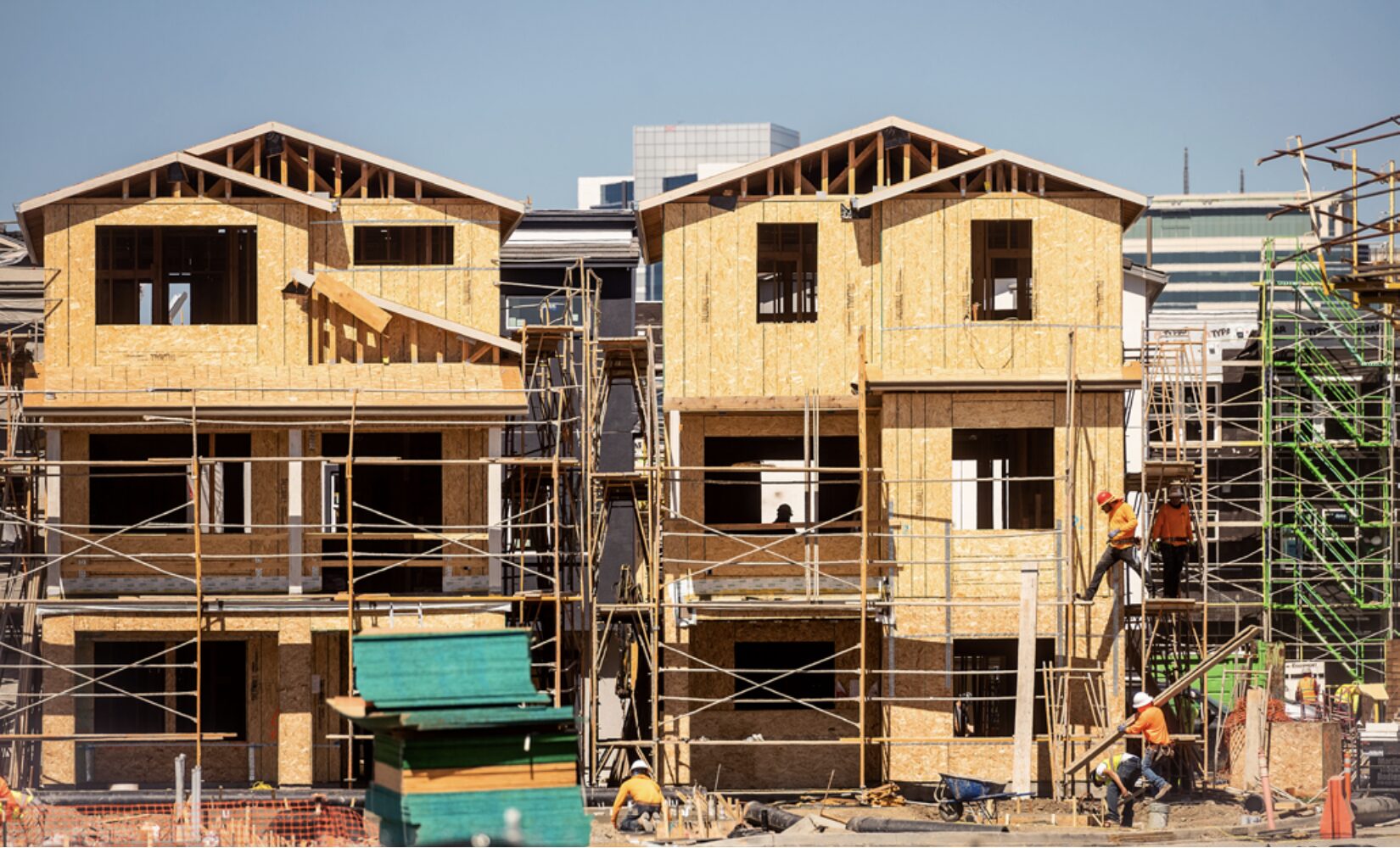
Multifamily housing construction in Santa Clara County. Photo: Noah Berger
By all estimates, the Bay Area’s housing affordability crisis is out of control. The median one-bedroom rent in San Francisco reached $4,300 in August, a staggering 26% increase from July 2025 — by far the largest year-over-year rise among 100 cities studied by real estate site Zumper.
The city only trails New York in median one-bedroom prices, but it shot to the top spot for two-bedrooms, which now come with a median rent of $6,120. San José is also the fourth- and third-most expensive market for one- and two-bedrooms, respectively.
Even before this AI boom-driven explosion, about half of all Bay Area renters were housing cost-burdened in 2024, meaning they spent at least 30% of their income on rent, according to data from the Metropolitan Transportation Commission.
The state has long required every California city to do its part by creating plans to build a minimum amount of new market-rate and affordable housing, but enforcement was weak until recent years, when Gov. Gavin Newsom’s administration started aggressively cracking down on cities that have failed to meet their goals. But despite this progress, there remains a need for more urban regions to coordinate their plans across jurisdictions.
“We feel like there is not enough regionality to housing,” says Sara Amaral, assistant director of the Bay Area Housing Finance Authority.
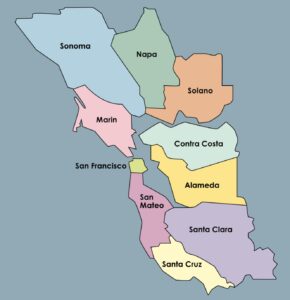
Recognizing the need for some type of regional collaboration, the state legislature created BAHFA in 2019 to design and fund the production of new affordable housing, the preservation of existing affordable housing, and the protection of tenants from displacement.
“We’re really new, but BAHFA has done a lot of work to support affordable housing development outside the traditional opportunities,” says Amaral. “It’s exciting to see these opportunities come up and think outside the box. I’ve been in affordable housing for 25 years, and it’s always been a response to a policy that’s been created, but now we’re actually thinking around that — what else can we do and how else can we do it?”
Other Recent Posts
The End is Coming for California’s Untouchable Grass
The law, which applies to grass that isn’t used for recreational purposes, could cut urban water use across California by more than 20% says Oakland thinktank.
Sonoma Vineyard Workers Burn toward a Better Future
A group of immigrant farmworkers are forming a worker-owned cooperative to bring back Indigenous burning practices that used to revitalize the soil.
Los trabajadores de los viñedos de Sonoma queman por un futuro mejor
Un grupo de trabajadores agrícolas inmigrantes está formando una cooperativa de propiedad de los trabajadores para recuperar las prácticas indígenas de quema que solían revitalizar el suelo año tras año.
New Voices Shape Design of Berkeley’s North Basin Strip
Twenty acres of parkland between the highway and the Berkeley shore are slated for a coast-resilient makeover, with input from locals and stakeholders.
It’s Always Sunny In North Fair Oaks
Residents of the unincorporated community launched their second campaign in two years to get the county to care for dying street trees.
Siempre está soleado en North Fair Oaks
Los residentes de la comunidad no incorporada lanzaron su segunda campaña en dos años para lograr que el condado se ocupe de los árboles de la calle que se están muriendo.
Can Nature Help California’s Coast Fight Fire and Floods?
Local and state leaders gather for September summit on how to mainstream nature-based infrastructure.

Transit-oriented affordable housing development in Oakland Chinatown.
But, like many housing efforts over the years, BAHFA has gone through its own fits and starts and is only just gaining its footing in the region. The state provided one-time grants for the agency to hire staff and launch some initial pilot programs, and the founding legislation also gave it special authority to raise money by putting a new tax or bond measure on the ballot.
Under its first business plan, BAHFA was supposed to be primarily funded with a $20 billion bond measure on the November 2024 ballot. MTC ultimately pulled that question from the ballot over concerns that it wouldn’t reach the two-thirds approval threshold to pass, punting the long-term funding for BAHFA back to 2028.
Now, it’s in the early stages of a long-term plan to bring a permanent funding measure to the ballot in just over two years. BAHFA staff are working with a Regional Housing Stakeholder Committee to amend the organization’s founding legislation over the next year, according to a presentation to several regional housing committees earlier this month. Under consideration are expansions to the types of taxes BAHFA can bring to the table and additional non-ballot fundraising through things like tax increment financing.
Despite uncertainty over its permanent sustainability, the organization has drummed up enough money to make an impact over the last couple of years, including a loan program launching later this year to support the construction of new mixed-income affordable housing.
BAHFA’s existing and upcoming programs include:
- Mixed-Income Financing Program (launching later this year): Loans to developers to either build new housing with a minimum number of affordable units or acquire, rehab, and convert existing buildings into permanently affordable housing, “demonstrating and testing BAHFA’s potential as a public lender and creating a stable revenue stream for the agency.”
- Welfare Tax Exemption Program: Property tax breaks for owners of naturally occurring affordable housing (privately-owned housing that provides affordable units without government subsidies) in exchange for those units remaining affordable for 55 years.
- Doorway: A one-stop shop for renters to find all affordable housing options and applications available across all nine counties in the region.
- Housing Preservation Project Technical Assistance Grant Program: Grants to cover predevelopment inspections, feasibility studies, design, and engineering work.
- Housing Preservation Loan Pilot: Low-interest loans for nonprofit developers and community land trusts to buy and rehab properties already predominately occupied by low- and middle-income households to keep them permanently affordable.
- Bay Area Eviction Study: An analysis of data from courts and law enforcement agencies to identify areas and populations of need.
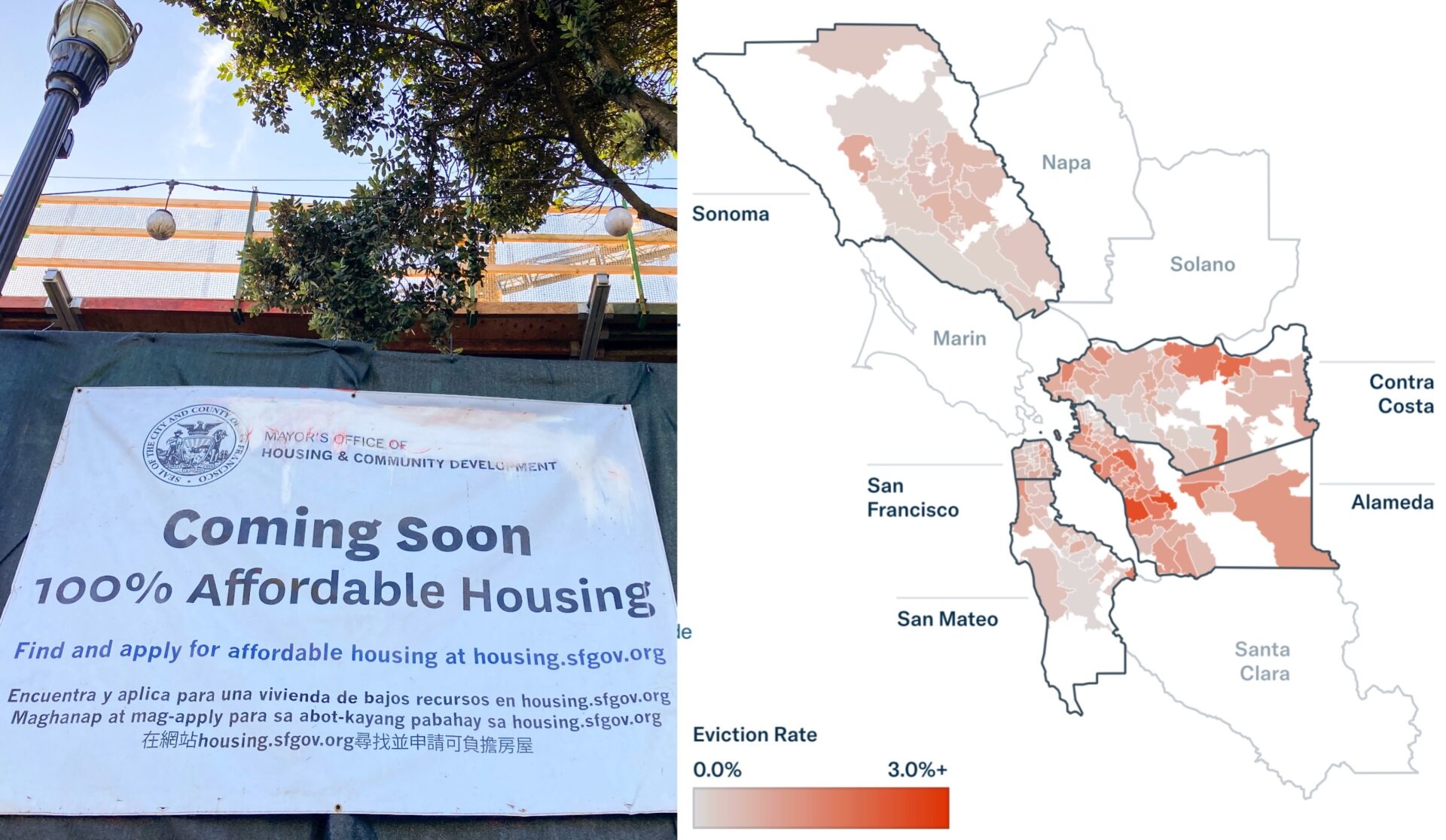
BAHFA Eviction Study. Source: MTC
The Housing Preservation Loan Pilot, funded with $17.8 million from the state, has supported a number of projects and provides $250,000 per unit. BAHFA is also planning to put more than $30 million into the mixed-income program through fundraising, state grants, and MTC support, according to Amaral. The agency has already used the property tax exemption to preserve the affordability of nearly 900 units across the region, too.
Both Amaral and Rebecca Long, MTC’s director of legislation and public affairs, point to the mixed-income pilot and the Doorway site as BAHFA priorities.
“The research really shows better outcomes on a whole host of factors for communities when you have not just a project being all for very low-income households, but a mixture,” Long says. “And the need is there — we have enough luxury housing, but we need more housing in the moderate-income category as well as the extremely low-income. It’s modeled on this social housing concept that’s been quite successful overseas, of just broadening the eligibility of who can live in subsidized housing.”
Every eight years, state officials publish a Regional Housing Needs Assessment that identifies the number of new units needed for people of various income levels over the next eight years. In the 2015 to 2023 cycle, according to the Bay Area Equity Atlas, more than double the housing needed for the above moderate-income population was created, while about half the necessary units for very-low-, low-, and moderate-income households was produced.
For his part, Fernando Marti, a local architect, housing activist, and the former co-director of the Council of Community Housing Organizations, says he’s excited about the ideas that BAHFA is pursuing, but that he’d like to see more carve outs specifically for housing preservation. When the idea of BAHFA first came to the table, he and his colleagues pushed for the organization to dedicate 30% of its funds to preservation, but that came down to 15% in the final legislation approved by the state.
The current legislation amendment process underway, though, is also considering changes to the funding breakdown shown below, including an increase to the minimum allocation for tenant protections and set asides for extremely low-income housing.
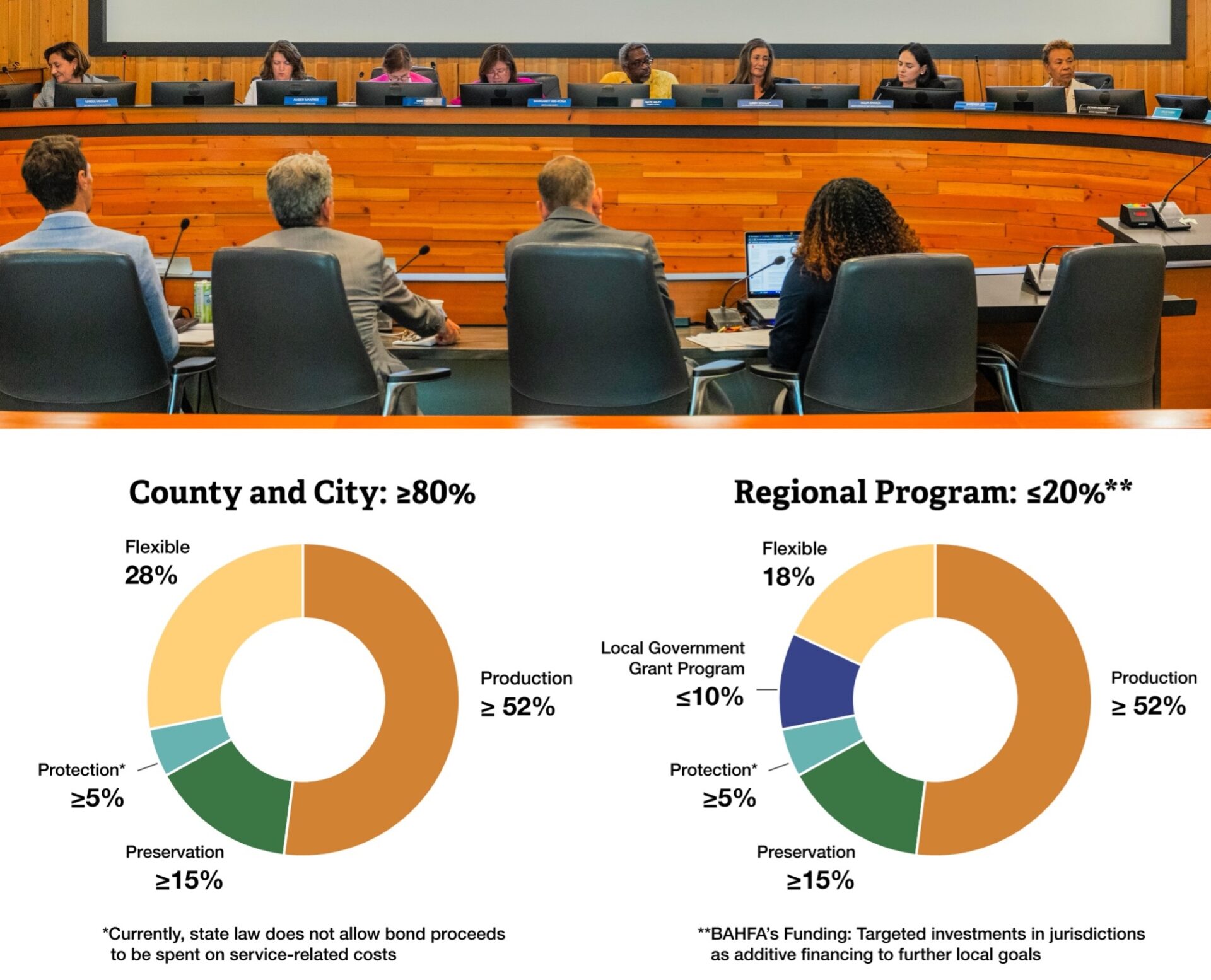
Breakdown of where BAHFA money can go. Source: BAHFA business plan
But Marti still emphasizes the importance of the preservation piece of the puzzle.
“Invest the money to acquire that property, make it permanently affordable and bring it up to code, to some sense of dignified living — that should be a significant chunk” of funding, Marti says. “The preservation doesn’t get as much love as we wish it did because I think the emphasis is often on building units as opposed to protecting people.”