



UC Berkeley’s Brilliant Breakthrough in Carbon Capture
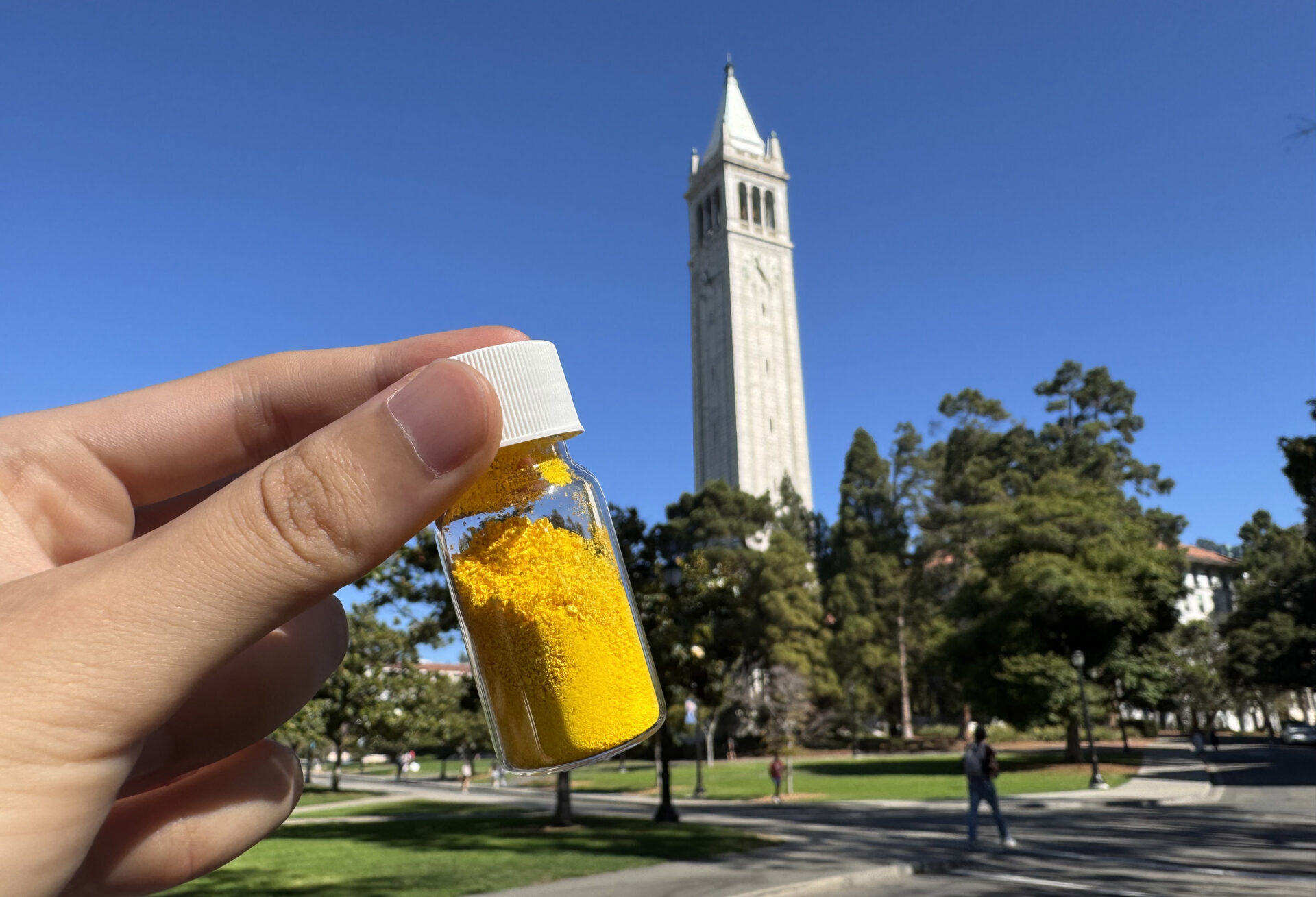
Photo: Zihui Zhou
A canary-yellow powder developed at UC Berkeley has jumped a long-standing carbon capture hurdle: it can absorb CO₂ from the air directly, and it can do so over and over without rapidly degrading.
This material, called COF-999, is the latest iteration of “covalent organic framework” technology developed by Omar Yaghi, professor of chemistry at UC Berkeley and senior author of the paper on COF-999 published in Nature in October. COFs are essentially tiny sponges: honeycombed tubes with a massive surface area and lots of holes that snag CO₂ molecules as air flows through. The challenge is that these porous frameworks are fragile, easily degraded by water, sulfur, nitrogen, and other airborne molecules.
UC Berkeley graduate student Zihui Zhou, the Nature paper’s lead author, spent years trying to create a stronger COF that could pull more carbon out of the air before degrading.
“I tried maybe hundreds of reactions, hundreds of materials,” says Zhou. “And after two years of work, we finally found this material.”
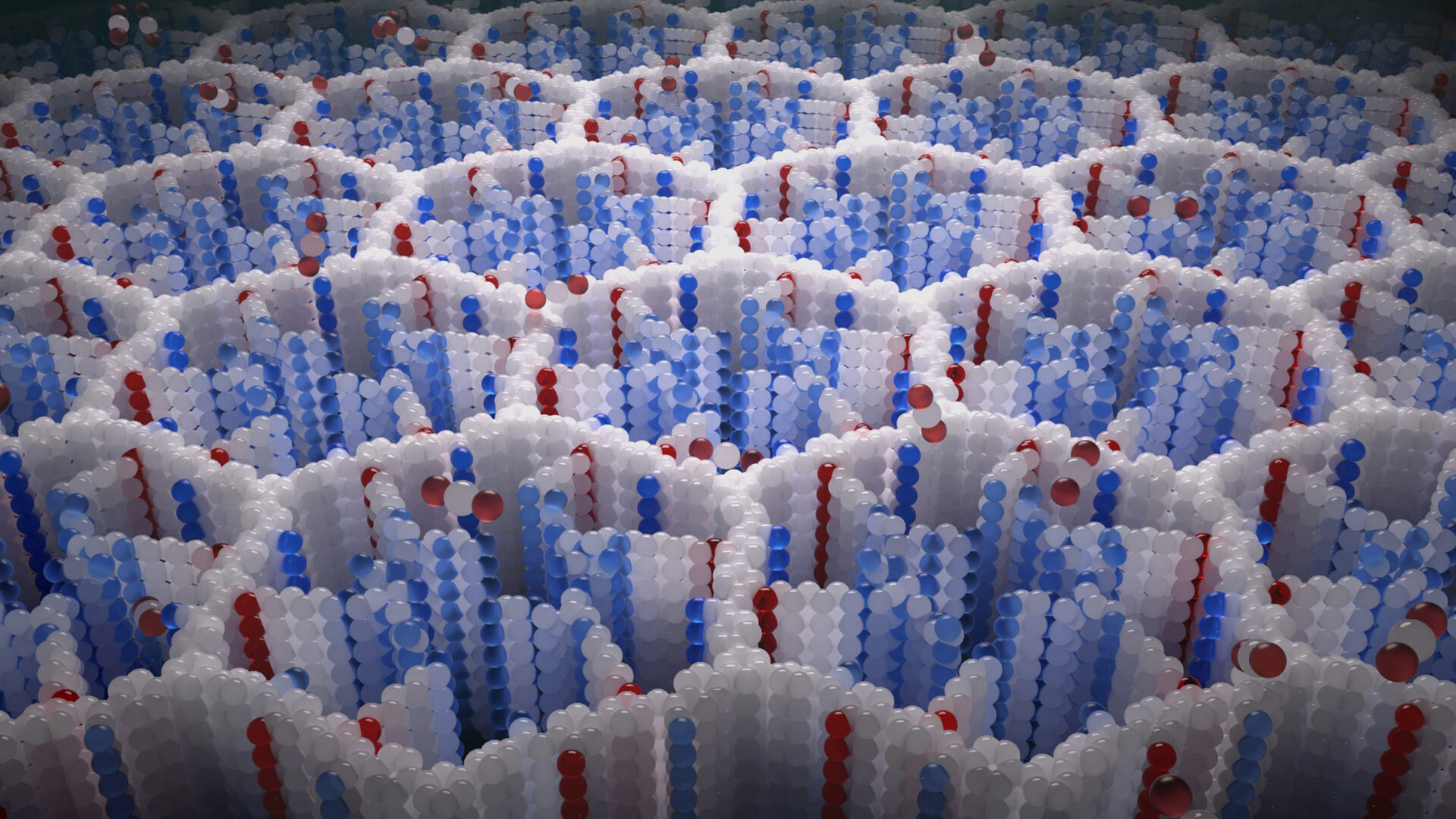
A visualization of COF-999’s crystalline structure. Image: Chaoyang Zhao
Zhou designed COF-999 to be stronger, stabler, and longer-lasting. The structure is studded with amines (NH2 groups), then flushed with more amines that form short amine polymers. As air passes through these structures, the CO₂ molecules bind to the amines. Unlike past direct air capture technologies, COF-999 actually works better in the presence of moisture.
“I think the exciting part was when I said to Zihui, ‘Why don’t we just pipe in Berkeley air and see if it takes up the CO₂?’” says Yaghi. “And it did – not just the excess CO₂, but all the CO₂.”
Then, Zhou carried out 100 catch-and-release cycles — scrubbing carbon from the air with COF-999, then heating it to release the carbon — without major efficiency loss. According to Zhou, less than half a pound of COF-999 can take up 44 lbs of CO₂ in a year — about as much as a tree.
While this new technology is exciting, it’s important to point out the limitations of Direct Air Capture. An International Energy Agency report estimates that, if all currently planned Direct Air Capture projects were to move forward, they could remove around 65 million tons of CO2 per year in 2030.
Other Recent Posts
Feds Meddling With Protections For California Coast
NOAA is reviewing California’s Coastal Management Program in a renewed push for offshore oil and gas drilling.
New Study Shows Rain Gardens Filter Chemicals Out of Stormwater
Scientists found rain gardens dramatically reduce toxic chemicals in stormwater while providing biodiversity and cooling.
The Tricky Art of Growing Oysters in the Lab So They Can Survive in the Field
The Nature Conservancy, the Amah Mutsun Tribal Band, and others are growing oysters in the lab and planting them in the wild in estuaries around San Francisco Bay.
Printing Without Plastic: The Vintage Machine Winning Over Eco-Conscious Artists
This comic guide to risograph printing explains how the 1980s Japanese machine cuts energy use and avoids plastic toner.
East Bay Kids Fight Extreme Heat in their Schoolyards
Many California schools are ill-equipped to tackle heat, with many campuses lacking sufficient tree coverage. These students are fighting to change that.
How a North Bay Regional Park Helped Me Reconnect With Nature — and Myself
A young Fairfield resident reflects on how hiking during the pandemic became a refuge from digital overload and the growing realities of climate change.
Wild Pigs Rough Up Bay Area Greens
They tear up landscapes in search of food, prey on native wildlife, and damage streams, and warming could bring them closer to urban areas.

Carbon molecules flow into a COF-999 structure. Image: Chaoyang Zhao
Global carbon emissions in 2024 were 37.41 billion metric tons. So, even at the best-case-scenario 2030 rate, it would take about 575 years to remove one year’s worth of emissions. Let’s imagine that our DAC capacity improves by 10,000%; it would still take about six years of capture to scrub 2024’s CO2 emissions. In short: if we’re still emitting significant amounts of new CO2 into the atmosphere, Direct Air Capture can do little to stop warming. But if advances like COF-999 are combined with driving down emissions and other carbon capture methods like reforestation, DAC could become a valuable piece of the decarbonization puzzle.
The next step for COF-999 is scaling up production, then actually deploying it. Yaghi anticipates relatively low costs — the material doesn’t require rare minerals or complex synthesis. “I estimate that, within a year, we would be able to make [metric] ton quantities,” says Yaghi.
Meanwhile, Zhou is working on improving the material further, pushing the COF’s efficiency by helping a higher percentage of the amines snag CO₂ during each cycle. It’s a slow, steady process of tiny tweaks and precise observation.
“Zihui probably makes hundreds of observations every day,” says Yaghi, proudly. “He has to make a decision about which observation is the most important to pursue. Much to his credit, he pursued the right observation.”
Yaghi isn’t new to making the news — but this is Zhou’s first major project with real-world implications. He was so excited about the data he was collecting that he texted Professor Yaghi about it almost every day, he says.
“The human aspect of this is often untold,” says Yaghi. “We leave the security of our home behind because we want to advance the frontiers of knowledge. And if you’ve worked hard and you have the right thinking, you will discover something that potentially could contribute to society. I think that this is how civilizations evolve.”