




New Study Shows Rain Gardens Filter Chemicals Out of Stormwater
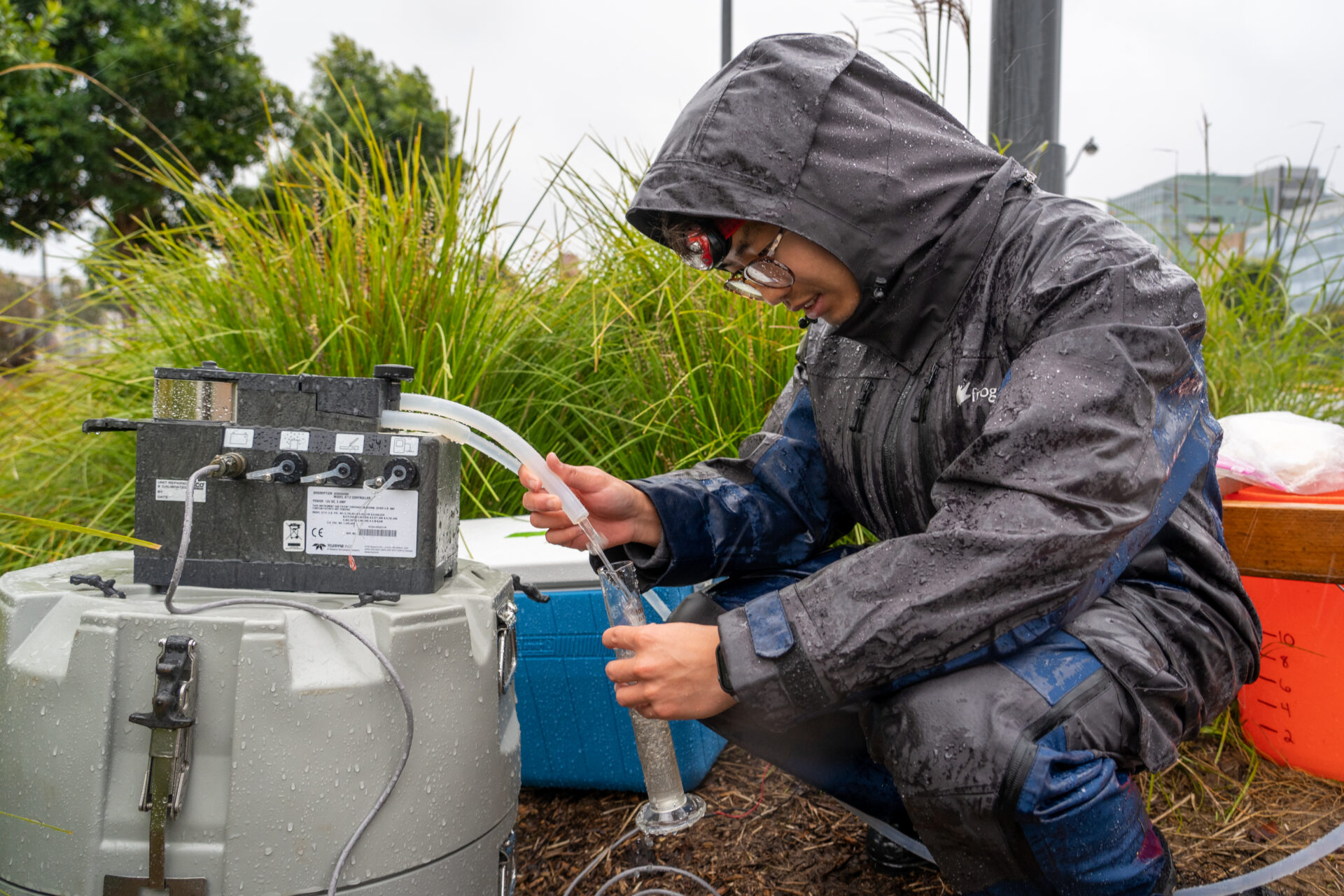
A San Francisco Estuary Institute researcher collects a stormwater sample from a Mission Bay rain garden in December 2022. Photo: Shira Bezalel
A new study found that Bay Area rain gardens are highly effective at filtering harmful
contaminants out of stormwater before it reaches the Bay.
The study, published earlier this month by the San Francisco Estuary Institute, examined rain
samples from four San Francisco rain gardens across 15 rain events between 2022 and 2024.
Twenty-one different contaminants — primarily pesticides, preservatives, pharmaceuticals, microplastics, and vehicle-derived chemicals from materials like tires — were measured in stormwater runoff as it both entered and exited the rain gardens.
In many cases, the gardens successfully removed more than 90% of the chemicals.
“We didn’t have a number expectation going into the study,” says principal investigator Melissa
Foley. “So to see, for some of those contaminants, a 90% reduction between stormwater coming
in and stormwater coming out, that was really exciting for the team.”
According to Foley, many modern rain gardens are often specifically engineered to filter out
highly-toxic “legacy contaminants” like heavy metals and synthetic pollutants. But SFEI wanted
to know how rain gardens were performing against “emerging contaminants” — found in
products like cosmetics, paint, pesticides, and vehicle parts — which can be harmful but are as yet unregulated.
The study took a close look at 6PPD-quinone, an especially toxic emerging contaminant made from a chemical that
vehicle manufacturers use to prevent tire degradation. It’s estimated that trillions of tire particles
enter the San Francisco Bay every year. The chemical poses a threat to coho salmon, which are
extinct in the Bay, and steelhead trout.
On average, the four rain gardens studied filtered out more than 95% of the stormwater’s
6PPD-quinone, and were overall even better at removing emerging contaminants than legacy contaminants. However, the remaining amount of 6PPD-quinone was still above the Environmental Protection Agency’s safe threshold to protect aquatic life.
Other Recent Posts
Fire Weather in the Wind
As the hot Nevada air cools every fall, it gets pushed west to lower pressure areas over the Central Valley, where the wind heats up and dries out.
My Morning Cleaning Up the Oakland Estuary
On Oakland’s Creek to Bay Day, I joined 100 volunteers for I Heart Oakland-Alameda Estuary to remove shoreline trash.
RCDs Pay Extra Attention to North Bay High Schoolers
A $15,000 grant will help three North Bay conservation districts evaluate youth education programs and prepare high school students for environmental careers.
Creeks Make Good & Bad Homes
San Jose State researcher Costanza Rampini explores why the houseless favor creek banks, and how they weather the flood risk.
Bay Area Braces for Record-Breaking El Niño
Record high water temperatures in the Pacific are expected to bring dangerous sea level rise, waves, and rain to the region this winter.
Regional Housing Agency Invests in Affordability
The Bay Area Housing Finance Authority is launching a loan program to support the construction of mixed-income rental properties.
The End is Coming for California’s Untouchable Grass
The law, which applies to grass that isn’t used for recreational purposes, could cut urban water use across California by more than 20% says Oakland thinktank.
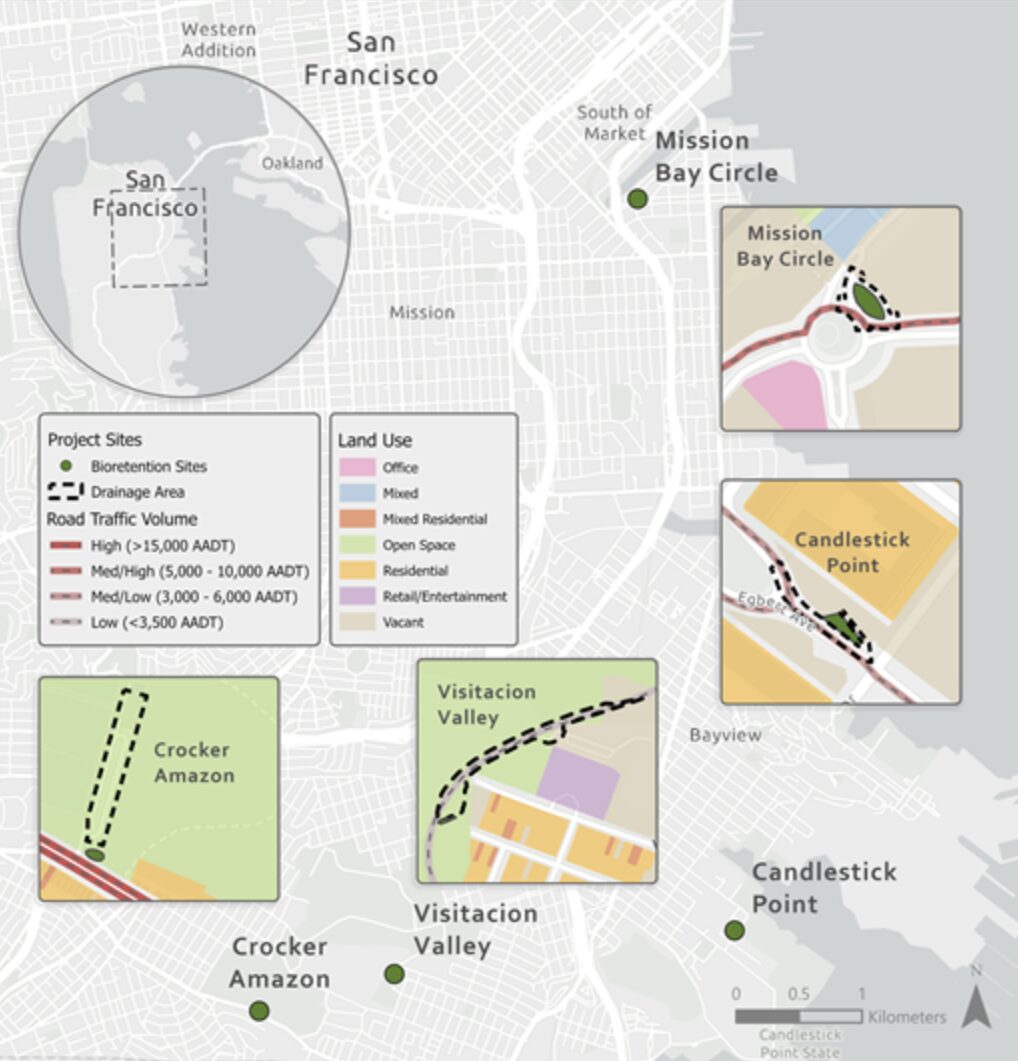
A map of the four rain gardens studied by SFEI. Graphic: Environmental Science: Water Research & Technology
The state is working with tire makers to find a safer replacement for 6PPD-quinone, and the California legislature has preemptively passed a law banning the chemical in new vehicles once a substitute is found.
Still, we know very little about emerging contaminants and the threats they pose to the Bay ecosystem, according to SFEI researchers.
“To my knowledge, the contaminants that we’re looking at [other than 6PPD-quinone], for the information that we have, are at levels that are OK,” says Foley. “The thing that we don’t know is, what about this urban cocktail of contaminants that’s coming into the Bay? That’s something we don’t generally do a good job of testing.”
For now, though, Foley and other SFEI scientists stress that rain gardens are a vital piece of a larger urban greenery puzzle.
Rebecca Sutton, a managing senior scientist at SFEI studying emerging contaminants, describes rain gardens as a “targeted intervention” that can be highly effective when deployed near places like industrial sites or farms that use a lot of pesticides.
“There’s just so much stormwater in our cities … we can’t make enough rain gardens to handle all that flow,” says Sutton. “But if you have key habitats you’re really focusing on, that might be a great place to establish more rain gardens.”
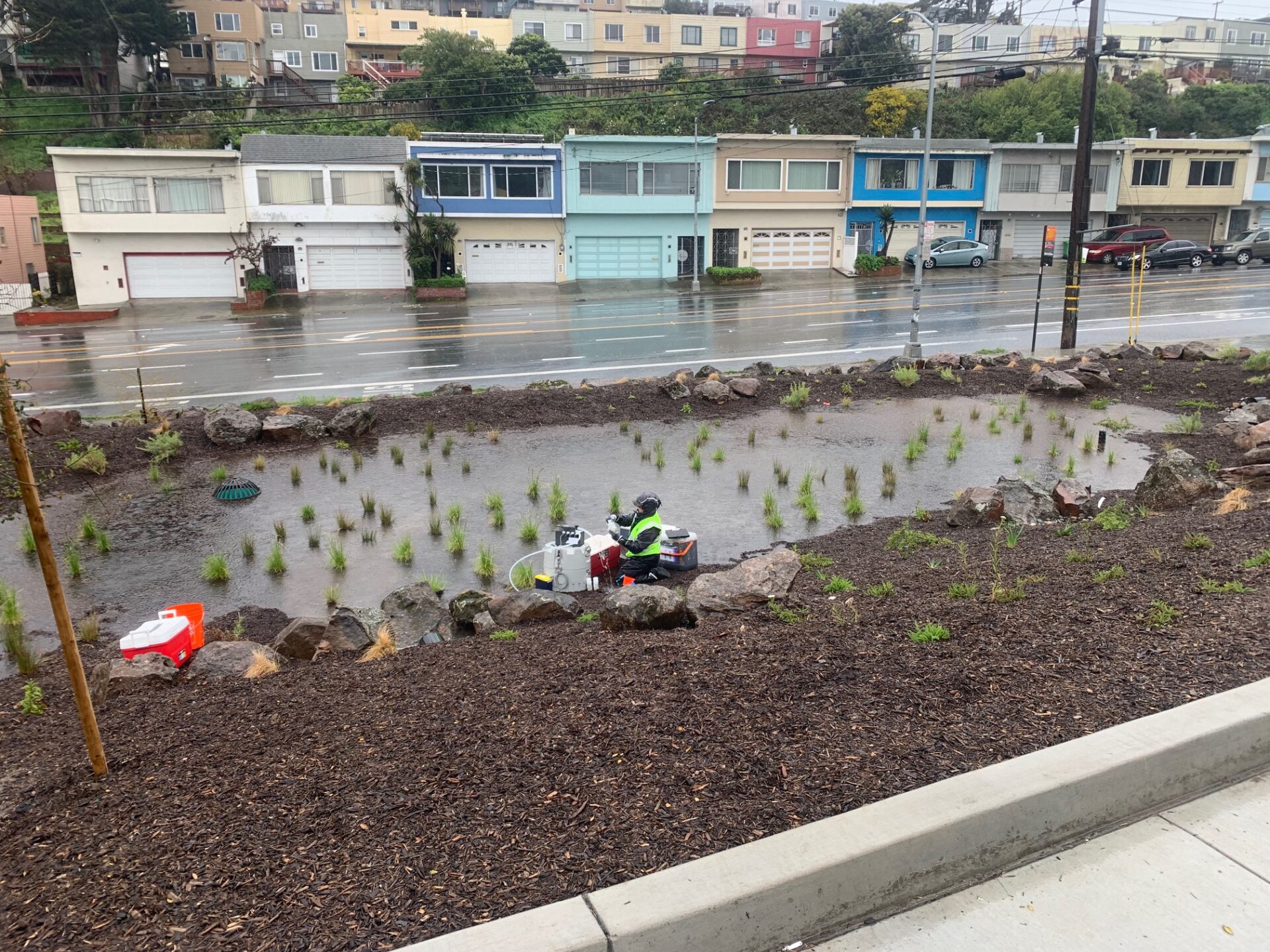
Collecting samples from the Crocker-Amazon neighborhood in San Francisco. Photo: SFEI
Currently, the San Francisco Public Utilities Commission has built or is in the process of building 575 urban rain gardens that will filter 333 million gallons of stormwater annually, with a goal to reach a billion gallons by 2050. Generally, those projects call for replacing the soil every 25 to 30 years, which is in line with the level of contaminants trapped by soil samples analyzed by SFEI, according to Foley and Sutton. There’s not much information available about potential harmful effects on plants in rain gardens, though.
Foley also notes that, in addition to formal rain gardens, backyard gardens or small patches of greenery maintained by neighborhood volunteers can make a difference in stormwater filtration. The problem, though, is that “greenery is very unequally distributed around the city,” she says, with the south end of San Francisco suffering from much more concrete and runoff than other neighborhoods. So certain parts of the Bay Area could benefit more from the introduction of new rain gardens.
“I know this study is really about water quality, but I want to make it clear that these rain gardens are so much more,” Foley says. “If properly designed and maintained, they’re also really important in urban spaces for biodiversity support and heat mitigation, and just green space in cities. It’s a multi-benefit solution in cities. They can be a powerhouse.”