


King Kong Levee: Two Miles Done, Two To Go
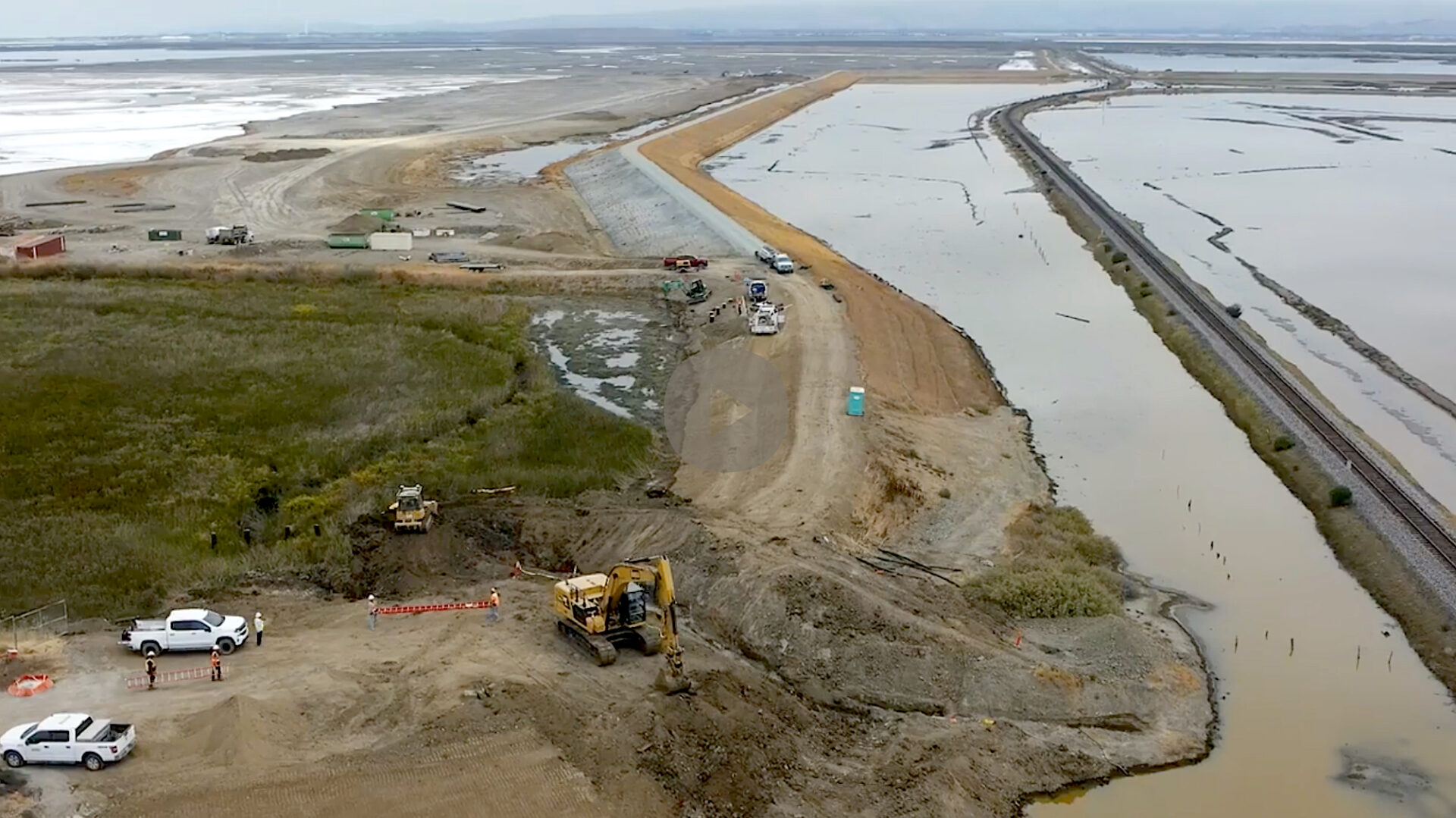
South Bay shoreline levee. Photo: Paola Reyes, Valley Water
Compared to the myriad mini-levees planned around the Bay in 2025, the South Bay’s growing shoreline levee stands out for its sheer scale and engineering.
This is no mere mound of dirt, like the 19th century earthworks still keeping the Bay out of pastures and local salt ponds, nor an experiment in how to use wastewater to irrigate new gray-green levees and filter out nutrients while protecting sewage treatment plants from sea level rise.
These two miles of 15-foot-tall, 16-foot-wide-at-the-top levee are of the more traditional Army Corps, FEMA-approved style: a major, multi-benefit flood control project designed to protect the oft-water-logged town of Alviso and parts of San Jose. This September marked completion of Phase 1 after 20 years in planning, development, and construction. The entire project, which will stretch from Alviso Slough to Coyote Creek, is expected to be completed by 2035 (provided additional funding is forthcoming).
Richard Santos grew up in the tiny fishing town of Alviso and remembers the floods in the 1960s, ’80s, and 1995. “It wasn’t just the water, but the damage and fear they brought. This project is more than infrastructure; it’s an important step toward peace of mind, safety, and confidence for our community,” says the Valley Water board director.
“As extreme weather and climate change-related emergencies increase in frequency, I am glad to see these life-saving protections for San Jose residents completed,” says Rep. Zoe Lofgren (CA-18).
To date, the $545 million project has required complex collaborations among local jurisdictions and partners (Valley Water, the Army Corps of Engineers, the California Coastal Conservancy, the Don Edwards National Wildlife Refuge, the city of San Jose, a railroad, the local parks district, and more). Eventually, the project will also enable the restoration of almost 3,000 acres of tidal wetlands on former salt ponds and completion of the Bay Trail through the area.
More importantly, it offers a tangible on-the-ground reminder of the scale of project necessary in the future as the region looks to protect airports, urban waterfronts, bridge touch-downs, and shoreline freeways from the steady rise of the Bay due to global warming.
“No project on the San Francisco Bay shoreline is easy,” says the Conservancy’s Amy Hutzel. “It’s always a complicated mix of jurisdictions and landowners and utilities, infrastructure and communities, all with lots of different needs. The Shoreline Project, I think, is a really great model of what we can do here.”
Next steps include constructing and revegetatating an ecotone along the levee, which will provide habitat for wildlife, and completing the remaining two miles of levee.
Other Recent Posts
Fire Weather in the Wind
As the hot Nevada air cools every fall, it gets pushed west to lower pressure areas over the Central Valley, where the wind heats up and dries out.
My Morning Cleaning Up the Oakland Estuary
On Oakland’s Creek to Bay Day, I joined 100 volunteers for I Heart Oakland-Alameda Estuary to remove shoreline trash.
RCDs Pay Extra Attention to North Bay High Schoolers
A $15,000 grant will help three North Bay conservation districts evaluate youth education programs and prepare high school students for environmental careers.
Creeks Make Good & Bad Homes
San Jose State researcher Costanza Rampini explores why the houseless favor creek banks, and how they weather the flood risk.
Bay Area Braces for Record-Breaking El Niño
Record high water temperatures in the Pacific are expected to bring dangerous sea level rise, waves, and rain to the region this winter.
Regional Housing Agency Invests in Affordability
The Bay Area Housing Finance Authority is launching a loan program to support the construction of mixed-income rental properties.
The End is Coming for California’s Untouchable Grass
The law, which applies to grass that isn’t used for recreational purposes, could cut urban water use across California by more than 20% says Oakland thinktank.
MORE
- Delivering Tunnel Muck to South Bay Marshes, August 2024
- A South Bay Levee Breaks Ground, April 2022