


Meet the Oakland Biologist Making Native Plants Go Viral

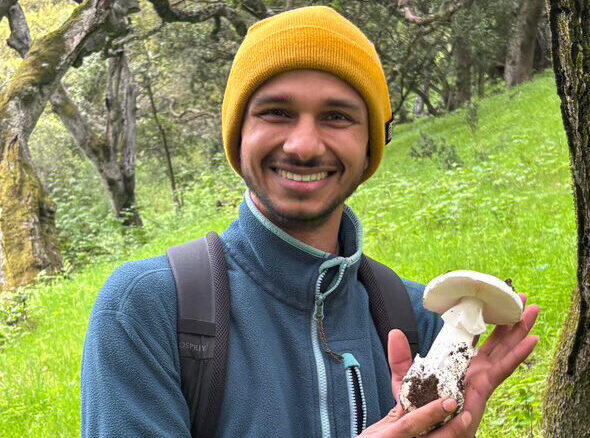
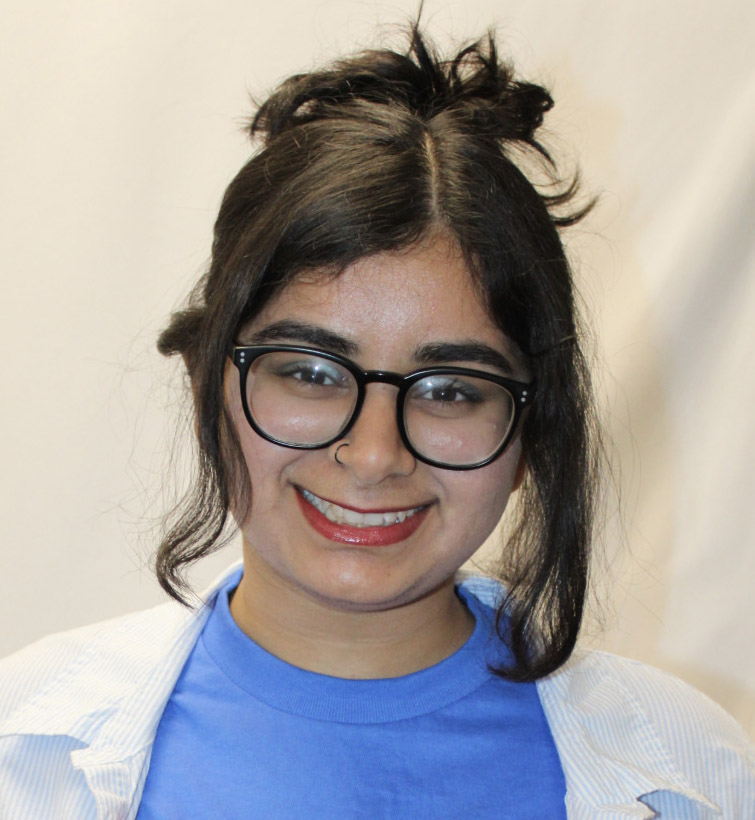
Saumitra Kelkar proudly displays a mushroom. Photo: Courtesy Saumitra Kelkar
From starting an ant colony at home to teaching in Hawaii, Saumitra Kelkar has seen it all.
Kelkar, a UC Berkeley alum and biologist, lives in Oakland and works on native plant landscaping around the city. He’s also a part-time environmental consultant and a former environmental biology teacher at Skyline High School.
As an ecology and biodiversity expert, he also likes sharing his knowledge on the internet. Online, he goes by the username “Oakland.bio,” and he’s cultivated a community of like-minded individuals interested in learning more about biodiversity by posting videos on Instagram.
But Kelkar didn’t take the typical “climate influencer” route to popularity. He started the account during his time as a teacher, which had its ups and downs. Before working at Skyline High, he taught biology in Hawaii, where he noticed a big difference in the environmental science curriculum.
“In traditional Hawaiian culture, people do not see themselves as separate from the land of the living processes that sustain life,” Kelkar says. But teaching in Oakland, “it felt almost impossible to build a relationship between students and the natural world.”
In response to a limited curriculum, a few of his students suggested that he start an Instagram account to share biology-related content. “Taking a video makes things feel more alive to people,” he says. But it wasn’t until he quit his job as a teacher that he regularly started uploading reels. To his pleasant surprise, his first video that blew up was about grass.
Other Recent Posts
Regional Housing Agency Invests in Affordability
The Bay Area Housing Finance Authority is launching a loan program to support the construction of mixed-income rental properties.
The End is Coming for California’s Untouchable Grass
The law, which applies to grass that isn’t used for recreational purposes, could cut urban water use across California by more than 20% says Oakland thinktank.
Sonoma Vineyard Workers Burn toward a Better Future
A group of immigrant farmworkers are forming a worker-owned cooperative to bring back Indigenous burning practices that used to revitalize the soil.
Los trabajadores de los viñedos de Sonoma queman por un futuro mejor
Un grupo de trabajadores agrícolas inmigrantes está formando una cooperativa de propiedad de los trabajadores para recuperar las prácticas indígenas de quema que solían revitalizar el suelo año tras año.
New Voices Shape Design of Berkeley’s North Basin Strip
Twenty acres of parkland between the highway and the Berkeley shore are slated for a coast-resilient makeover, with input from locals and stakeholders.
It’s Always Sunny In North Fair Oaks
Residents of the unincorporated community launched their second campaign in two years to get the county to care for dying street trees.
Siempre está soleado en North Fair Oaks
Los residentes de la comunidad no incorporada lanzaron su segunda campaña en dos años para lograr que el condado se ocupe de los árboles de la calle que se están muriendo.
Kelkar grew up in the suburbs of Southern California in Los Angeles County. He describes his surroundings as “baking hot all the time.” The environment seemed to suck the life out of nature.
“The landscape is super manicured,” he says. “They don’t even let the weeds grow on the sidewalks. There’s no nature anywhere.”
But this all changed when he moved to the East Bay to attend UC Berkeley. Suddenly, there was life blossoming all around him. There, he connected with other people passionate about the environment. Studying at the College of Natural Resources, the support he received from the community encouraged him to pursue a hands-on career in the environmental field.
Kelkar’s love for biology has led to a growing passion for photography and linguistics. When he started identifying plant species in his community, he paired the experience with a camera to capture close-up shots of his discoveries.
But visuals can only reveal so much. He believes learning the scientific names of different plant species has “helped me learn a lot more about each species. The species becomes so much more than it is named. [We] develop a more intimate and honest relationship with the creature itself that is less tainted by the words we assigned to that creature.”
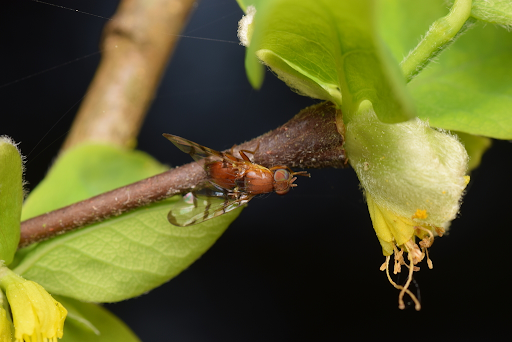
An insect on a branch of Western leatherwood, a rare plant found in only a few Bay Area locations. Photo: Saumitra Kelkar
For many professionals, biology is not just a career, but a way of life. For Kelkar, it’s an “all encompassing experience to be so intimately connected with everything in the living world around you.”
In Oakland, invasive species pose an immediate threat to the city’s biodiversity. “The vast majority of species in any ecosystem are highly dependent on specific host species that they evolved symbiotic relationships with. So when you remove native plants from the landscape, you are also removing the symbiotic relationships and required associations with the plants,” explains Kelkar. But people don’t necessarily have the education necessary to advocate for the preservation of plants and trees native to their local environments.
“Even most of the people who care about the right things don’t know enough about their local environment to care effectively, because every environment is very locally specific,” Kelkar says. It’s not a lack of intent, but rather a lack of local resources that proves challenging, he adds. He plans to tackle such issues with the help of his Instagram platform.
To support native plants, Kelkar encourages people to join existing local organizations. Friends of Sausal Creek, for example, has been active in Oakland for decades now and has successfully restored native plant communities. In Oakland, he recommends planting native trees like the California buckeye, Oregon ash, and white elder. But always research the species native to your community first, he says.