



More Signatures Needed to Save Bay Area Transit
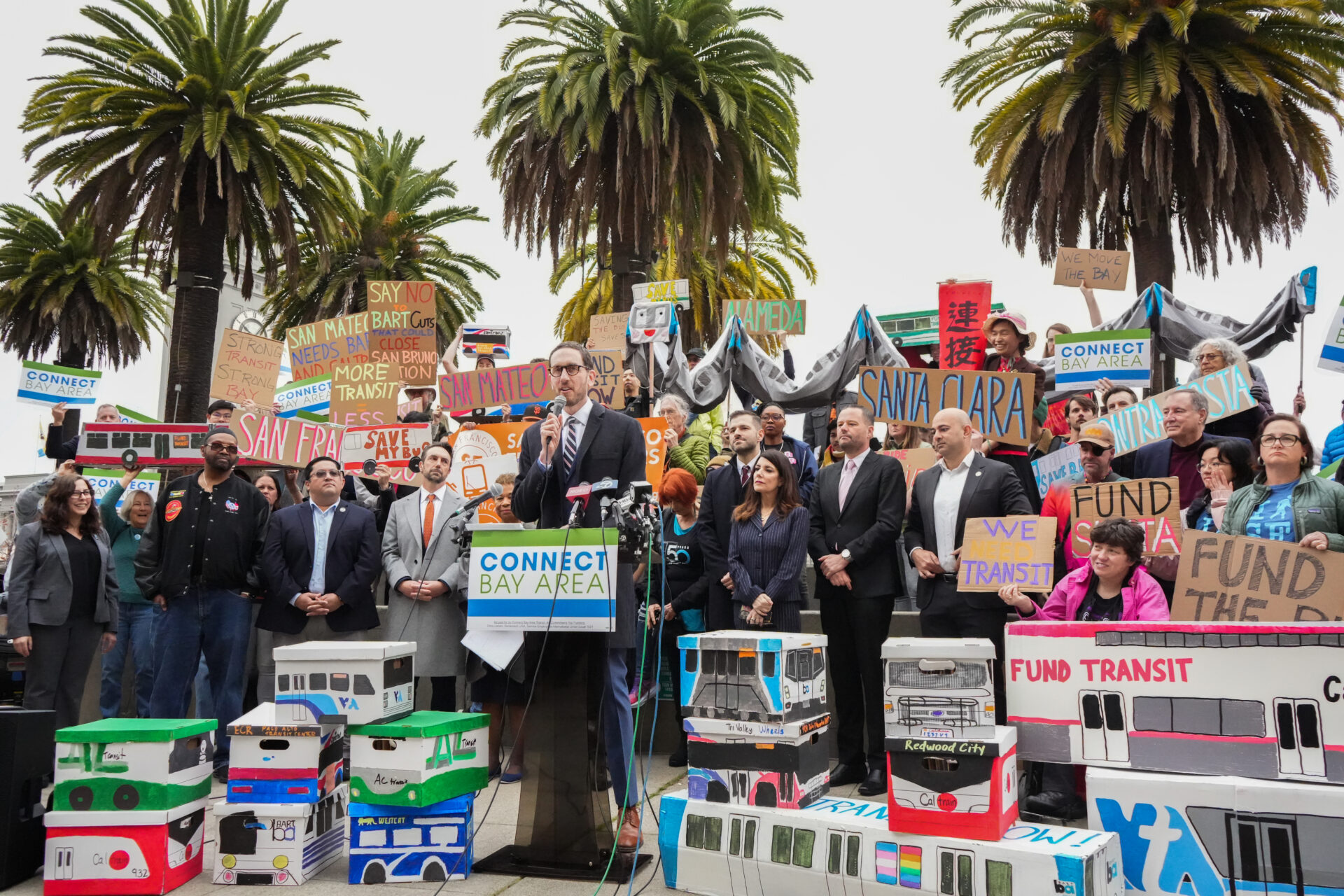
California State Senator Scott Wiener speaks at a rally in San Francisco in support of the transit rescue campaign. Photo: Connect Bay Area
With less than three months left for the Connect Bay Area campaign to collect the requisite 200,000 signatures to get a transit rescue measure on the ballot in November, a surprising mix of organizations are joining forces to keep BART and Muni trains running.
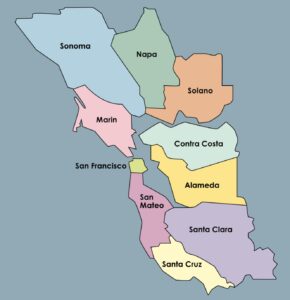
Groups who are often at odds — labor organizers, climate activists, elected officials, and big corporations — are all involved in the final push to get this measure over the finish line. If they succeed, Alameda, Contra Costa, San Francisco, San Mateo, and Santa Clara counties will vote on a new sales tax (of 1% in San Francisco and 0.5% in the other four counties) to make up a combined budget shortfall of more than $800 million coming to BART, Muni, Caltrain, and AC Transit in 2027.
“Passing these measures and preserving public transit is a win-win for everyone,” says Dylan Fabris, the community and policy manager for SF Transit Riders.
Last year, the state legislature passed SB63 in support of a new tax to maintain public transit service in the Bay Area. That bill provided two paths forward — either the Metropolitan Transportation Commission could place the measure on this coming November’s ballot directly, or a citizens’ initiative with 200,000 signatures could do so. The catch? Direct placement by the MTC would require two-thirds of the vote to pass, while the citizens’ initiative would just need a simple majority.
As a result, MTC waived its right to create the ballot measure itself. In mid-January, SF Transit Riders, the Transbay Coalition, SPUR, SEIU 1021, and many others launched the Connect Bay Area campaign, which has until the first week of June to collect those 200,000 signatures. Since then, this coalition has dispatched about 1,000 volunteers to events across the region.
Other Recent Posts
Fire Weather in the Wind
As the hot Nevada air cools every fall, it gets pushed west to lower pressure areas over the Central Valley, where the wind heats up and dries out.
My Morning Cleaning Up the Oakland Estuary
On Oakland’s Creek to Bay Day, I joined 100 volunteers for I Heart Oakland-Alameda Estuary to remove shoreline trash.
RCDs Pay Extra Attention to North Bay High Schoolers
A $13,500 grant will help three North Bay conservation districts evaluate youth education programs and prepare high school students for environmental careers.
Creeks Make Good & Bad Homes
San Jose State researcher Costanza Rampini explores why the houseless favor creek banks, and how they weather the flood risk.
Bay Area Braces for Record-Breaking El Niño
Record high water temperatures in the Pacific are expected to bring dangerous sea level rise, waves, and rain to the region this winter.
Regional Housing Agency Invests in Affordability
The Bay Area Housing Finance Authority is launching a loan program to support the construction of mixed-income rental properties.
The End is Coming for California’s Untouchable Grass
The law, which applies to grass that isn’t used for recreational purposes, could cut urban water use across California by more than 20% says Oakland thinktank.
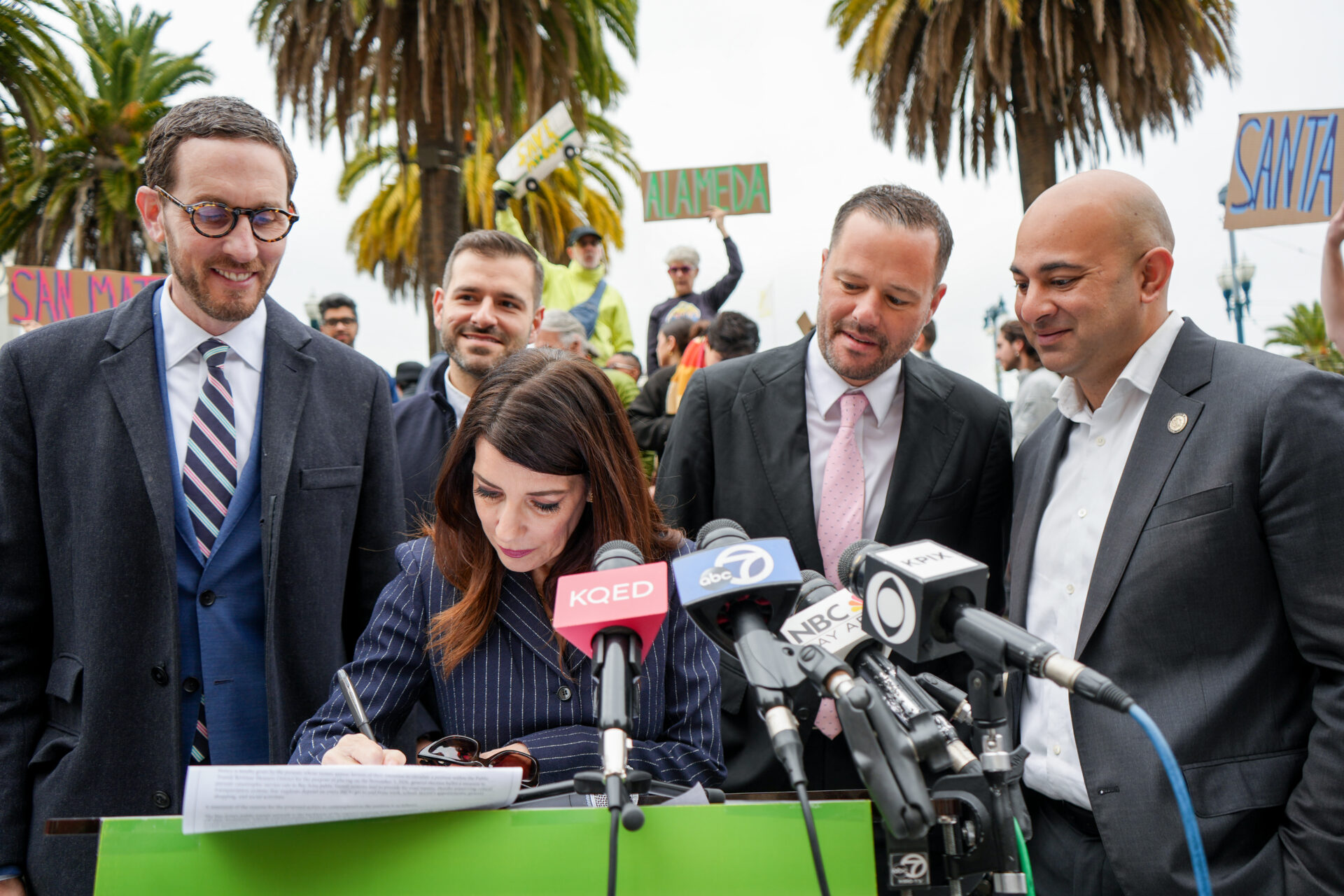
California Assemblymember Catherine Stefani signs the campaign measure. Photo: Connect Bay Area
“You get to 200,000 by being everywhere, by talking to everyone. So we do need that person in Morgan Hill to step up and say, ‘I will be the person to talk to everyone in my neighborhood,’” says Carter Lavin, co-founder of the Transbay Coalition. “The stakes couldn’t be higher. We’re talking about BART not existing. The amount of service cuts to AC Transit would be bigger than when COVID started. We’re talking about the cable cars in San Francisco being gone, which hasn’t happened in a hundred years. We’re talking about drastic cuts to Caltrain.”
Anyone interested in volunteering can sign up here. The campaign also has signature gathering events scheduled nearly every day — including a recent one at the Hunky Jesus Contest on Easter Sunday in Dolores Park — which you can find on this calendar.
Fabris and SF Transit Riders are also focusing on a companion ballot measure in San Francisco to round out funding specifically for Muni. That measure requires 10,000 signatures, with a deadline of July 6, and it will ask voters to support a parcel tax for property owners, which Fabris describes as “the most progressive parcel tax ever passed in San Francisco.” Under the proposal, owners of single-family homes less than 3,000 square feet would pay $129 a year, with the owners of anything larger than that paying more based on their additional square footage, capped at $50,000 for multifamily buildings and $400,000 for commercial properties.
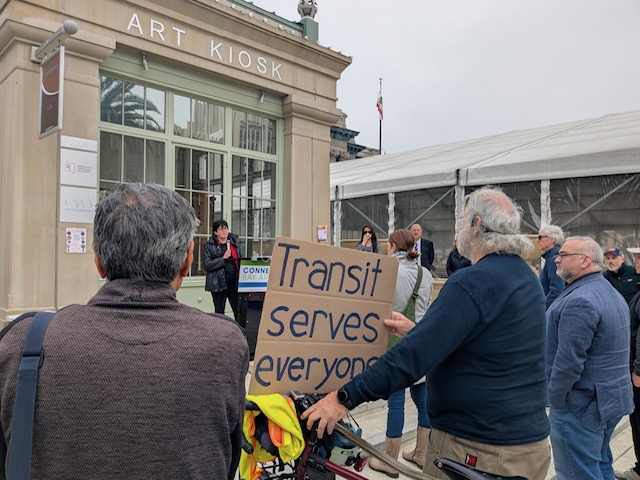
Rally in San Mateo. Photo: Connect Bay Area
As both Fabris and Lavin note, the environmental outlook for the Bay Area is bleak if these measures fail. According to agency leaders, Caltrain would cut all weekend service and run trains just once an hour on weekdays, BART would close 15 stations, and Muni would shutter 20 bus lines. Unsurprisingly, signature collectors have heard all kinds of stories about why people support the funding measure — a couple living in different suburbs who are able to meet thanks to BART, a group of moms fighting against teen drunk driving, blue collar workers who are able to live more cheaply in Antioch and take the train into the city.
Plus, according to the signature campaign measure, 31% of BART riders, 38% of Muni riders, and 70% of AC Transit riders are low-income residents who will be forced to drive cheap, old, gas-guzzling cars if they can no longer take transit to and from work. That could cause vehicle emissions and traffic congestion to skyrocket.
“I know there’s a lot going on this world,” Lavin says, “but if you’re in the Bay Area, in one of these five counties, one of the absolute most important things you can do for the climate is get yourself a signature packet, talk to neighbors, talk to strangers, get some signatures, help us save our transit.”