



“I Invite Everyone To Be a Scientist”


Photo: Jasmine Neal
Over the past year, Berkeley-based amateur plant biologist Jasmine Neal has attempted to grow over a thousand plants inside her own home.
Her journey from the co-founder of TUNE, a vibroacoustic technology company, to plant biologist started in a surprising place: toilet bowls.
“I had an idea for a plastic-free pregnancy test that uses a visual indicator in the toilet bowl as a diagnostic environment,” says Neal.
The toilet bowl project kicked off a series of career moves: it sparked an interest in molecular biology and took her to a Brooklyn community lab; what she learned there brought her to the lab’s biochemistry research group studying synthetic spider silk, and then an Entrepreneur-in-Residence position at open access biotech company Arcadia Science.
“At Arcadia, I was known for propagating cuttings from the plants in the office and setting up a little propagation station at my desk and near one of the windows,” says Neal. After she left that role in 2024, she decided to devote all of her time to plant biology.
She received equipment donations from her large network of biologist contacts and built a laboratory in her spare room. Between research at her home lab and partnerships with community groups like Oakland’s Counter Culture Labs, Neal has successfully grown hundreds of plants.
![Jasmine Neal in a corner of her home lab. Photo courtesy of Jasmine Neal]](https://www.kneedeeptimes.org/wp-content/uploads/2025/03/1-2_HomeLab.jpg "Jasmine Neal home lab")
Jasmine Neal in a corner of her home lab. Photo: Jasmine Neal
The plants in Neal’s home lab, samples for her experiments in genetic modification and cloning, might not be immediately recognizable as such. She grows tiny plantlets inside clear, plastic boxes with a layer of nutrient-rich gel.
Once the bit of plant is introduced to the gel, its cells begin to rapidly multiply, creating a rough callus of basic, non-specialized cells. Six to eight weeks later, the tissue is introduced to another medium that encourages the mass of callus cells to transform into new cells with specific roles. Roots appear and start to wind their way downward, while stems develop, reaching for sunlight.
This process, plant tissue culture, allows scientists to quickly create virus-free clones, genetically engineer new traits, or even harvest seeds of rare plants. As climate change threatens the survival of up to 40% of all land plants, biologists can grow thousands of endangered species in less than 100 square feet, quickly preserving them and their seeds for future generations. The common sandwort, for example, was removed from the Federal List of Endangered and Threatened Plants in 2021 after volunteers cloned and planted seedlings.
![Plantlets grow in a bed of nutrient-rich gel. Photo courtesy of Jasmine Neal]](https://www.kneedeeptimes.org/wp-content/uploads/2025/03/1-3-alt-Lab3up.jpg "Plantlets grow in a bed of nutrient-rich gel. Photo courtesy of Jasmine Neal]")
Plantlets grow in a bed of nutrient-rich gel. Photos: Jasmine Neal
Now, Neal is hoping to democratize access to tissue culture research by creating something of her own: a climate-focused community lab dedicated to plant biology. At her lab, amateurs will have the resources to pursue their own plant tissue culture experiments, generating data for an open-source database on how to grow plants threatened by or vulnerable to climate change. Another community project will gradually acclimate plants to their local environment through grafting. By combining the stress-tolerant roots of one plant with the branches of another, the grafted plant is better able to survive harsher conditions.
“I would love for people to think about what interests them in regards to their plants and how we can create experiments around it,” says Neal. “I want the lab to not just be a scientific hub, but also a social and cultural hub.”
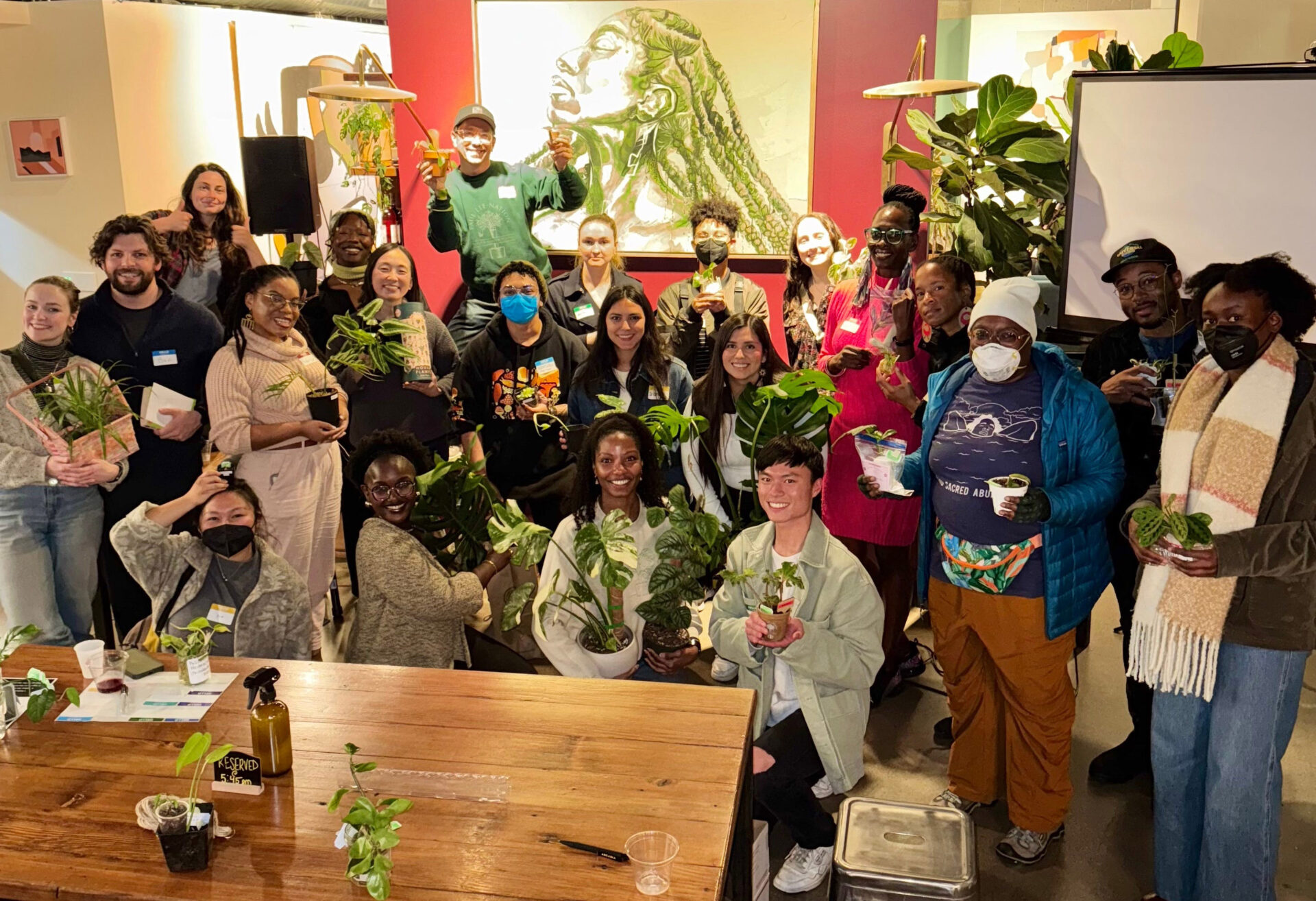
December 2024 plant swap and tissue culture discussion in Oakland. Photo: Jasmine Neal
Neal envisions the lab as a community space, hosting open discussions around controversial topics like genetically modified organisms, and giving advice about sick houseplants. She’s working on determining the scope of the lab’s research and testing a grassroots funding model.
“There’s a lot of evidence of amateurs and self-taught researchers contributing to the hard sciences,” says Neal. “I invite everyone to be a scientist. The world needs your unique, weird, playful ideas.”
MORE
During Women’s History Month, KneeDeep honors the work of women scientists exploring the frontlines of citizen science and local ecology.
Other Recent Posts
How Can I Get Clean, Green, Climate-Forward Job Training in the Bay Area?
Looking for a hands-on job working outdoors that actually pays? Here’s a list of training programs.
Santa Rosa Residents Rethink Trees
The heat-burdened Roseland neighborhood is learning how to monitor temperatures and developing an action plan focused on tree shade.
How to Make Conservation a Career
California nonprofits are developing paid apprenticeships to prepare workers for the growing ecological restoration economy.
Raft of Resilience Initiatives Keeps Tahoe Blue
Beach robots, boat inspections, forest thinning, and wetland restoration are among the projects helping the lake confront environmental threats.
Weathering the Present While Training for the Future
A stewardship immersion experience from the School for Inclement Weather and Weaving Earth combines ecological knowledge and spiritual connection.
Feds Meddling With Protections For California Coast
NOAA is reviewing California’s Coastal Management Program in a renewed push for offshore oil and gas drilling.
New Study Shows Rain Gardens Filter Chemicals Out of Stormwater
Scientists found rain gardens dramatically reduce toxic chemicals in stormwater while providing biodiversity and cooling.