




State Nudges Ocean Coast Planners to Be More Prepared

It has been a watershed year and a half for California sea level rise policy. On the heels of new California sea level rise scenarios and the passage of Senate Bill 272 explicitly requiring shoreline communities to plan responses to sea level rise, in August the California Coastal Commission released a draft guidance for how to use all of this new information in coastal plans and development.
“Ensuring that our communities are resilient to climate change requires proactive planning,” says Kelsey Ducklow, the Commission’s coastal resilience coordinator who presented the draft guidance to commissioners in early August. “That will mean continuing to update our understanding of sea level rise science and adaptation practices.”
The biggest news is that projected sea level rise has decreased — a welcome change after over a decade of estimates spiraling higher with each new sea level rise study. The Coastal Commission’s 2018 update estimated 3.4-10.2 feet of sea level at the San Francisco tide gauge by 2100; now the projection is 1.0-6.5 feet. While the low end is unlikely given how global emissions and temperatures continue rising, advances in understanding ice sheet melt dynamics now pushes 10 feet of sea level rise back until around 2130 — or possibly avoidable altogether under some optimistic emission reduction scenarios.
Of course, even a mere one foot of sea level rise (projected to occur around 2050 or 2060) could double the amount of coastal flooding that occurs today, and the bulk of the new draft guidance is how to plan for that unavoidable future.
Other Recent Posts
Fire Weather in the Wind
As the hot Nevada air cools every fall, it gets pushed west to lower pressure areas over the Central Valley, where the wind heats up and dries out.
My Morning Cleaning Up the Oakland Estuary
On Oakland’s Creek to Bay Day, I joined 100 volunteers for I Heart Oakland-Alameda Estuary to remove shoreline trash.
RCDs Pay Extra Attention to North Bay High Schoolers
A $13,500 grant will help three North Bay conservation districts evaluate youth education programs and prepare high school students for environmental careers.
Creeks Make Good & Bad Homes
San Jose State researcher Costanza Rampini explores why the houseless favor creek banks, and how they weather the flood risk.
Bay Area Braces for Record-Breaking El Niño
Record high water temperatures in the Pacific are expected to bring dangerous sea level rise, waves, and rain to the region this winter.
Regional Housing Agency Invests in Affordability
The Bay Area Housing Finance Authority is launching a loan program to support the construction of mixed-income rental properties.
The End is Coming for California’s Untouchable Grass
The law, which applies to grass that isn’t used for recreational purposes, could cut urban water use across California by more than 20% says Oakland thinktank.
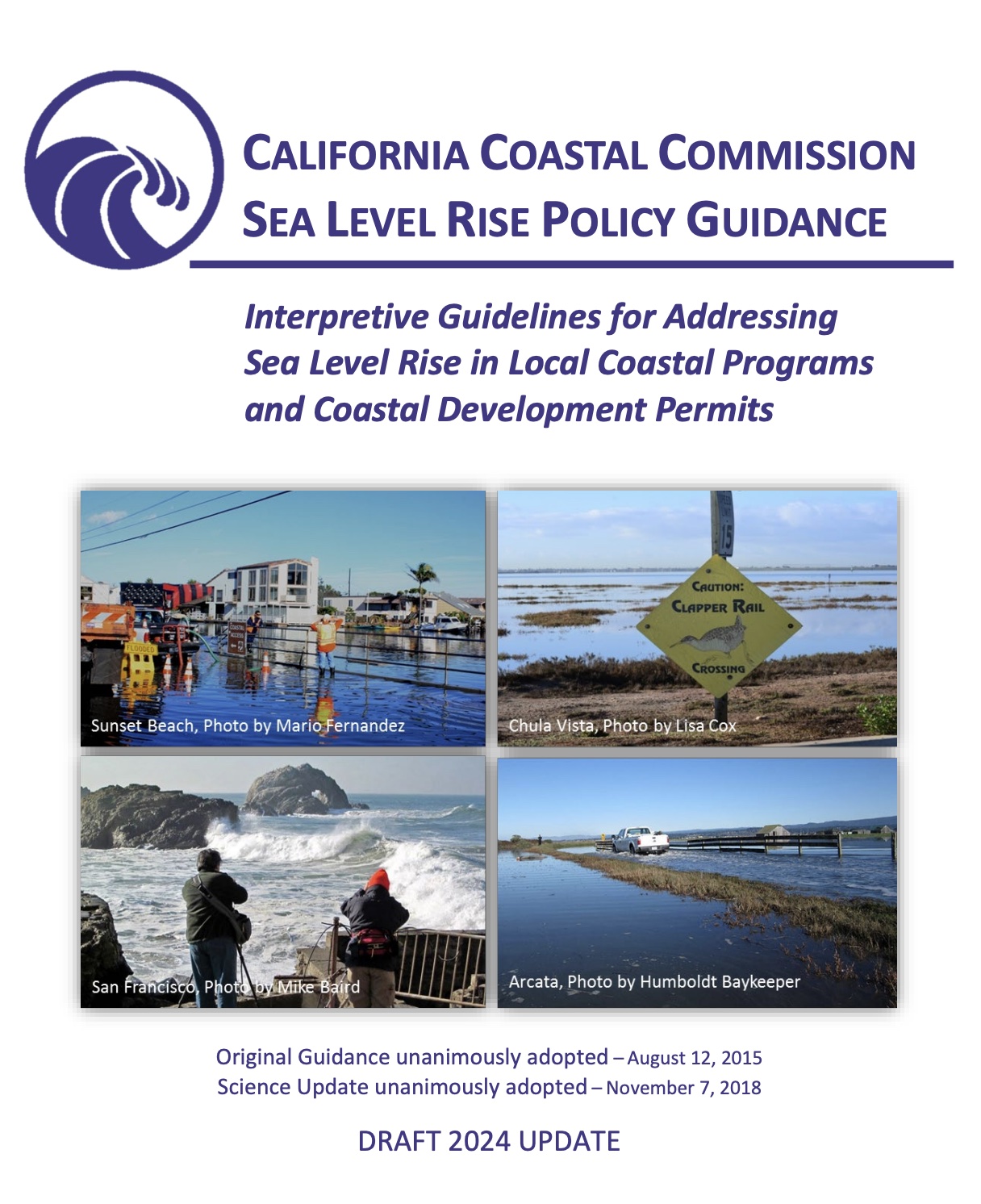
The draft guidance focuses on Local Coastal Programs, or LCPs in agency-ese, which are agreements between each jurisdiction and the Coastal Commission that govern development in the coastal zone. For the past few years LCPs have been a political battleground over sea level rise adaptation: on one side are advocates for a coastal armoring approach via seawalls and revetment that many waterfront home owners prefer, but which is contrary to the Coastal Act and can result in the destruction of public beaches, open space, and public access. On the other side is a managed retreat approach that offers tremendous public benefits for everyone who enjoys the coast. However the latter strategy alarms homeowners so much that local governments are loath to even mention its name. Angry homeowner revolts in Pacifica, Imperial Beach, and Del Mar in recent years led to both hasty retreats from the concept by local officials and broader discussions of “graceful withdrawal.”
As a result of this impasse recent attempts to update Local Coastal Programs have stalled, either remaining years to decades out of date, or in some cases becoming new “hybrid” LCPs — ones containing updated policies governing everything except for those related to coastal hazards and sea level rise adaptation, which remain woefully incomplete while coastal flooding increases. Now per SB 272 that lack of action will no longer be an option by 2034, as coastal communities must include specific adaptation projects in updated LCPs that the Coastal Commission has final approval over.
The Coastal Commission’s draft guidance offers a broad vision of how to accomplish that mandate, including how to best include environmental justice as part of the planning process. There is ample funding available from the Coastal Commission and the Ocean Protection Council to follow the guidance and update LCPs — but only time will tell whether that dangling incentive is enough to overcome the deep divisions between coastal development and protection.
The Coastal Commission is accepting public comment on the guidance until September 23.