

Coastal Mapping Tool Updated to Include Groundwater
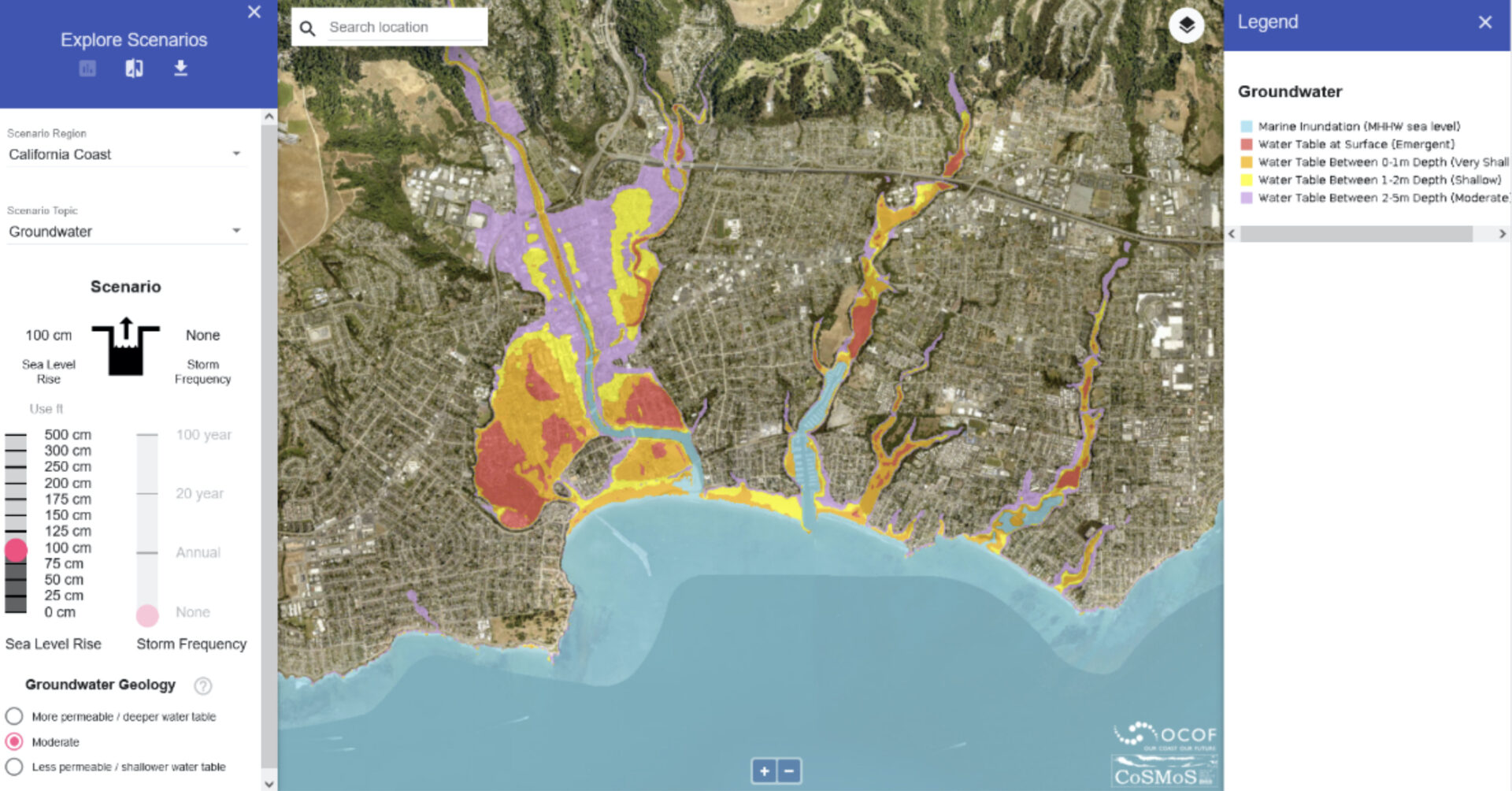
In the past decade sea-level rise models have popped up faster than fungi after a storm: today it seems like every agency has one. However in August USGS geologist Patrick Barnard and colleagues at Point Blue Conservation Science unveiled a new feature of their Our Coast, Our Future (OCOF) tool that none of the others have: a projection of how sea level rise will impact local groundwater along the California coast.
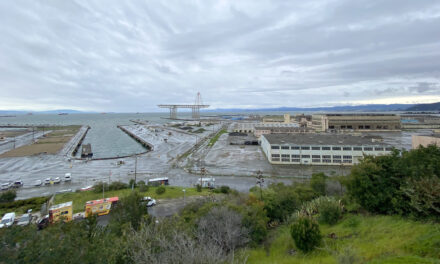
Using groundwater modeling led by Kevin Befus from the University of Arkansas, OCOF users can now look at their local estimated depth to groundwater and use soil permeability assumptions to identify where future sea level rise may push groundwater up and cause inland flooding. Befus demonstrated the feature for the Bay Area in an August 10 webinar, using the tool to show possible locations of emergent flooding from groundwater in the South Bay and Point San Pablo from one meter of sea level rise.
Though the model is long-term and doesn’t account for seasonal groundwater change due to storms or pumping, it is one of the first tools available for the public to plan for groundwater impact from sea-level rise. The City of Manhattan Beach recently used the OCOF feature to assess their risk of groundwater flooding due to sea-level rise – ultimately finding a low projected hazard as the model showed a deep water table under most of the city.
The advancement comes from the team and model that in 2019 released a statewide analysis showing that the combination of higher tides and storms would expose up to 600,000 Californians and $200 billion of coastal development to flooding by 2100 – about three times as many people as modeling just sea level rise alone.
“We are trying to provide products that can support coastal adaptation options so we don’t see these numbers in the future,” said Barnard in the August 10 webinar, stressing that none of the impacts the OCOF tool shows are predetermined – they will only come to pass if we do nothing.
Other Recent Posts
How Can I Get Clean, Green, Climate-Forward Job Training in the Bay Area?
Looking for a hands-on job working outdoors that actually pays? Here’s a list of training programs.
Santa Rosa Residents Rethink Trees
The heat-burdened Roseland neighborhood is learning how to monitor temperatures and developing an action plan focused on tree shade.
How to Make Conservation a Career
California nonprofits are developing paid apprenticeships to prepare workers for the growing ecological restoration economy.
Raft of Resilience Initiatives Keeps Tahoe Blue
Beach robots, boat inspections, forest thinning, and wetland restoration are among the projects helping the lake confront environmental threats.
Weathering the Present While Training for the Future
A stewardship immersion experience from the School for Inclement Weather and Weaving Earth combines ecological knowledge and spiritual connection.
Feds Meddling With Protections For California Coast
NOAA is reviewing California’s Coastal Management Program in a renewed push for offshore oil and gas drilling.
New Study Shows Rain Gardens Filter Chemicals Out of Stormwater
Scientists found rain gardens dramatically reduce toxic chemicals in stormwater while providing biodiversity and cooling.
The Tricky Art of Growing Oysters in the Lab So They Can Survive in the Field
The Nature Conservancy, the Amah Mutsun Tribal Band, and others are growing oysters in the lab and planting them in the wild in estuaries around San Francisco Bay.