



Mapping Those Most At Risk
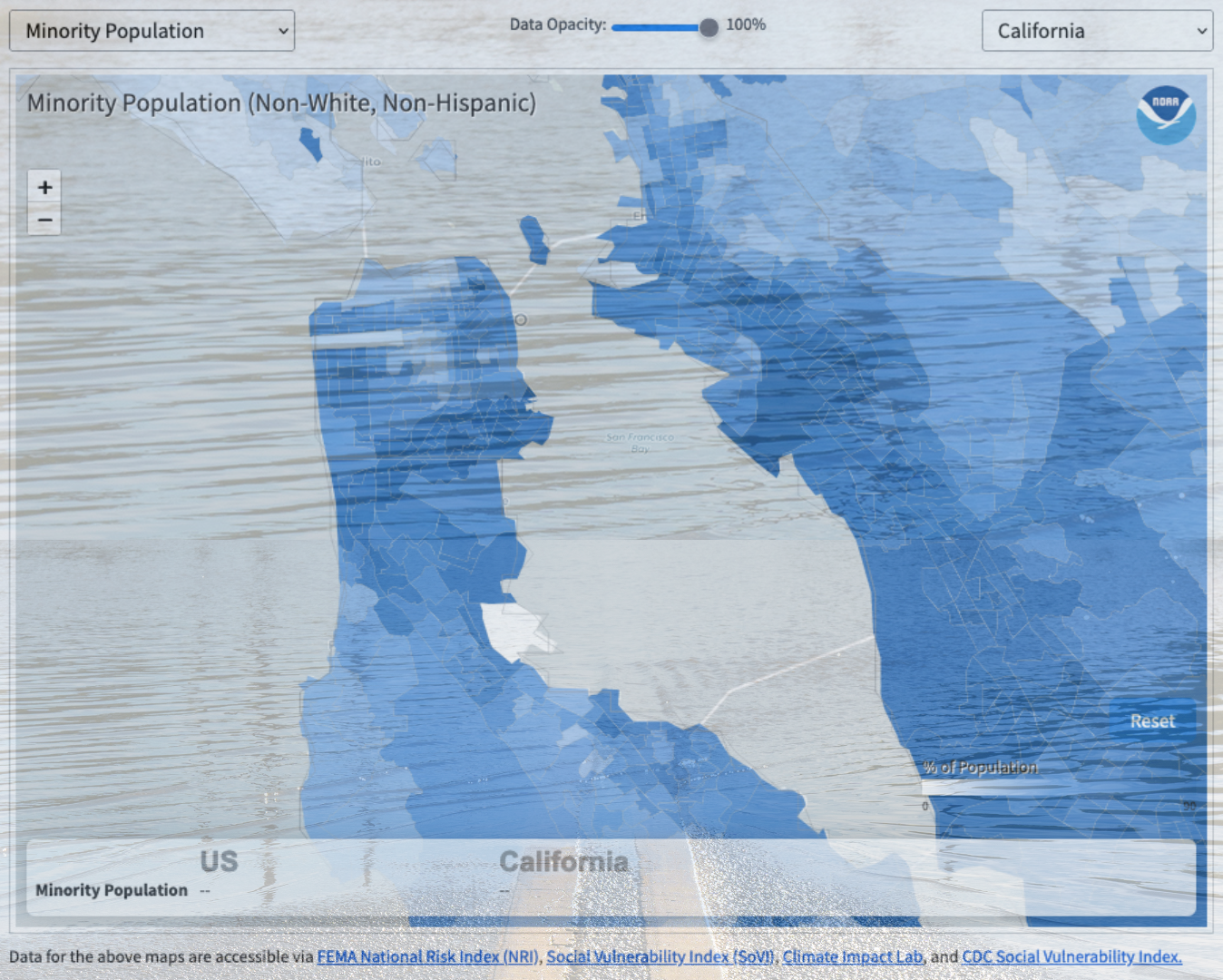
When planning for climate disaster, many federal agencies assess risk on the scale of cities and counties. But in reality, neighborhoods within a city are impacted very differently from one another. A flood that hits Bayview-Hunters Point in San Francisco would pummel a dense, 96% minority community with a poverty rate nearly three times as high as the county average. That same flood in the Marina District would encounter a spread-out, predominantly white, and highly educated population with an average salary nearly ten times greater than Bayview-Hunters Point’s — making the area far more able to withstand the flood and bounce back.
With the National Oceanic and Atmospheric Administration’s recent update to their long-running Billion Dollar Disaster Map, urban planners and citizens can see for themselves how disaster risk and vulnerability vary at the much finer “census tract” scale, representing about 4,000 people in a geographic area. Using the tool to look at “hazard risk” and “social vulnerability,” one can see how frontline communities like San Jose’s Alviso, Marin City, the San Rafael Canal District, East Oakland, and others stand out in stark contrast to the wealthier, whiter neighborhoods around them. The tool shows which census tracts have a significant number of people with characteristics that contribute to social vulnerability — for instance, those without vehicles, senior citizens, or the mobility-challenged. Or race, income, and educational level, which correlate with lower access to essential government programs and services that are essential to helping people and communities rebuild after a disaster.
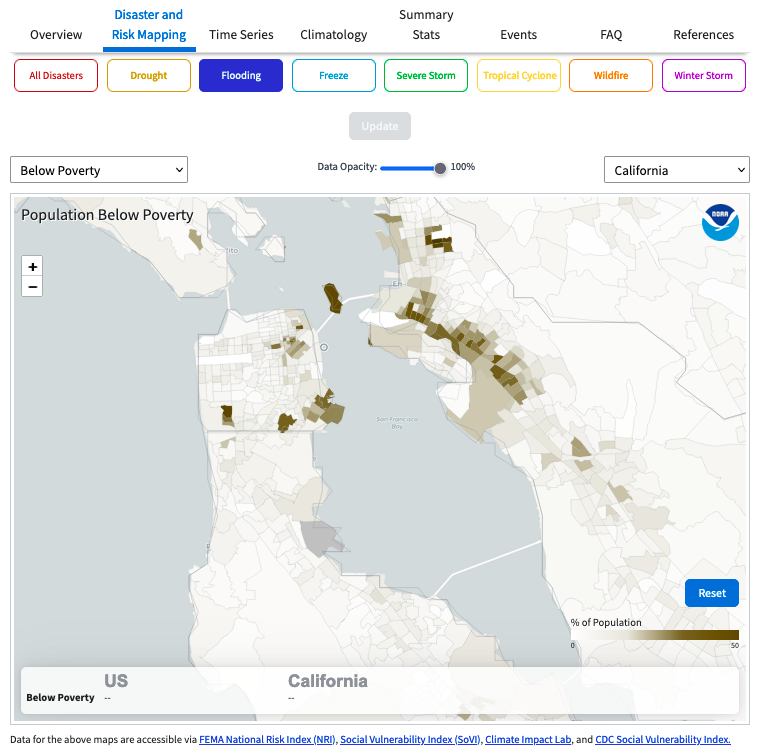
As risk maps go — and there are an overwhelming number out there — NOAA’s is still a little clunky. The census tract view is hidden in a drop-down menu above and to the right of the map, and to look at historic flood hazard risk one has to manually de-select all six other hazard types. The Bay Conservation and Development Commission’s regional Community Vulnerability map is even more granular, analyzing vulnerability at the small “census block” scale (geographic areas of 3,000 people or less), and it also indicates contamination exposure. But hopefully NOAA’s update represents progress toward seeing pre-existing risk and vulnerability disparities within a city or county, and taking ameliorative steps before the next disaster exposes and widens them.
Other Recent Posts
Affordability Top of Mind For 6 Oaklanders This Election Season
KneeDeep’s Alex McCutcheon spent a recent afternoon asking passers by along Lake Merritt for their thoughts on affordability and climate change.
A Wasted Opportunity
Too many of this year’s crop of Democratic candidates are squandering the opportunity to connect the affordability crisis to the climate crisis.
Climate Issues On Your Ballot This Fall
Voters have a chance to approve more than $13 billion in resilient and transportation infrastructure funding for the Bay Area and the state this midterm election.
The Sleepy Midterm Race with the Biggest Influence on Climate Policy
Typically an undercovered downballot race in the past, the election of California’s next insurance commissioner could reshape the state’s fire and flood coverage.
Fire Weather in the Wind
As the hot Nevada air cools every fall, it gets pushed west to lower pressure areas over the Central Valley, where the wind heats up and dries out.
My Morning Cleaning Up the Oakland Estuary
On Oakland’s Creek to Bay Day, I joined 100 volunteers for I Heart Oakland-Alameda Estuary to remove shoreline trash.
RCDs Pay Extra Attention to North Bay High Schoolers
A $13,500 grant will help three North Bay conservation districts evaluate youth education programs and prepare high school students for environmental careers.
Creeks Make Good & Bad Homes
San Jose State researcher Costanza Rampini explores why the houseless favor creek banks, and how they weather the flood risk.
Bay Area Braces for Record-Breaking El Niño
Record high water temperatures in the Pacific are expected to bring dangerous sea level rise, waves, and rain to the region this winter.
Regional Housing Agency Invests in Affordability
The Bay Area Housing Finance Authority is launching a loan program to support the construction of mixed-income rental properties.