



Building Sustainably with Mass Timber
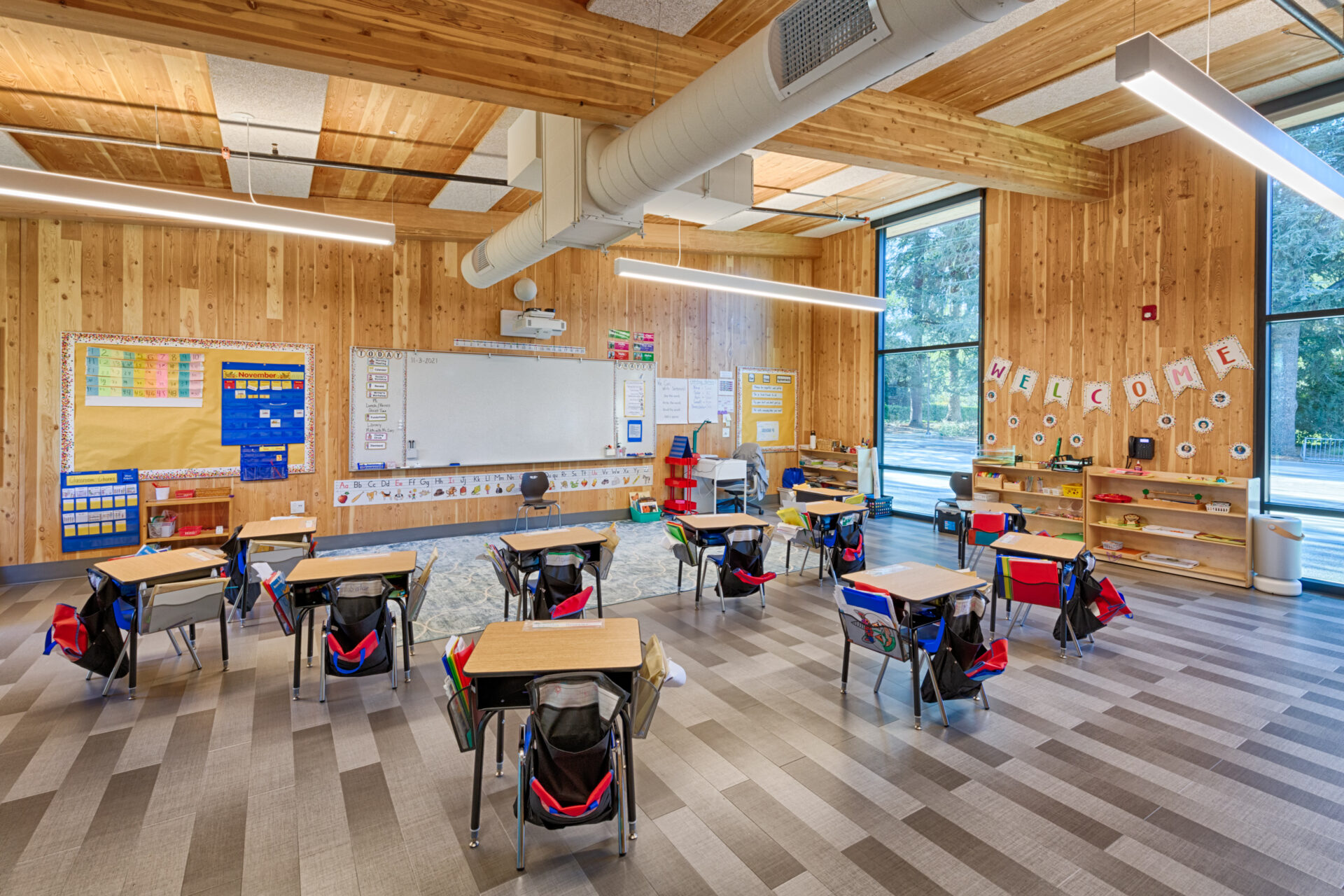
A classroom in a new building made out of mass timber at Sacred Heart School in Atherton. Photo: Marco Zecchin
A new movement in sustainable design is starting to take shape in the Bay Area, and advocates think it can reduce both carbon emissions and wildfire risk at the same time.
With a number of new schools and companies employing it — including a recently built Google office building — mass timber has architects and experts on wood construction excited about the future. They believe they can usher in a new generation of buildings made out of smaller diameter trees that, when left in the forest indefinitely, burn more easily and act as kindling for large wildfires. Their proposal: save those trees before they burn and keep them from contributing to greenhouse gas emissions by using them in construction.
California wildfires release a lot of carbon dioxide into the atmosphere — about 22 million metric tons of it per year on average from 2000 through 2021, equal to the carbon contained in 15% of all single-family homes in the state, according to the California Air Resources Board.
A particularly bad fire year can even rival vehicle emissions. CARB estimates that 2020 alone saw 112 million metric tons of CO2 emissions from wildfires, compared with about 140 million metric tons emitted by the transportation sector.
But what if we could have saved some of that lumber before it went up in flames?
“We have too much wood in California that we should be using, and right now, instead of using it, we just let it burn. All this wood burning creates an insane amount of carbon emissions. It’s one of the major contributors to climate change and the carbon footprint of the state of California,” says Paul Mayencourt, a design professor and mass timber researcher with the UC Berkeley Wood Lab.
On top of that, he adds, “if you’re designing a new building, you have a couple options for the material — concrete, steel, mass timber, or more traditional timber, and each material per pound has a certain amount of carbon footprint, and timber has a much lower carbon footprint.”
Other Recent Posts
Journalism Fellowship Opportunities
Our magazine offers a variety of modest fellowships for journalists in training or community storytellers.
Plants Facilitate Transition to Higher Water
Save The Bay is restoring habitat transition zones with native plants to accommodate rising sea levels and support wildlife.
Hundreds Protest Proposed Cuts to San Francisco Environment Department
Mayor Daniel Lurie’s office has introduced sweeping budget cuts for the next fiscal year, including reduced support for climate action.
El Cerrito Bets on Car-Free Living
An East Bay city is building more than 700 housing units on BART parking lots.
The Nuances of Tapping North Bay Sediment Supplies
How Adobe Creek and the Petaluma River can help three parcels, including a popular park, evolve into one resilient shore.
Meet the Oakland Biologist Making Native Plants Go Viral
Saumitra Kelkar shares videos about local biodiversity and native plants through his account, Oakland.bio.
Mountain View’s Shoreline Gets Serious SLR Attention
After four breaches, imports of clean fill, and the addition of rocks, bird islands and bridges the South Bay’s Shoreline Park has more climate resilient environs.
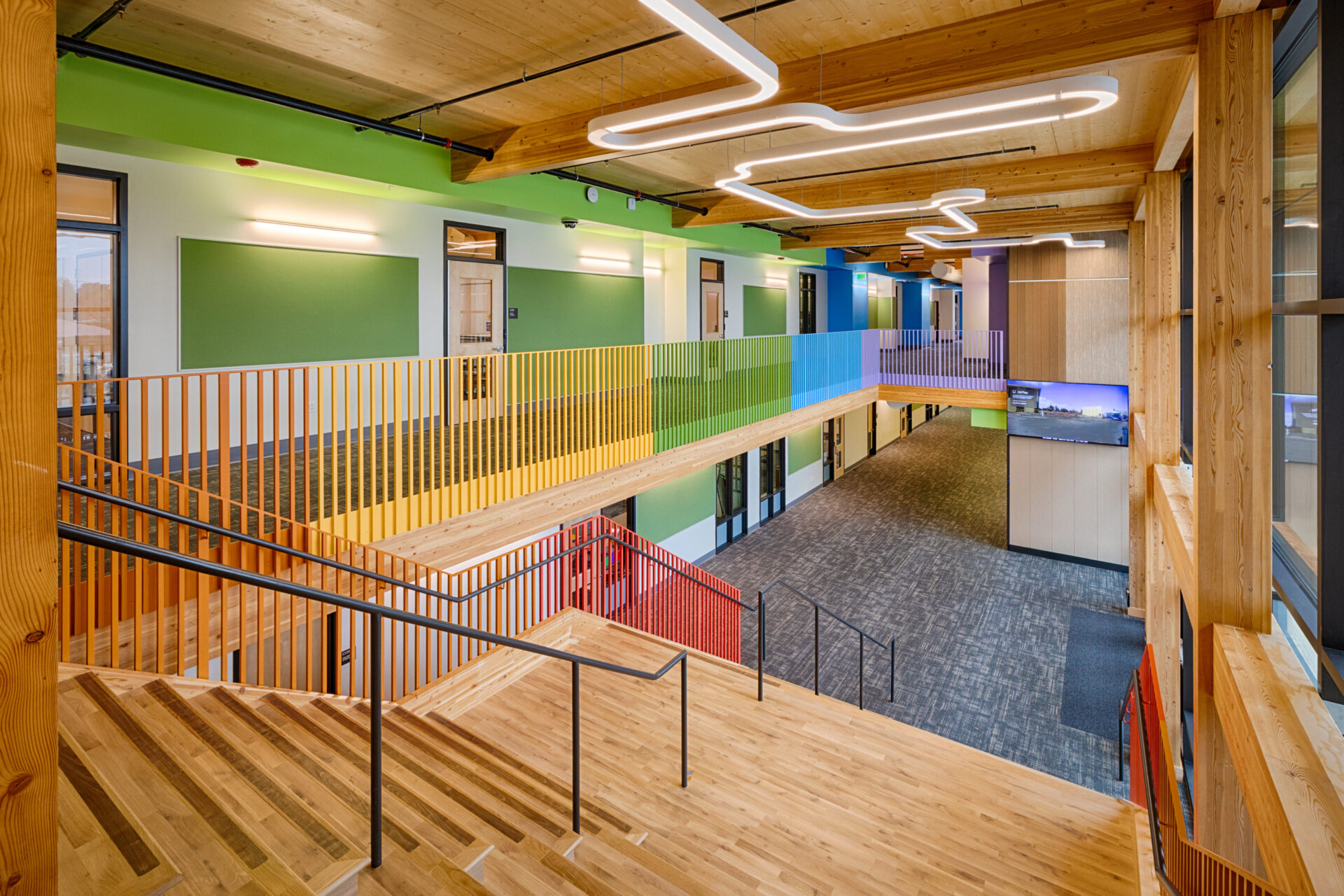
The recently rebuilt Hoover Elementary School in Palo Alto. Photo: Marco Zecchin
Traditionally in the United States, wood buildings have been made out of heavy timber, which might look like columns and beams carved from one single tree, or rows of logs lined up next to each other. Mass timber buildings, on the other hand, are made out of layers of wood from smaller trees that are most often nailed or glued together.
According to Chelsea Drenick, a structural engineer for the mass timber company WoodWorks — a nonprofit that provides education and free technical support related to wood construction — these layers make for particularly large and strong beams ideal for multistory buildings. And their size also often contributes to a high fire rating for mass timber buildings because “large cross sections of wood burn very slowly,” Drenick says.
One barrier to the widespread adoption of mass timber construction, both Mayencourt and Drenick note, is cost. Wood is lighter than concrete, which can help save costs on foundations and building seismic systems. Although the cost of mass timber material (with the addition of extra things like glue) is higher than the cost of concrete, prefabrication of mass timber components that can easily be assembled onsite can contribute to overall project savings, says Drenick.
That’s why Mayencourt is researching a lower-cost option that’s even better for the environment. While the most mainstream forms of mass timber rely on glue or nails, dowel-laminated timber connects layers through wooden cylinders instead. After being pressed through planks of timber, these rods absorb their moisture and expand, thus stabilizing pieces of the beam together. The result is an all-wood product that’s cheaper, more quickly assembled, and more easily recyclable, Mayencourt points out.
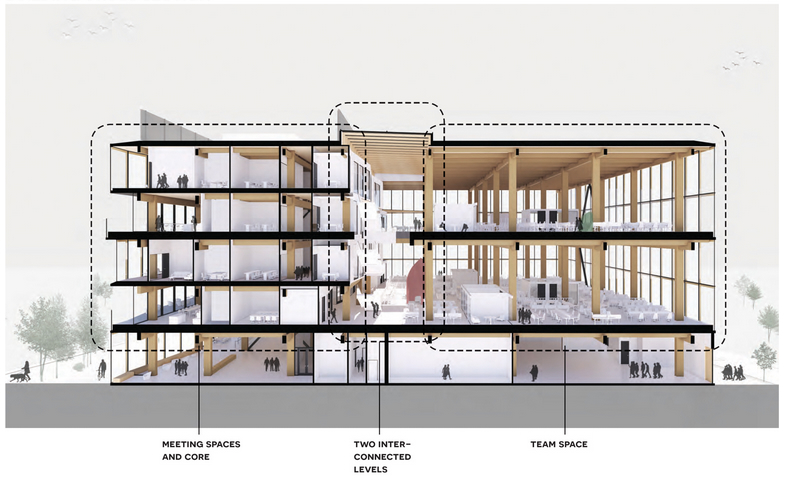
Cross-section of Google mass timber building. Art: Michael Green Architecture
The other challenge is simply convincing contractors and developers to get on board.
“We did a business case study to assess some built projects, and everyone loves these buildings. People love to occupy them. They’re beautiful. It’s a relaxing place to be. People want to stay in them, and owners love them,” Drenick says. “It’s really getting that initial buy-in on, ‘Let’s do something new and see how it goes.’ … We’re still getting over that learning curve of this is something new, and I think it’s still going to be a while before it’s adopted widespread.”
Mayencourt has one final message, too, on the importance of building with local timber.
“A lot of projects now in California are done with imports of mass timber products from outside the state or country, and I think it would be great for new products to focus on using local wood specifically. Mass timber is really nice and really cool for local buildings, but if you don’t use local trees in California, we’re missing a really, really large opportunity to support the health of our forests,” he says. “It’s not the easiest path, but it’s the path that makes the most sense for so many reasons … beautiful buildings made out of local wood that would support forest restoration and reduce the risk of wildfires.”
Editor’s note: Mass Timber is one of the engineering plants, animals, and materials being featured in KneeDeep’s mini-series on the building blocks of climate adaptation. You can also read our features on beavers, sea blite, baycrete, and pervious concrete, or send us ideas for other materials to cover.