




Hundreds Protest Proposed Cuts to San Francisco Environment Department
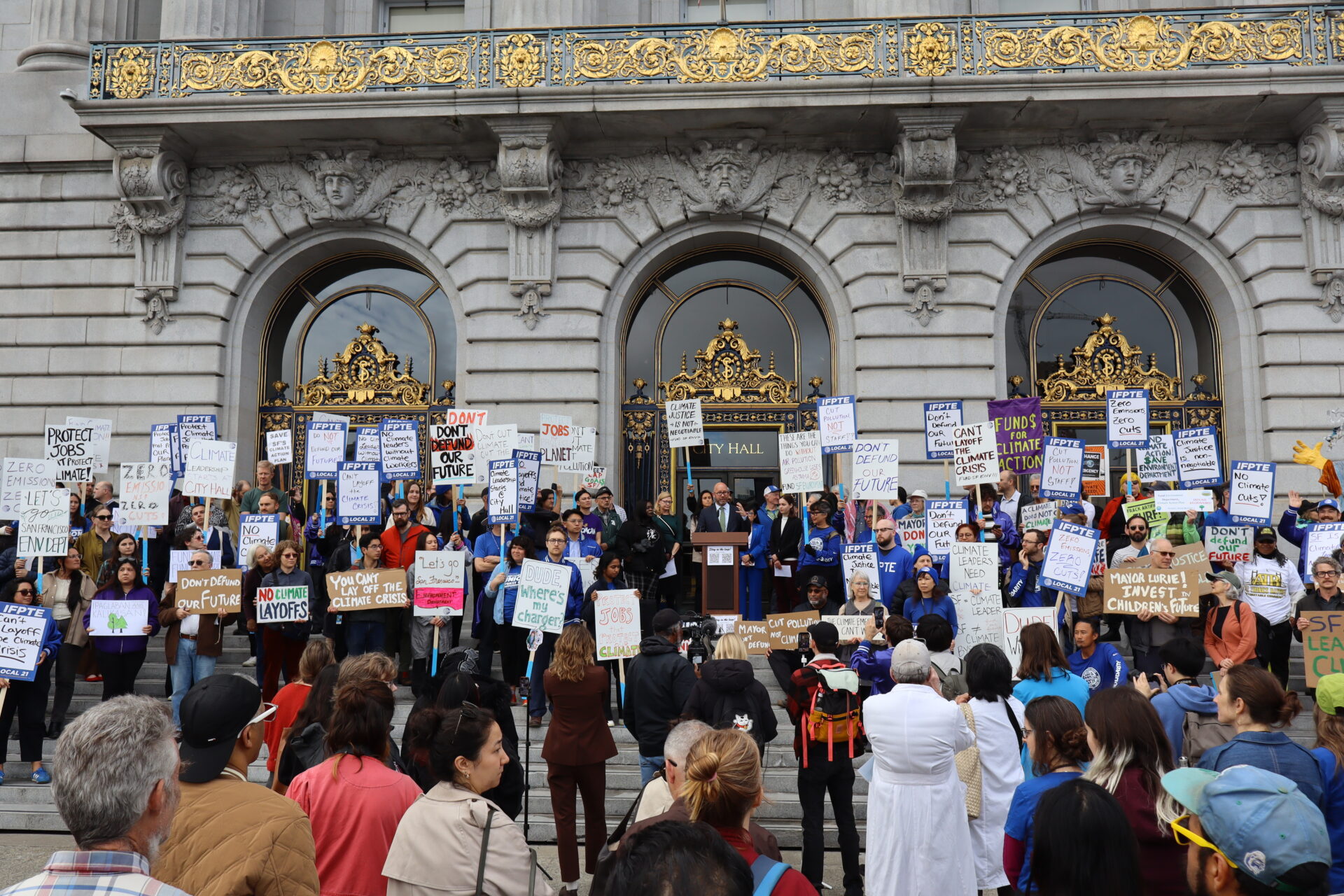
Elected officials, labor organizers, and activists gather for a climate action rally on Feb. 25, 2026 at San Francisco City Hall. Photo: Duncan Agnew
Dozens of climate action organizations and hundreds of activists gathered at noon on Wednesday, February 25 on the front steps of San Francisco City Hall to rally against layoffs and program cuts to the city’s Environment Department proposed by Mayor Daniel Lurie’s office.
San Francisco is facing a $400 million budget shortfall for fiscal year 2026-2027 and a combined deficit of nearly $900 million over the next two years. That situation has forced the mayor’s budget team to introduce sweeping reductions across city departments, with Lurie only pledging to leave “core” services like public safety and transportation untouched.
The result could be devastating to the city’s ability to reach its climate goals, including its main target of net zero emissions by 2040, advocates and Environment Department staff warn. Lurie has proposed laying off about eight employees (7.8 to be exact, because of part-time and hourly workers) from SFE and cutting direct General Fund support for the department from more than $3 million to less than $600,000.
“I don’t see how we begin to contemplate implementing the Climate Action Plan without the capacity of the Department of the Environment to do that work — real human beings to keep track of the goals and measure what the different departments are doing to advance and achieve those goals,” Board of Supervisors President Rafael Mandelman said at a Budget and Appropriations Committee meeting about this issue that followed the protest. “Without those people, without those resources, these ambitious goals are just numbers that won’t mean anything in the real world. And I think that would be a shame.”
Mandelman also addressed the crowd gathered outside City Hall earlier that same afternoon, where he went through San Francisco’s history of environmental activism: founding one of the nation’s first municipal Environment Departments in 1996, adopting a Climate Action Plan in 2004 that was most recently updated in 2021, becoming the first city in the country to mandate composting and recycling in 2009, banning natural gas hookups in new construction in 2020, tripling electric vehicle charging access since 2016, and creating a battery recycling program in 2025.
Other Recent Posts
Plants Facilitate Transition to Higher Water
Save The Bay is restoring habitat transition zones with native plants to accommodate rising sea levels and support wildlife.
El Cerrito Bets on Car-Free Living
An East Bay city is building more than 700 housing units on BART parking lots.
The Nuances of Tapping North Bay Sediment Supplies
How Adobe Creek and the Petaluma River can help three parcels, including a popular park, evolve into one resilient shore.
Meet the Oakland Biologist Making Native Plants Go Viral
Saumitra Kelkar shares videos about local biodiversity and native plants through his account, Oakland.bio.
Mountain View’s Shoreline Gets Serious SLR Attention
After four breaches, imports of clean fill, and the addition of rocks, bird islands and bridges the South Bay’s Shoreline Park has more climate resilient environs.
Adaptation Atlas
Thirty places to focus on nature-based adaptation around the Bay’s 400-mile shoreline.
Agroecology Commons Weathers a Weird Winter and Political Storms
A year after our first Agroecology Commons visit, the El Sobrante farm has a new greenhouse foundation, thriving farmer training program, and some unexpected wildlife.
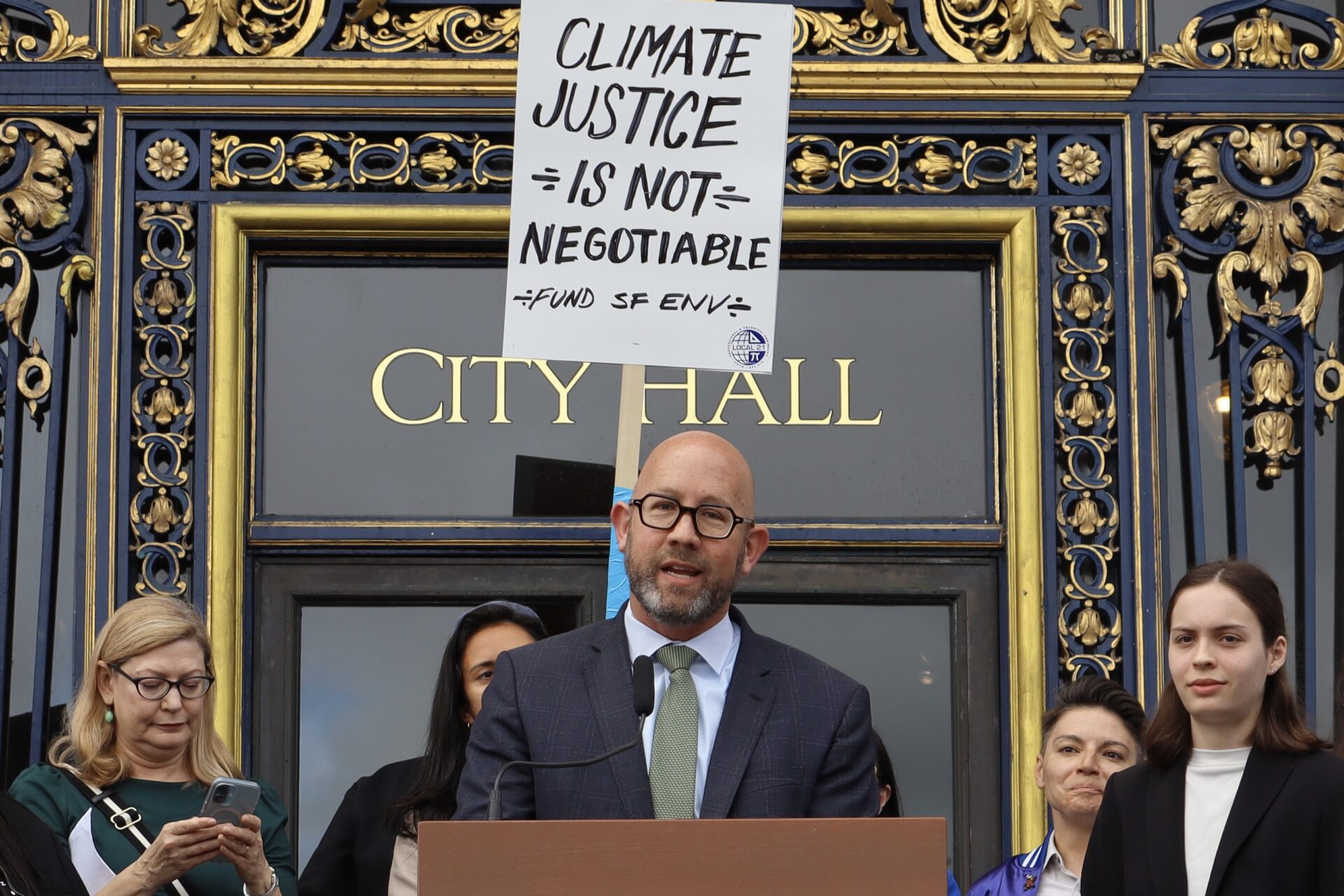
San Francisco Board of Supervisors President Rafael Mandelman addresses the crowd. Photo: Duncan Agnew
More than 50 climate action community groups delivered a letter to the mayor’s office after the rally demanding the restoration of $3.4 million to SFE’s 2026-2027 budget, which would prevent layoffs and preserve climate justice and clean energy programs on the chopping block. Earlier in February, San Francisco’s Commission on the Environment also unanimously approved a resolution urging Lurie to maintain SFE’s funding.
Joni Eisen, co-founder of the San Francisco Climate Emergency Coalition, kicked off the rally by quoting Lurie’s campaign promise to “prioritize climate action not just in words but in dollars and policy.”
“We encourage the mayor, with whom the buck stops, to make good on his campaign promises and show the leadership and vision SF needs to regain its position as a climate leader,” Eisen said.
Inside City Hall a couple hours later, SFE Director Tyrone Jue presented a series of facts and figures about the department’s funding to the Budget and Appropriations Committee. Among other things, Jue highlighted the fact that SFE has won $84 million in grants to support things like building and transportation electrification since November 2022, amounting to $29 earned for every $1 of the city’s General Fund invested.
One of the major challenges that SFE faces, however, is that 93% of its budget is restricted to specific purposes and can’t be moved around based on changes to the city’s climate needs. Only dollars from the General Fund, which represent a tiny portion of the department’s budget, are flexible.
“We can’t reallocate dollars to cover core staff when flexible funding declines,” Jue said.
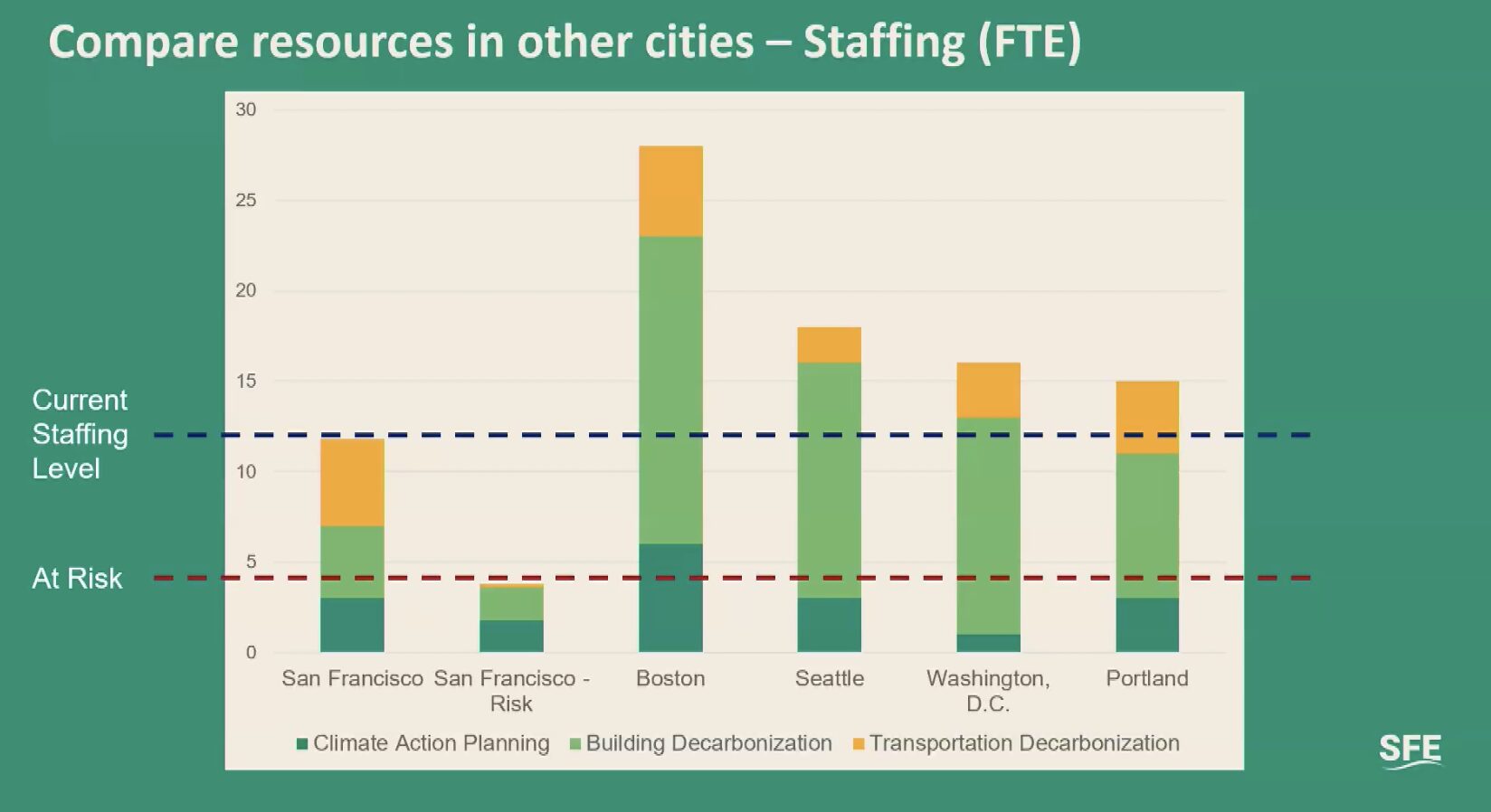
Environment department staff for various cities, including San Francisco’s current staff and potential future staff if proposed layoffs go through. Graph: SFE
And perhaps most significantly, he presented a graph showing the environmental staffing of some of San Francisco’s peer cities (Boston, Seattle, Portland, and Washington, D.C.) with similar populations and budgets. All four employ more people, and while San Francisco has a similar number of staff working on climate action planning and clean transportation, it lags way behind on its investment in people working on building decarbonization.
Climate Equity Hub
One of the biggest and most influential programs at risk of elimination from budget cuts is the Climate Equity Hub, which installs new all-electric appliances (primarily water heaters) in low-income households for free.
This hub targets neighborhoods that have borne the brunt of industrial pollution for generations, and it ensures that low-income communities “don’t have to poison themselves because they can’t afford to decarbonize,” as one speaker put it during the public comment portion of the committee meeting.
Dr. Bret Andrews of San Francisco Bay Physicians for Social Responsibility also noted during the rally that, despite receiving accolades for its electrification work, the region still has the sixth-worst air quality in the nation. Several activists from the historically Black Bayview-Hunters Point neighborhood noted the particular importance of programs like the Climate Equity Hub to their community because of its long-term exposure to fossil fuel-fired power plants and radioactive waste leftover from the Naval Radiological Defense Laboratory.
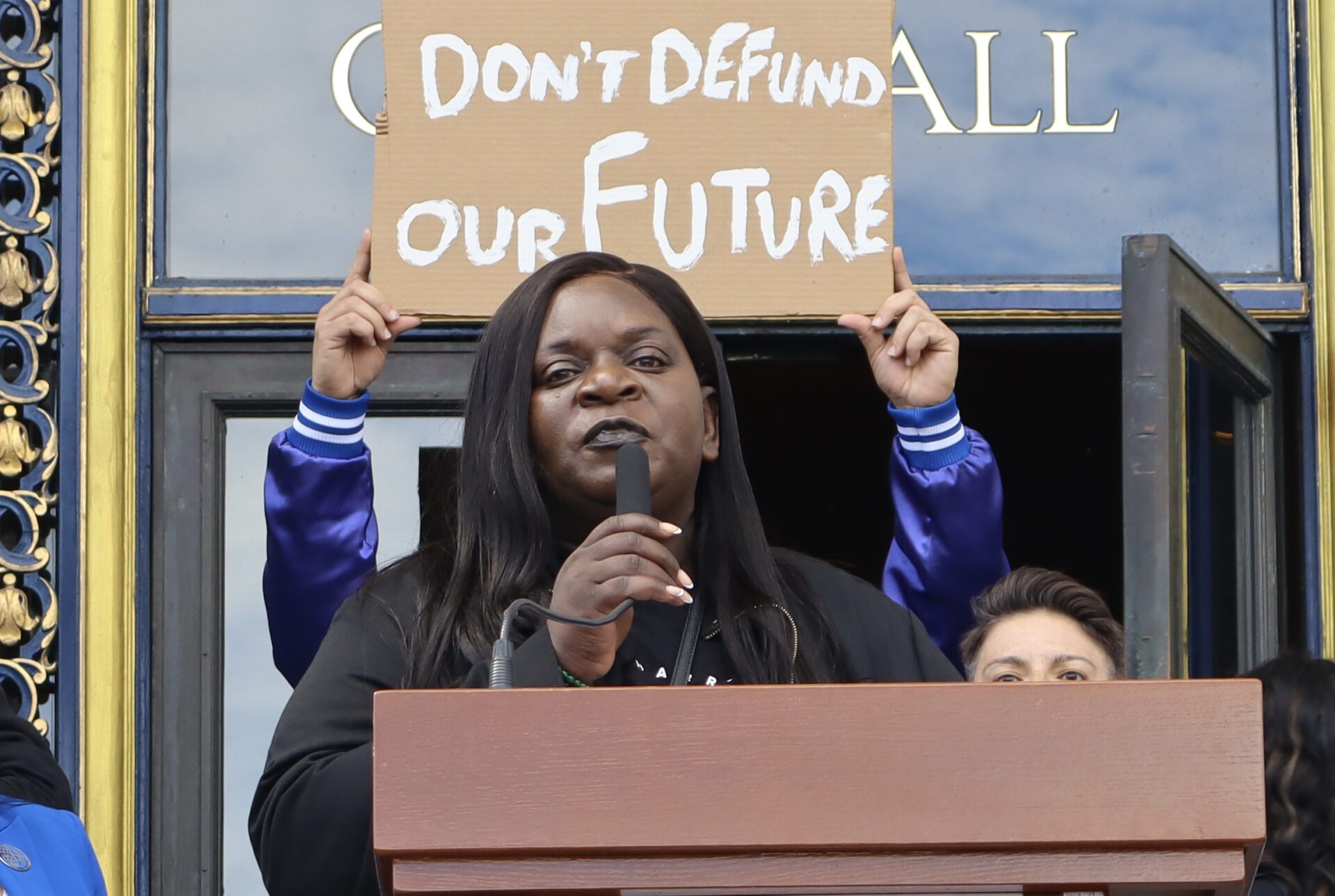
Arieann Harrison speaks to the crowd. Photo: Duncan Agnew
“I have heard licensed professionals say that we [Bayview residents] automatically have 15 years taken off our life living in an ‘environmental sacrifice zone.’ We have the highest rates of cancer and asthma, according to CalEnviroScreen,” said Arieann Harrison, executive director of the Marie Harrison Community Foundation. “Humans are losing their lives and have been abandoned and forgotten about for a very long time in the southeast sector of San Francisco. It’s not just a District 10 issue. It’s a San Francisco issue. … Clean air, water, and land, we should not have to beg for. It is a human right.”