



The Gray-Green Alchemy of Baycrete
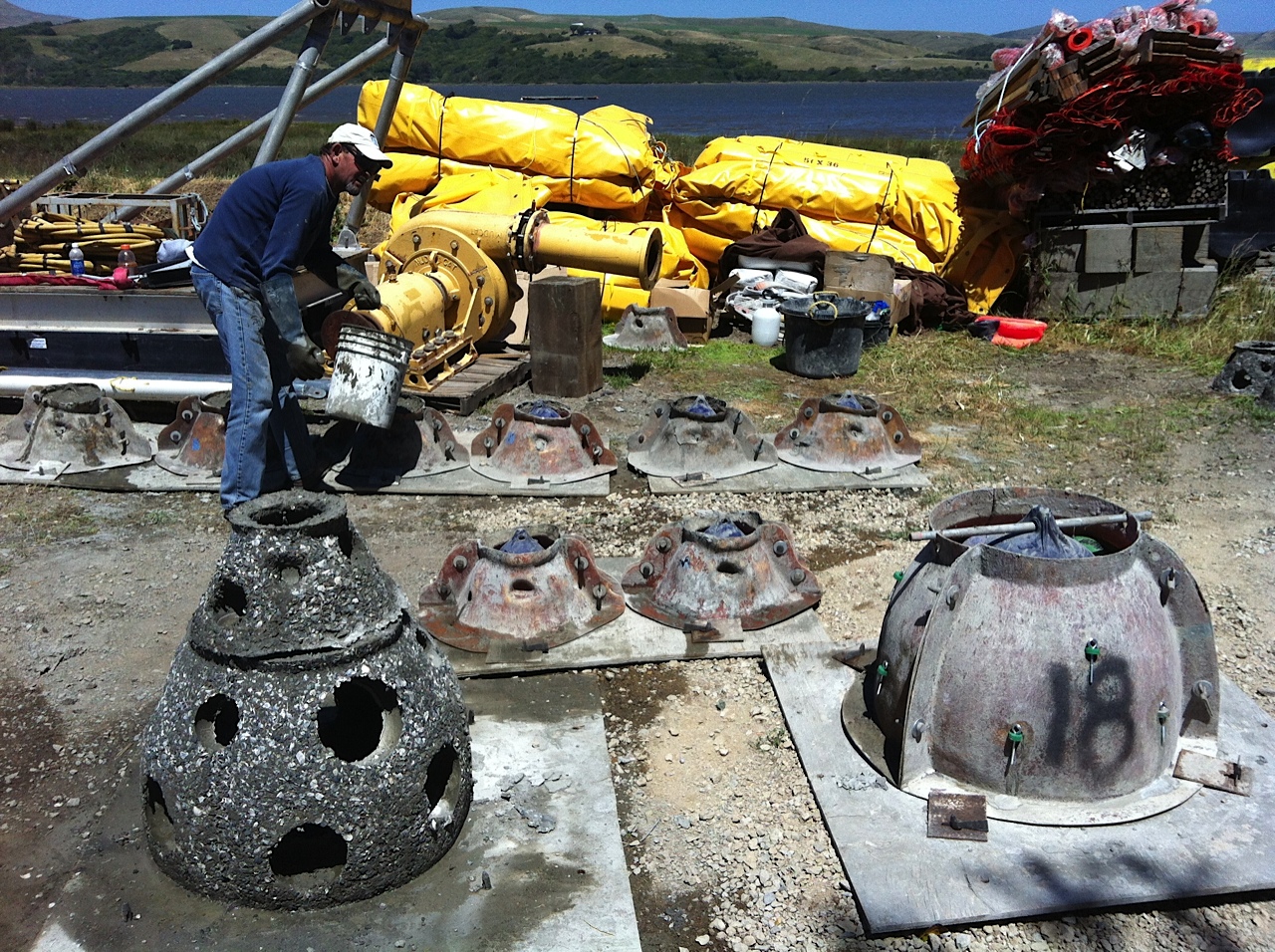
Building reef balls is an art. Photo: Marilyn Latta
In a hot Antioch yard in the summer of 2018, members of the North Bay Conservation Corps mixed a very strange cocktail. Here’s the recipe: marine-grade concrete is shaken with crushed oyster shells. Stir in native sand dredged from the Bay, gravel, and a whisper of admixture to hold it all together. This brew is “baycrete”: a material designed to create the base structure for man-made nearshore reefs and living shoreline projects, it can anchor habitat, slow waves, and invite life back into places hardened by fill and bulkheads. It’s roughly half concrete, half everything else.
“It really is a field fitting each time,” says Marilyn Latta of the California State Coastal Conservancy, who has shepherded this hybrid material from idea to reality. “The folks running the concrete pour and the mixer, where they’re adjusting that mix, are not exactly recording those details.” But guided by a good bartender’s instinct, it always turns out basically right.
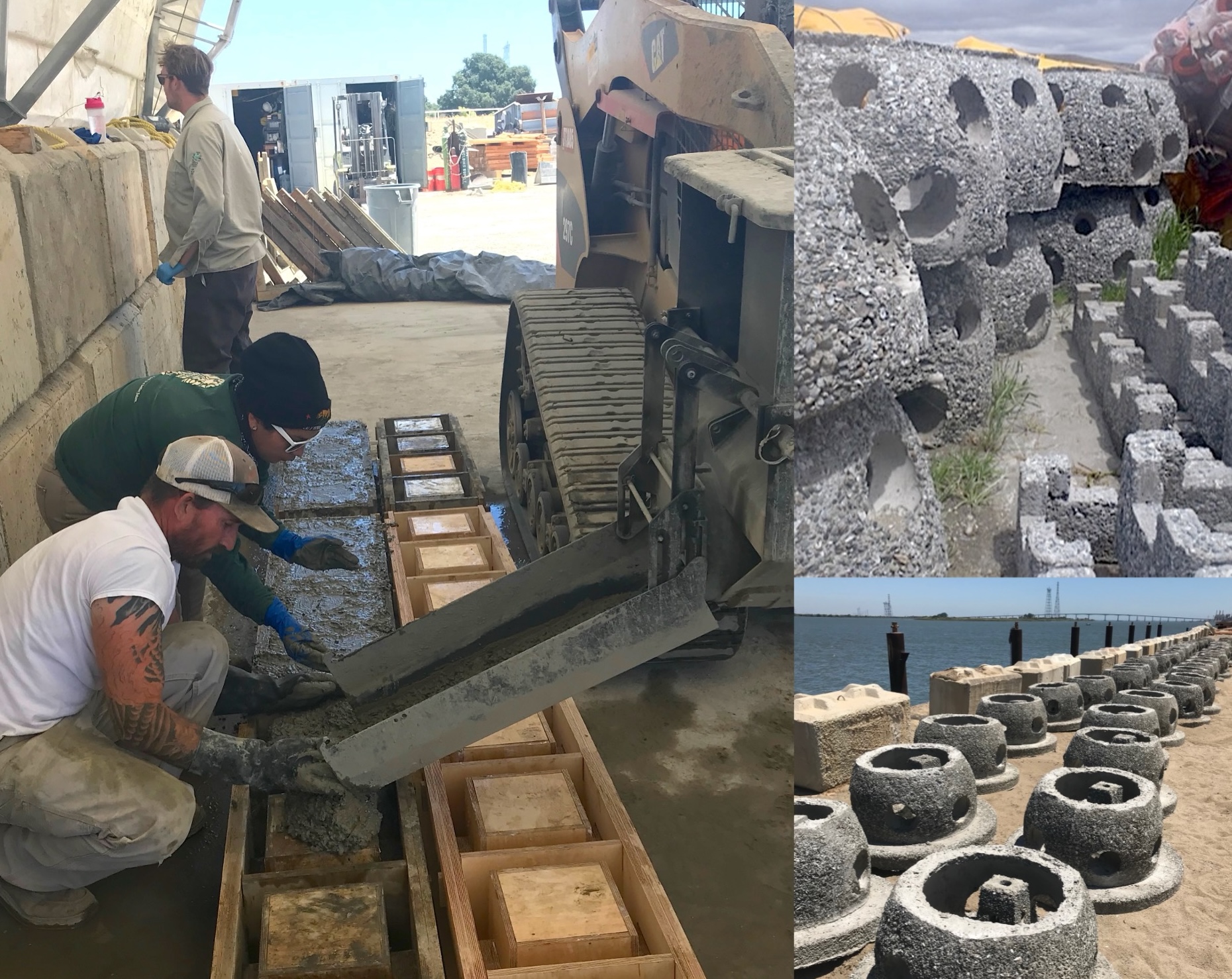
California Climate Corps helps brew baycrete oyster reef balls. Photos: Marilyn Latta
Other Recent Posts
Regional Housing Agency Invests in Affordability
The Bay Area Housing Finance Authority is launching a loan program to support the construction of mixed-income rental properties.
The End is Coming for California’s Untouchable Grass
The law, which applies to grass that isn’t used for recreational purposes, could cut urban water use across California by more than 20% says Oakland thinktank.
Sonoma Vineyard Workers Burn toward a Better Future
A group of immigrant farmworkers are forming a worker-owned cooperative to bring back Indigenous burning practices that used to revitalize the soil.
Los trabajadores de los viñedos de Sonoma queman por un futuro mejor
Un grupo de trabajadores agrícolas inmigrantes está formando una cooperativa de propiedad de los trabajadores para recuperar las prácticas indígenas de quema que solían revitalizar el suelo año tras año.
New Voices Shape Design of Berkeley’s North Basin Strip
Twenty acres of parkland between the highway and the Berkeley shore are slated for a coast-resilient makeover, with input from locals and stakeholders.
It’s Always Sunny In North Fair Oaks
Residents of the unincorporated community launched their second campaign in two years to get the county to care for dying street trees.
Siempre está soleado en North Fair Oaks
Los residentes de la comunidad no incorporada lanzaron su segunda campaña en dos años para lograr que el condado se ocupe de los árboles de la calle que se están muriendo.
The recipe itself came together around 2010, from a group of scientists, engineers, and restoration practitioners searching for alternatives to pure concrete for a reef ball project at San Rafael. “There’s so much anthropogenic fill in the bay,” says Latta. “We were very interested to see if we could at least have a hybrid approach [using both] green and gray materials for the reef structure.”
After being mixed and poured, each baycrete structure cures slowly in the sun, developing its own reef ball terroir. “It’s going to be influenced by the exact materials you got, the texture of the sand that happened to come,” says Latta. “The temperature varies slightly where you’re mixing” — the baycrete brewed in hot, dry Antioch cured much faster than in Inverness. Once cured, the baycrete reef balls and oyster blocks are hoisted into the Bay at sites like Giant Marsh, where they provide habitat, slow waves, trap sediment, and stabilize vulnerable marsh edges.
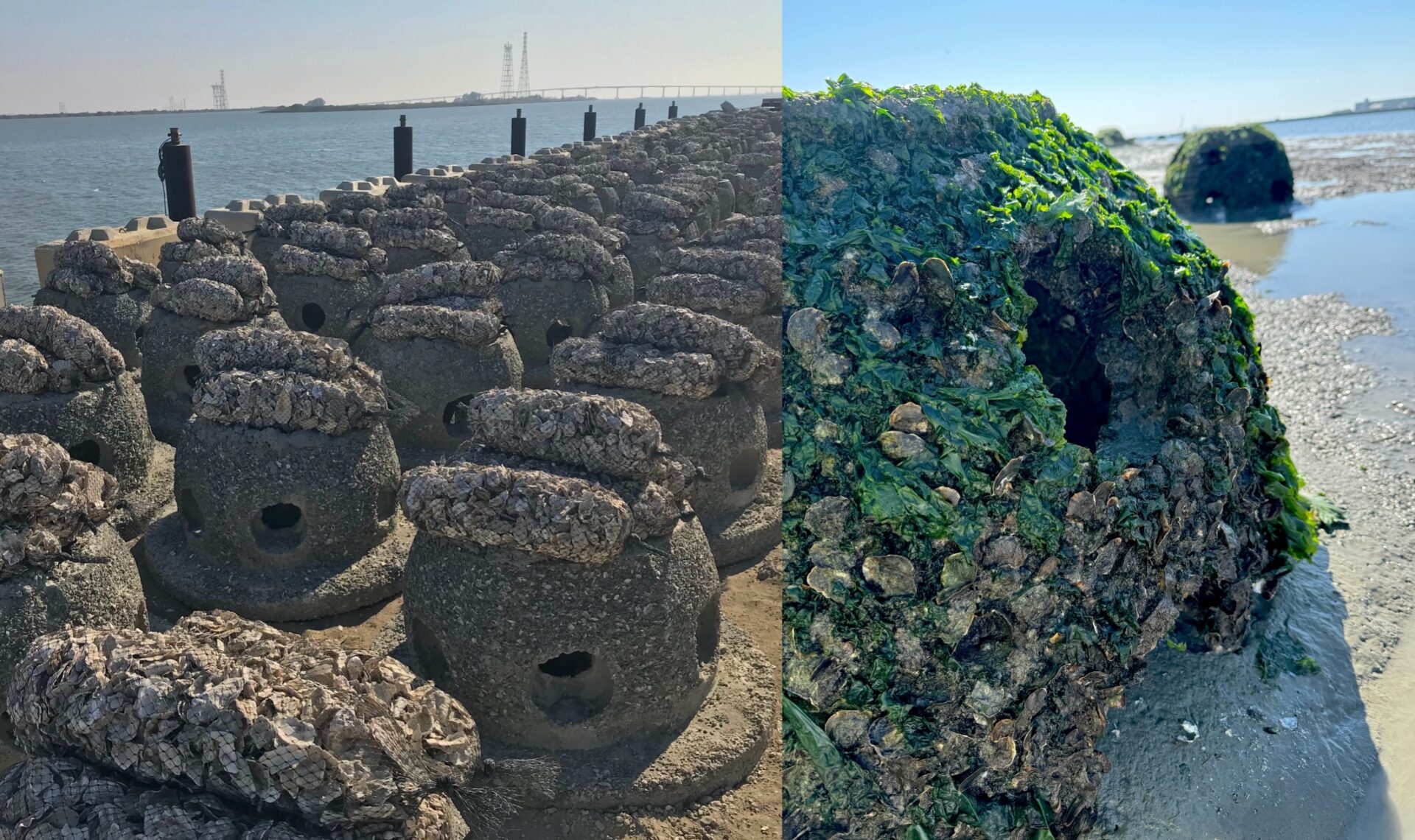
Reef balls with oyster packs on top; colonized reef ball at Heron’s Head park. Photos: Marilyn Latta and Chela Zabin
Baycrete is truly gray and green — concrete softened, seeded, and roughened. Olympia oyster shells, once burned in kilns to make the original concrete and mortar of early San Francisco, return, this time as natural fill, texture, and lure. The native oysters like to settle atop other oysters, so the shell in the mix likely makes the structures more attractive landing spots for larvae. The shell also contributes to the material’s rugosity: the measure of its surface roughness.
“Even if it’s [just] centimeters in that surface area, it gives little nooks and crannies — areas for moisture, or for critters to attach and get protection from predators or heat stress,” says Latta. In baycrete’s craggy skin, mussels, limpets, algae, crabs, and worms all find footholds.
Fourteen years after the first baycrete reef balls were deployed near San Rafael, they remain remarkably intact. “We originally thought five to 10 years would be the design life,” Latta says. “But so far, they’re still holding up.”
Some of that staying power may come from what’s growing on them. As oysters, mussels, and algae accumulate, they create what Latta calls “biological glue”: a living encrustation that covers the structure and may be helping to hold the baycrete together.
It’s a kind of estuarine recursion: oyster shell, once charred into cement to build a city, is folded back into cement to rebuild marine habitat, where now a new cohort of bivalves secretes their own biological cement, adhering the whole system together again.
Editor’s note: Baycrete is one of the engineering plants, animals, and materials being featured in KneeDeep’s mini-series on the building blocks of climate adaptation. You can also read our features on beavers, sea-blite, mass timber, and pervious concrete, or send us ideas for other materials to cover.