



Building Sustainably with Mass Timber
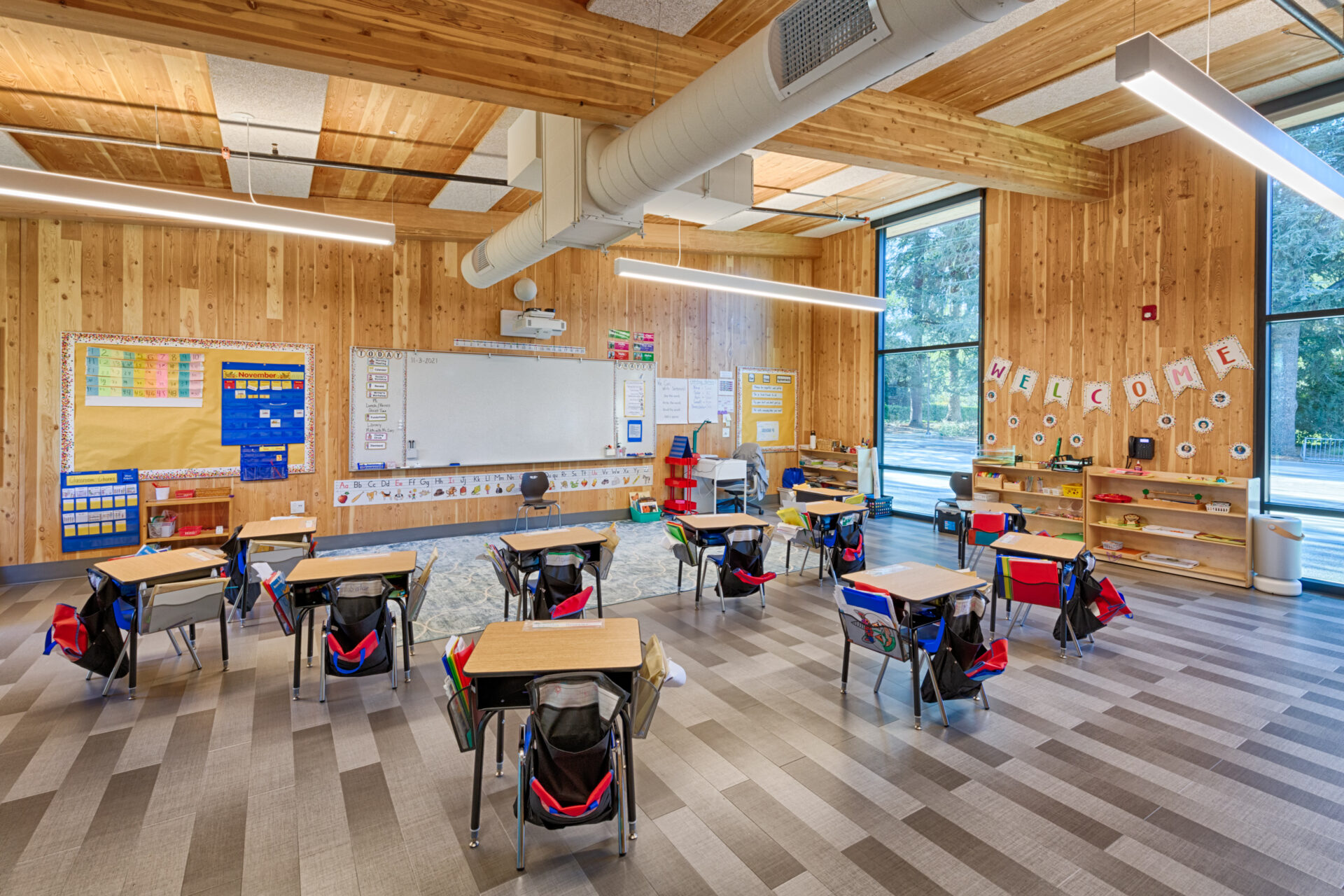
A classroom in a new building made out of mass timber at Sacred Heart School in Atherton. Photo: Marco Zecchin
A new movement in sustainable design is starting to take shape in the Bay Area, and advocates think it can reduce both carbon emissions and wildfire risk at the same time.
With a number of new schools and companies employing it — including a recently built Google office building — mass timber has architects and experts on wood construction excited about the future. They believe they can usher in a new generation of buildings made out of smaller diameter trees that, when left in the forest indefinitely, burn more easily and act as kindling for large wildfires. Their proposal: save those trees before they burn and keep them from contributing to greenhouse gas emissions by using them in construction.
California wildfires release a lot of carbon dioxide into the atmosphere — about 22 million metric tons of it per year on average from 2000 through 2021, equal to the carbon contained in 15% of all single-family homes in the state, according to the California Air Resources Board.
A particularly bad fire year can even rival vehicle emissions. CARB estimates that 2020 alone saw 112 million metric tons of CO2 emissions from wildfires, compared with about 140 million metric tons emitted by the transportation sector.
But what if we could have saved some of that lumber before it went up in flames?
“We have too much wood in California that we should be using, and right now, instead of using it, we just let it burn. All this wood burning creates an insane amount of carbon emissions. It’s one of the major contributors to climate change and the carbon footprint of the state of California,” says Paul Mayencourt, a design professor and mass timber researcher with the UC Berkeley Wood Lab.
On top of that, he adds, “if you’re designing a new building, you have a couple options for the material — concrete, steel, mass timber, or more traditional timber, and each material per pound has a certain amount of carbon footprint, and timber has a much lower carbon footprint.”
Other Recent Posts
Regional Housing Agency Invests in Affordability
The Bay Area Housing Finance Authority is launching a loan program to support the construction of mixed-income rental properties.
The End is Coming for California’s Untouchable Grass
The law, which applies to grass that isn’t used for recreational purposes, could cut urban water use across California by more than 20% says Oakland thinktank.
Sonoma Vineyard Workers Burn toward a Better Future
A group of immigrant farmworkers are forming a worker-owned cooperative to bring back Indigenous burning practices that used to revitalize the soil.
Los trabajadores de los viñedos de Sonoma queman por un futuro mejor
Un grupo de trabajadores agrícolas inmigrantes está formando una cooperativa de propiedad de los trabajadores para recuperar las prácticas indígenas de quema que solían revitalizar el suelo año tras año.
New Voices Shape Design of Berkeley’s North Basin Strip
Twenty acres of parkland between the highway and the Berkeley shore are slated for a coast-resilient makeover, with input from locals and stakeholders.
It’s Always Sunny In North Fair Oaks
Residents of the unincorporated community launched their second campaign in two years to get the county to care for dying street trees.
Siempre está soleado en North Fair Oaks
Los residentes de la comunidad no incorporada lanzaron su segunda campaña en dos años para lograr que el condado se ocupe de los árboles de la calle que se están muriendo.
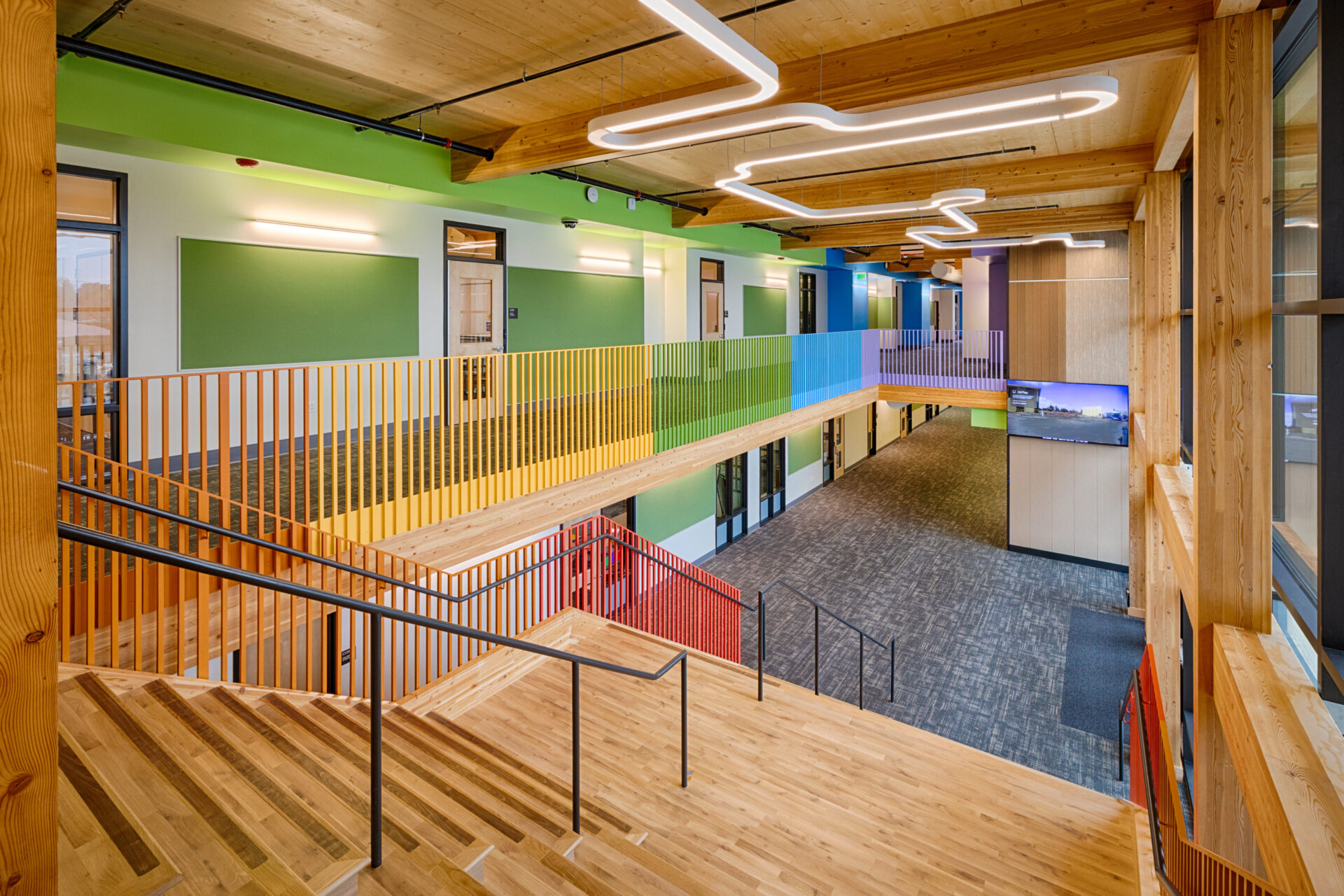
The recently rebuilt Hoover Elementary School in Palo Alto. Photo: Marco Zecchin
Traditionally in the United States, wood buildings have been made out of heavy timber, which might look like columns and beams carved from one single tree, or rows of logs lined up next to each other. Mass timber buildings, on the other hand, are made out of layers of wood from smaller trees that are most often nailed or glued together.
According to Chelsea Drenick, a structural engineer for the mass timber company WoodWorks — a nonprofit that provides education and free technical support related to wood construction — these layers make for particularly large and strong beams ideal for multistory buildings. And their size also often contributes to a high fire rating for mass timber buildings because “large cross sections of wood burn very slowly,” Drenick says.
One barrier to the widespread adoption of mass timber construction, both Mayencourt and Drenick note, is cost. Wood is lighter than concrete, which can help save costs on foundations and building seismic systems. Although the cost of mass timber material (with the addition of extra things like glue) is higher than the cost of concrete, prefabrication of mass timber components that can easily be assembled onsite can contribute to overall project savings, says Drenick.
That’s why Mayencourt is researching a lower-cost option that’s even better for the environment. While the most mainstream forms of mass timber rely on glue or nails, dowel-laminated timber connects layers through wooden cylinders instead. After being pressed through planks of timber, these rods absorb their moisture and expand, thus stabilizing pieces of the beam together. The result is an all-wood product that’s cheaper, more quickly assembled, and more easily recyclable, Mayencourt points out.
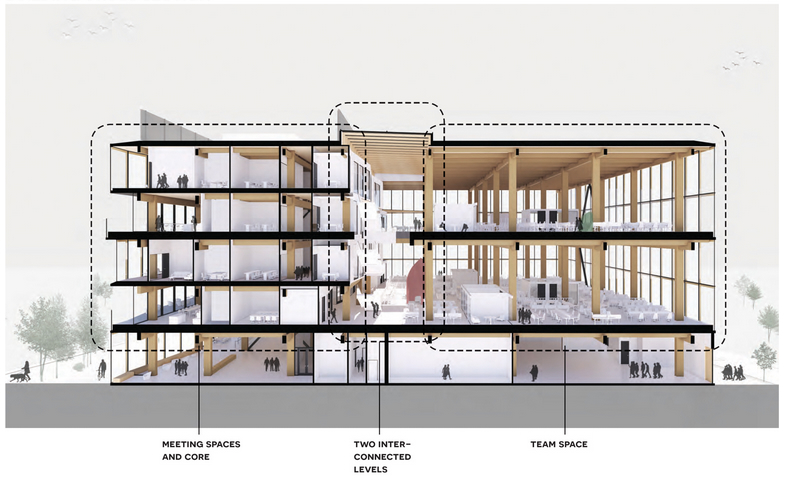
Cross-section of Google mass timber building. Art: Michael Green Architecture
The other challenge is simply convincing contractors and developers to get on board.
“We did a business case study to assess some built projects, and everyone loves these buildings. People love to occupy them. They’re beautiful. It’s a relaxing place to be. People want to stay in them, and owners love them,” Drenick says. “It’s really getting that initial buy-in on, ‘Let’s do something new and see how it goes.’ … We’re still getting over that learning curve of this is something new, and I think it’s still going to be a while before it’s adopted widespread.”
Mayencourt has one final message, too, on the importance of building with local timber.
“A lot of projects now in California are done with imports of mass timber products from outside the state or country, and I think it would be great for new products to focus on using local wood specifically. Mass timber is really nice and really cool for local buildings, but if you don’t use local trees in California, we’re missing a really, really large opportunity to support the health of our forests,” he says. “It’s not the easiest path, but it’s the path that makes the most sense for so many reasons … beautiful buildings made out of local wood that would support forest restoration and reduce the risk of wildfires.”
Editor’s note: Mass Timber is one of the engineering plants, animals, and materials being featured in KneeDeep’s mini-series on the building blocks of climate adaptation. You can also read our features on beavers, sea blite, baycrete, and pervious concrete, or send us ideas for other materials to cover.