



Nine Tiles Hint at Preferred Textures for Seawall Life
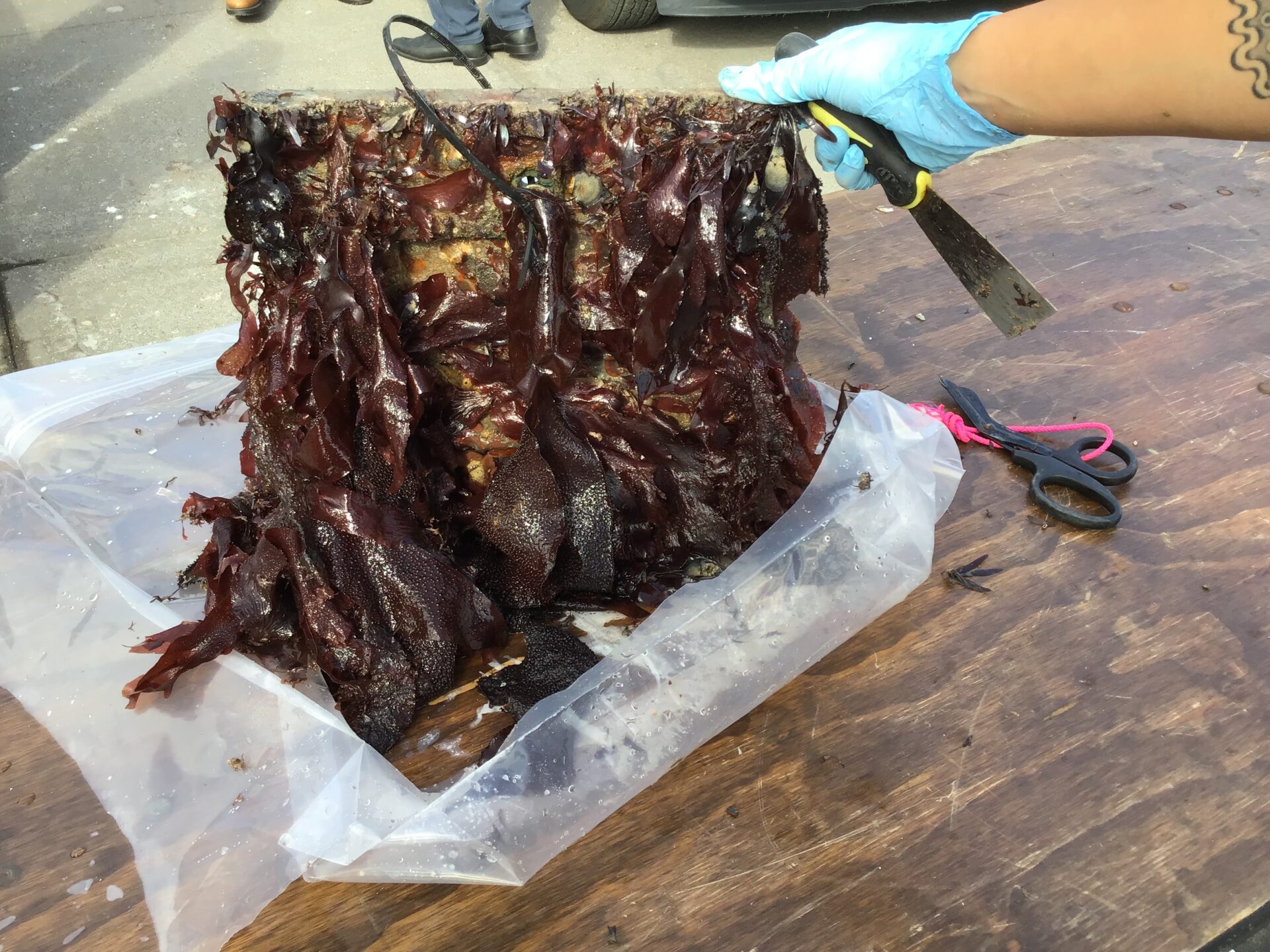
A tile covered with Turkish towel, a seaweed. Photo: Ariel Okamoto
Hanging off the San Francisco seawall in a body harness, the Bay chop swirling at his feet, is the most “extreme” field work that biologist Jeffrey Blumenthal has ever done, he says. “Usually, all I need is rubber boots or waders to do my job.”
Blumenthal is one of half a dozen scientists and students working for the Smithsonian Environmental Research Center to test whether texturing the concrete on San Francisco’s seawall, which requires an upgrade to accommodate rising seas, invites Bay life to colonize its nooks and crannies. A smooth conventional concrete seawall doesn’t offer much for estuarine creatures to hang onto.
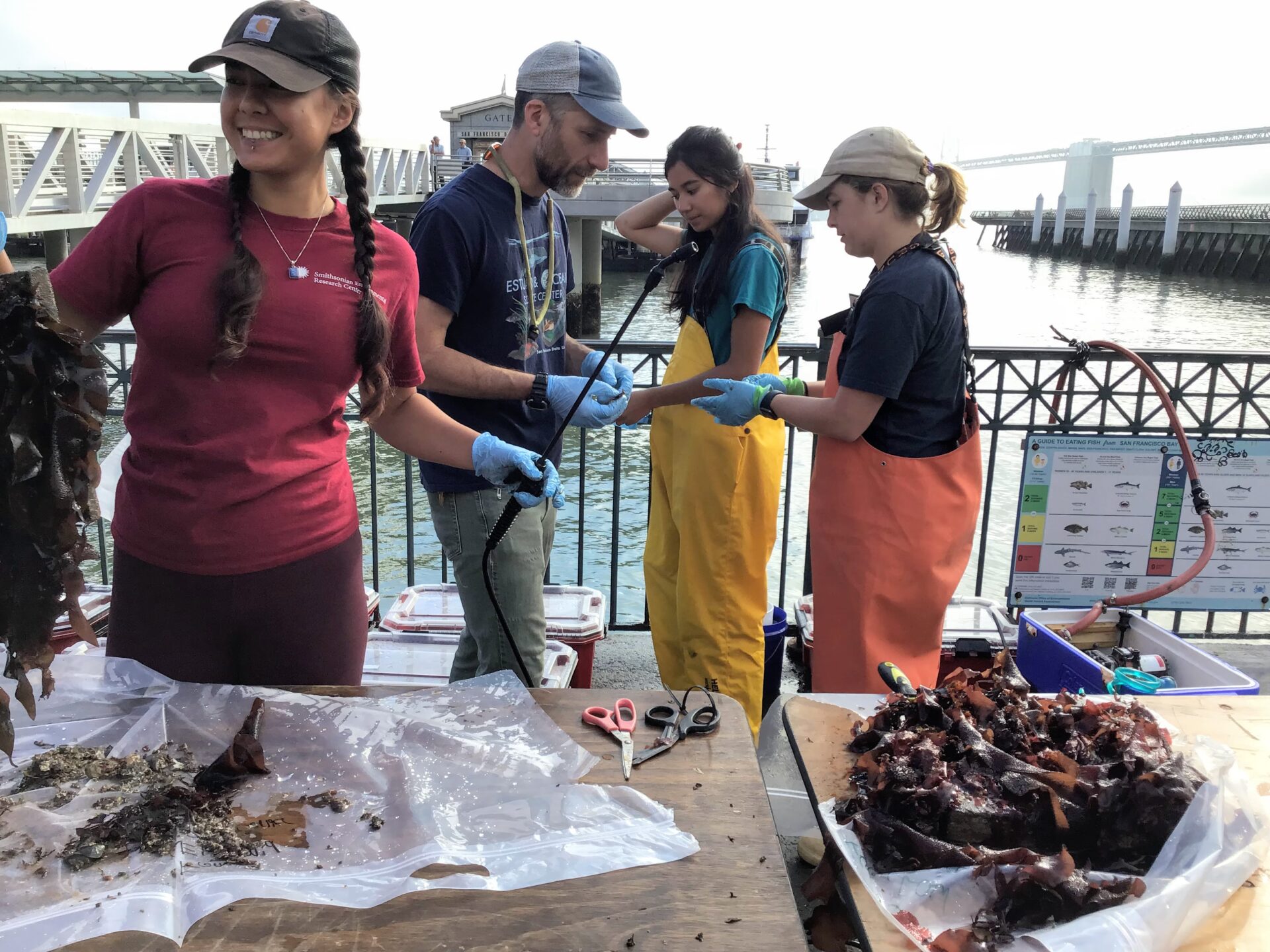
Scientists and students pack up the seawall tiles for lab anlaysis. Left to right, Julia Barbieri-Low, Jeff Blumenthal, Lillian Cusa, and Corryn Knapp. Photo: Ariel Okamoto
“As we plan to protect our city from flooding, we’re eager to pivot away from a purely human-made shoreline to something that also provides habitat for marine life,” says Brad Benson of the Port of San Francisco, which manages today’s aging rock and concrete seawall, an underwater structure that stretches over three miles from Fisherman’s Wharf to Mission Creek, and that protects more than $100 billion in assets including waterfront skyscrapers, BART, MUNI and ferry infrastructure.
The Port is funding the experiment, which has been underway for three years already. So far it has involved fabricating and hanging 288 tiles of different sizes and textures in three places off the San Francisco waterfront (Pier 45, Pier 14, and along a South Beach Harbor breakwater), and at several different elevations in relation to the tides, to see which species came to live on them.
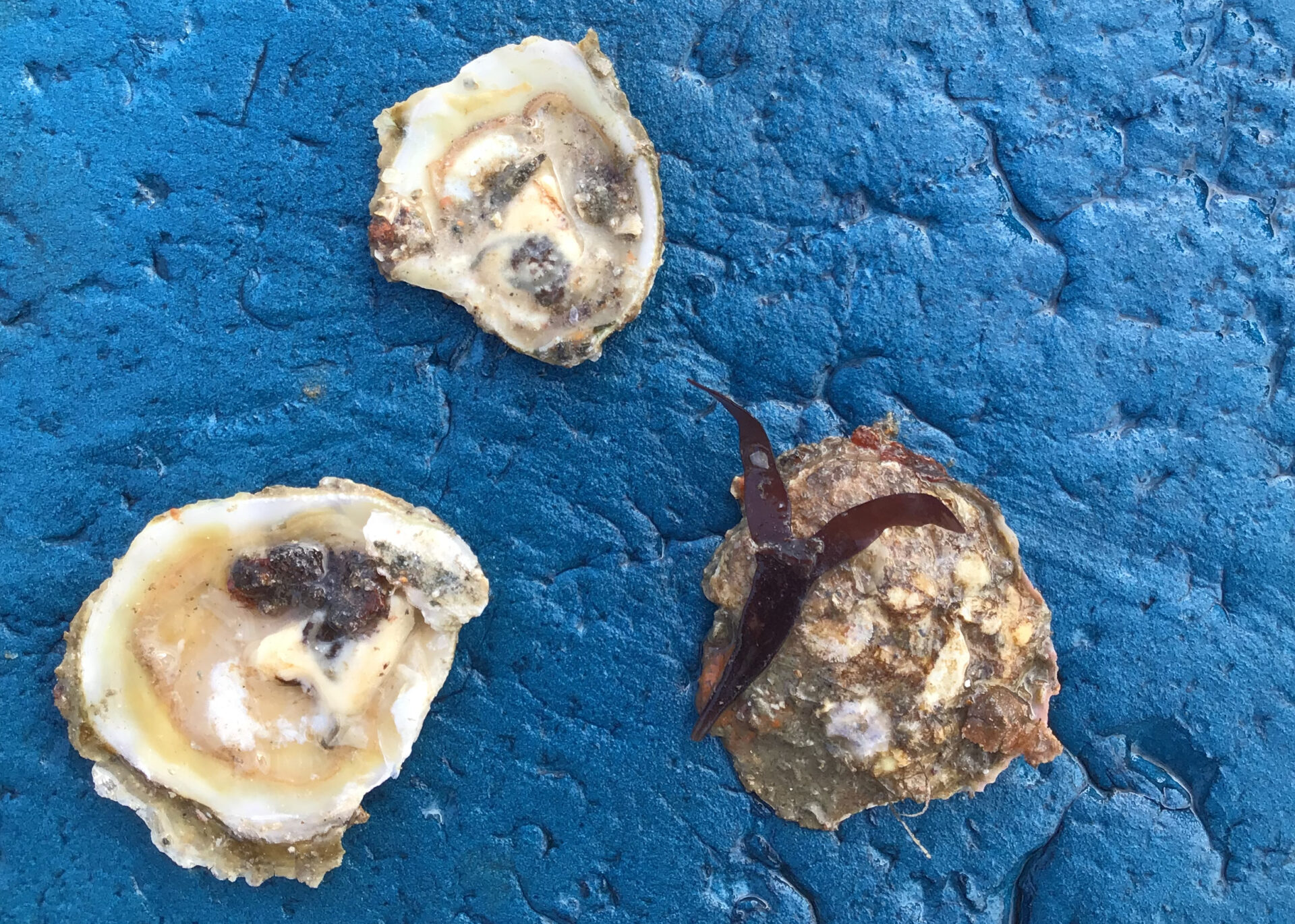
Native Olympia oyster removed from one of the seawall tiles, on a kickboard. Photo: Ariel Okamoto
Early results confirmed at least one very important outcome: most of the species growing on, hiding in, or attached to the tiles were native.
On this July day two years later, something new is up. Instead of counting and identifying the seaweeds, shellfish, worms, crabs, and sea slugs colonizing the tiles in situ — while still hanging in the tidal spray zone — the team is taking nine, foot-square tiles back to the lab.
“This phase will generate a different dataset,” says the Smithsonian’s Chela Zabin, one of two lead scientists for the project. “We’ll see a lot more things under the microscope than we can see in the field.” The team will be peering through scopes, dissecting specimens, and even sampling for eDNA (genetic evidence a species has visited the experimental environment, if not stayed there).
Back in the lab, the team also anticipates finding a plethora of new species too tiny to see with the naked eye – like kamptozoans, which Blumenthal describes for the layperson as “itty bitty.” In a few days, nine more tiles will be removed from San Francisco’s breakwaters and taken to the lab, and then nine more until the team has removed all but the biggest ones (which they hope to find funding to monitor for a few years more).
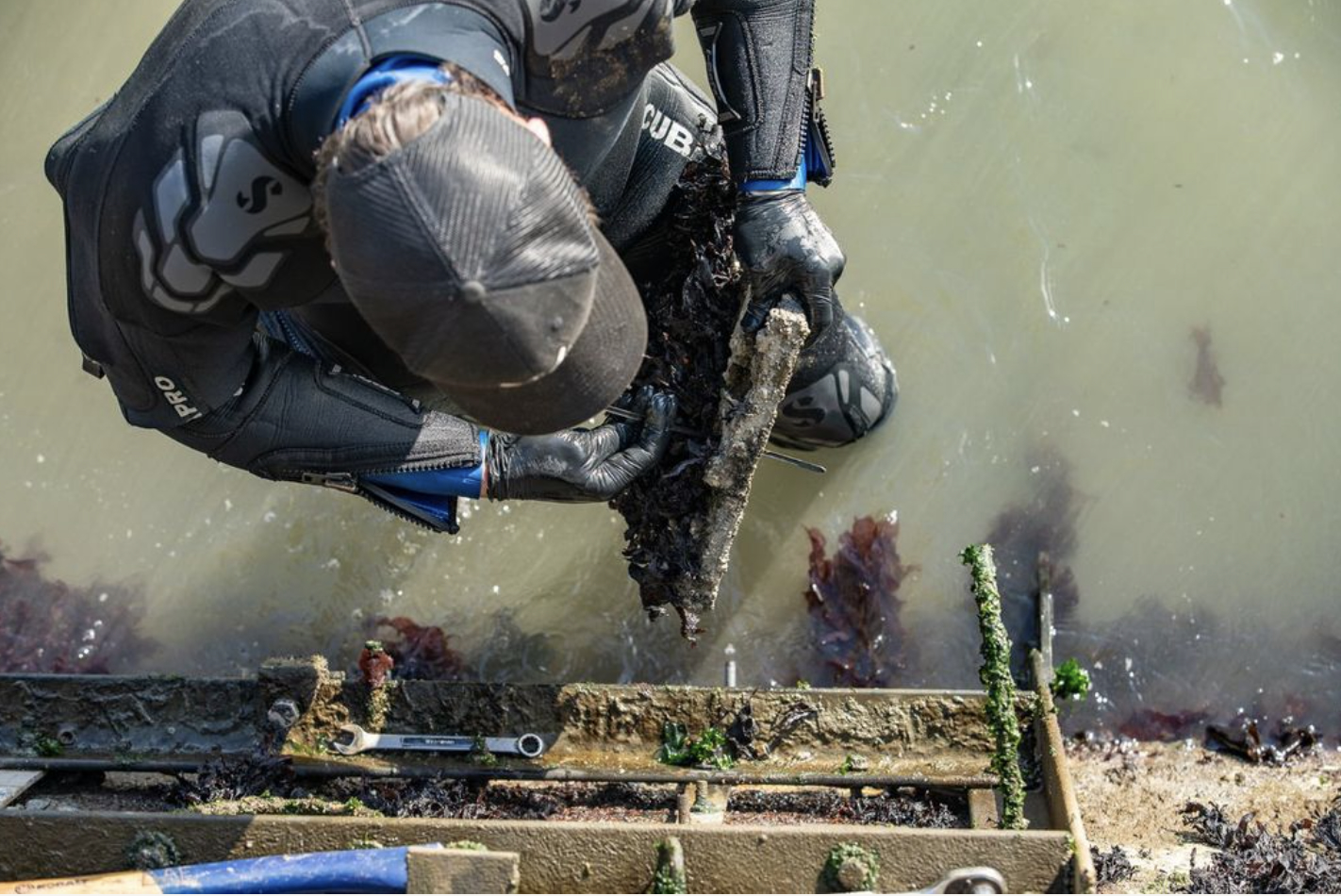
Careful removal of tiles that have been attached to the seawall for two years. Photo: Arianna Cunha, Port of San Francisco.
The results will help inform the ongoing redesign of the Embarcadero seawall, according to Benson. The port is interested in adding as much nature-based engineering as it can to the seawall redesign. “We need to provide flood defense for MUNI’s underground tunnels near the Rincon Center, so we’re going to have to push the seawall out further,” says Benson, who is working with the Army Corps of Engineers on a solution that may include another grey-green piece of infrastructure, an engineered rocky intertidal bluff. The new bluff may offer horizontal habitat for species that complements the more vertical habitats provided by any future textured seawall, he says.
Benson hopes to get some funding to defend San Francisco’s waterfront from California’s $10 billion Proposition 4 climate bond, which voters passed in November 2024. “It’s the state’s first really large investment in sea-level-rise adaptation for developed areas,” says Benson (the port’s waterfront in downtown San Francisco being about as “developed” as it gets).
The Smithsonian center, meanwhile, hopes to complete all its tile monitoring and research within the next year or two. “The Embarcadero area used to be a salt marsh, something we’ll never be able to rebuild here,” says Blumenthal. “So I’m excited to be able to support some of the life that once called this place home.”
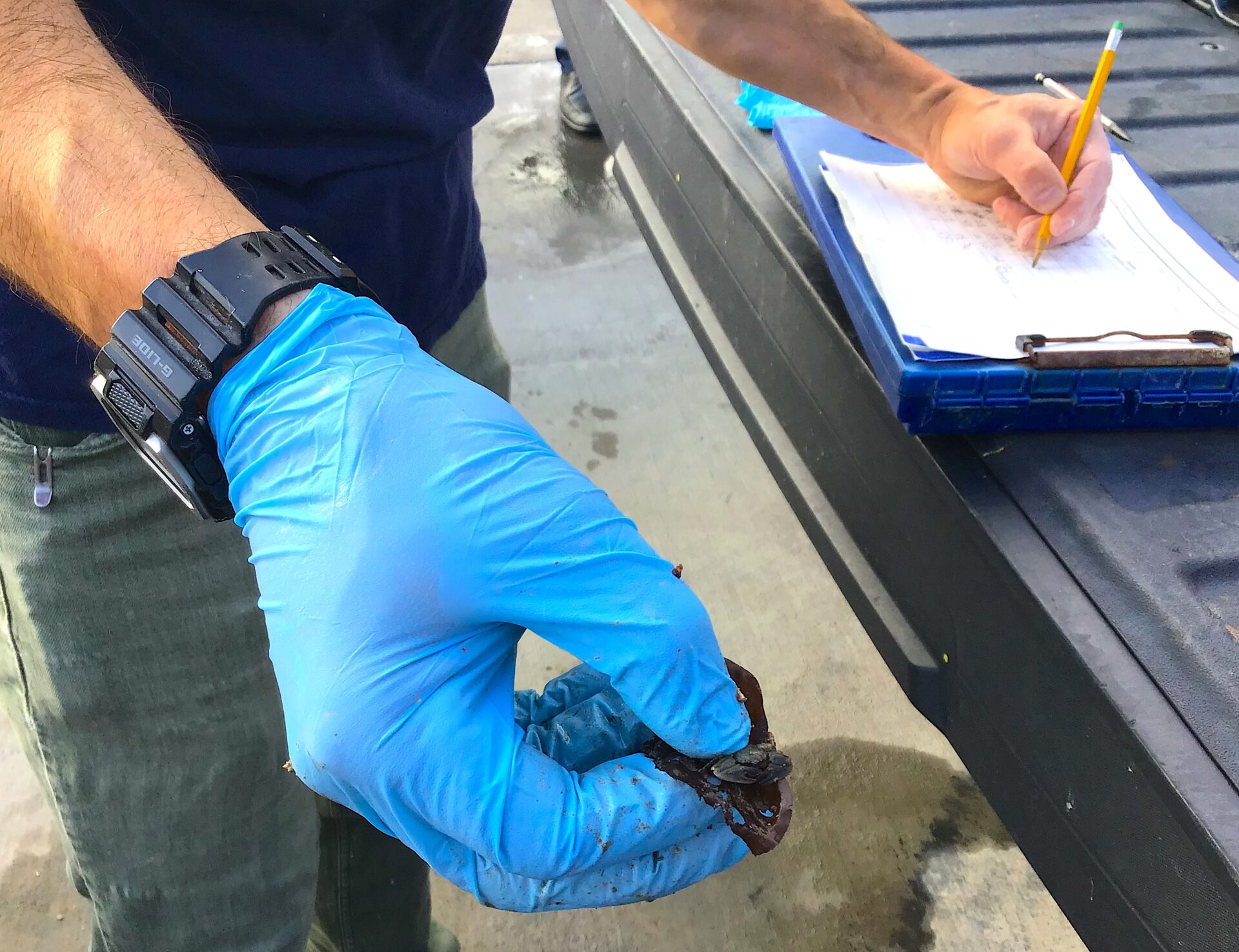
Jeff Blumenthal holds an "itty bitty" porcelain crab from the living seawall project. Photo: Ariel Okamoto
Other Recent Posts
Fire Weather in the Wind
As the hot Nevada air cools every fall, it gets pushed west to lower pressure areas over the Central Valley, where the wind heats up and dries out.
My Morning Cleaning Up the Oakland Estuary
On Oakland’s Creek to Bay Day, I joined 100 volunteers for I Heart Oakland-Alameda Estuary to remove shoreline trash.
RCDs Pay Extra Attention to North Bay High Schoolers
A $13,500 grant will help three North Bay conservation districts evaluate youth education programs and prepare high school students for environmental careers.
Creeks Make Good & Bad Homes
San Jose State researcher Costanza Rampini explores why the houseless favor creek banks, and how they weather the flood risk.
Bay Area Braces for Record-Breaking El Niño
Record high water temperatures in the Pacific are expected to bring dangerous sea level rise, waves, and rain to the region this winter.
Regional Housing Agency Invests in Affordability
The Bay Area Housing Finance Authority is launching a loan program to support the construction of mixed-income rental properties.
The End is Coming for California’s Untouchable Grass
The law, which applies to grass that isn’t used for recreational purposes, could cut urban water use across California by more than 20% says Oakland thinktank.