


Coalescing as a Region Around Sea Level Rise Response
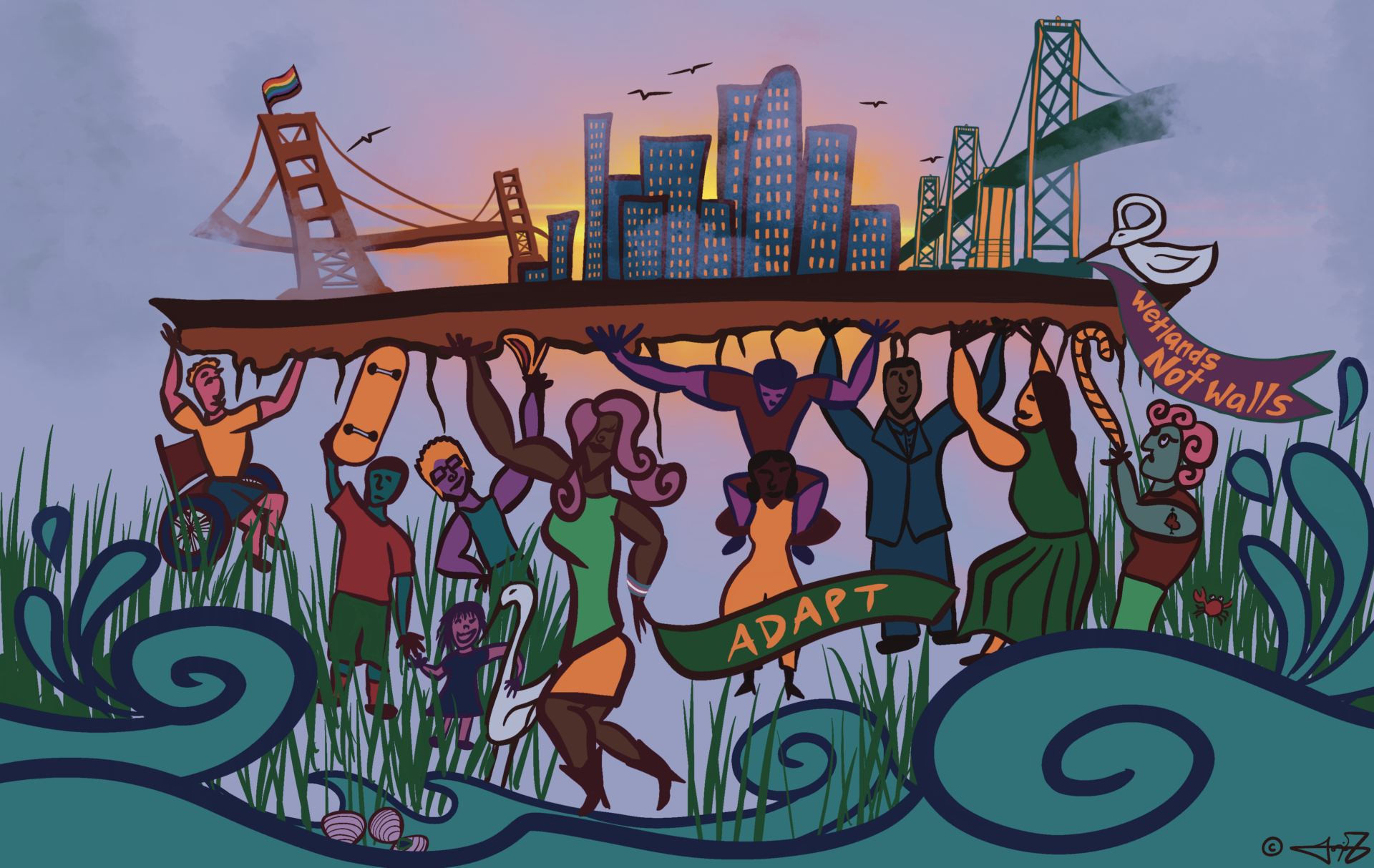
Regional leaders approved a joint platform of nine actions and 21 tasks this June aimed at galvanizing the Bay Area into collaboration on sea level rise adaptation. Actions range from rooting planning in communities to raising more money for resilience and making the best local science and technical support accessible to all. The platform also “centers the most vulnerable” – 28,000 disadvantaged people in the future flood zone and wildlife in drowning wetlands. Leaders approving the platform commended the effort to address so many governance challenges and channel so many diverse opinions: “Corralling this to where it is today quite a feat,” said the Bay Area Council’s Adrian Covert; “This document gets the balance between local responsibility and the regional role of a catalyst and supporting force pretty darn right, ” added Marin County’s Jack Liebster; “What is a platform? It is something to stand on moving forward,” summed up Mark Lubell of UC Davis.
The platform walks “hand-in-hand” in terms of sea level rise adaptation with another major regional planning document responding to climate change, Plan Bay Area, according to BCDC’s Jessica Fain. While in the past, Plan Bay Area focused more on where to locate housing and transit hubs, the latest version from the region’s government planners (MTC-ABAG) raises some deeper questions about where we’re at: “Does the region strategically move from isolation and fear into a future that is more affordable, diverse, connected, healthy and vibrant for every Bay Area resident, or do we continue down a path of inequality?”
More
First published in RARA Review, July 2021.
Other Recent Posts
How Can I Get Clean, Green, Climate-Forward Job Training in the Bay Area?
Looking for a hands-on job working outdoors that actually pays? Here’s a list of training programs.
Santa Rosa Residents Rethink Trees
The heat-burdened Roseland neighborhood is learning how to monitor temperatures and developing an action plan focused on tree shade.
How to Make Conservation a Career
California nonprofits are developing paid apprenticeships to prepare workers for the growing ecological restoration economy.
Raft of Resilience Initiatives Keeps Tahoe Blue
Beach robots, boat inspections, forest thinning, and wetland restoration are among the projects helping the lake confront environmental threats.
Weathering the Present While Training for the Future
A stewardship immersion experience from the School for Inclement Weather and Weaving Earth combines ecological knowledge and spiritual connection.
Feds Meddling With Protections For California Coast
NOAA is reviewing California’s Coastal Management Program in a renewed push for offshore oil and gas drilling.
New Study Shows Rain Gardens Filter Chemicals Out of Stormwater
Scientists found rain gardens dramatically reduce toxic chemicals in stormwater while providing biodiversity and cooling.
The Tricky Art of Growing Oysters in the Lab So They Can Survive in the Field
The Nature Conservancy, the Amah Mutsun Tribal Band, and others are growing oysters in the lab and planting them in the wild in estuaries around San Francisco Bay.