



Warner Chabot Shifts Gears
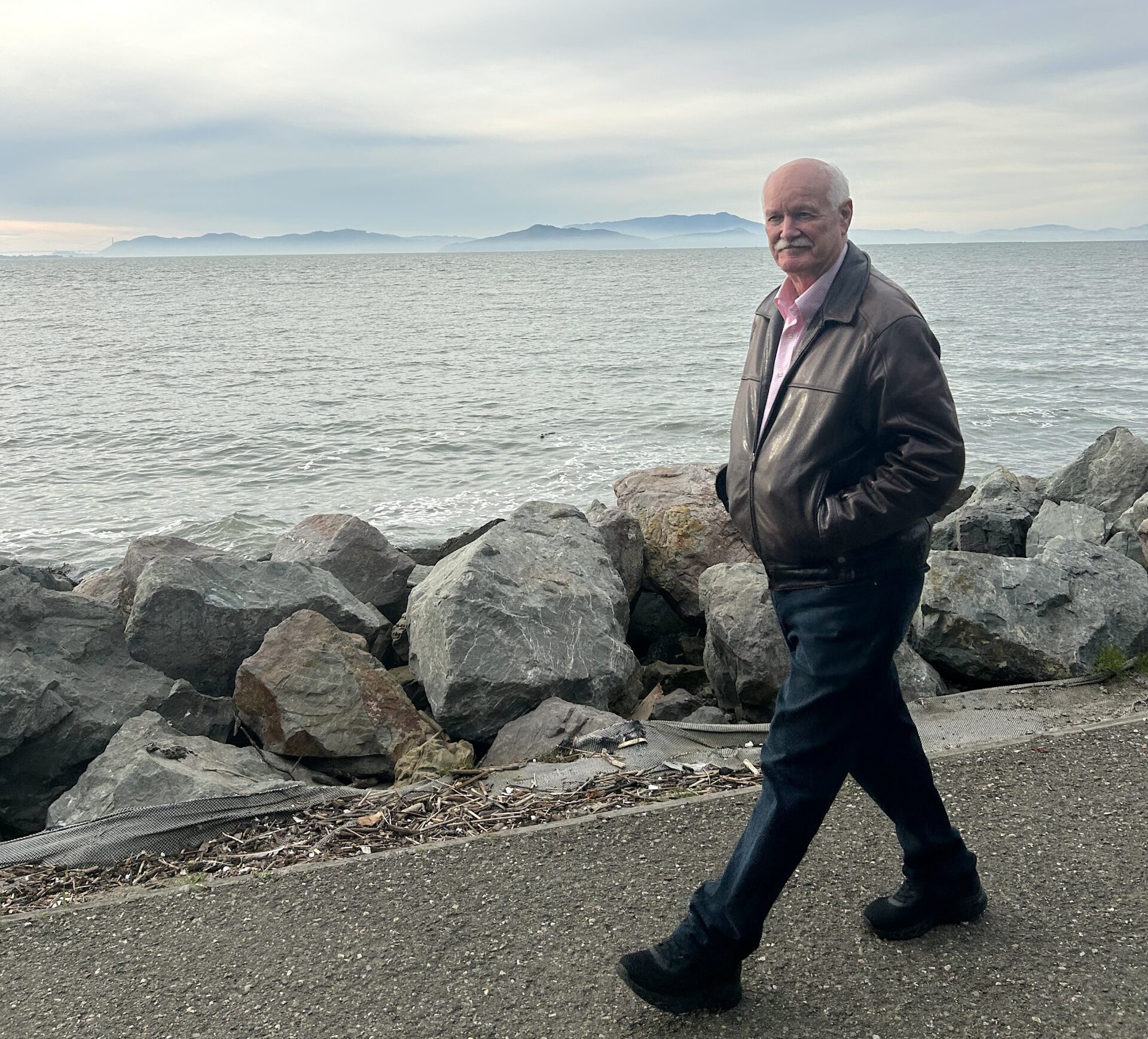
“Goodbye advocacy, hello science.” These were the words Warner Chabot wrote eleven years ago to his numerous colleagues and friends. It was November 2014, and he was hiring on as Executive Director of the San Francisco Estuary Institute, “the science geeks of the Bay.”
The early directors of the Institute had all been “geeks.” Chabot had decades behind him as a policy advocate, publicist, even prankster. Taking time off from architecture studies at Cal Poly San Luis Obispo to elect “green” candidates on local boards. Dropping out to organize volunteers in the campaign that created the California Coastal Commission. Pushing for marine sanctuaries as insurance against renewed offshore oil drilling. For four years, heading up the California League of Conservation Voters.
In 2014, freelancing as an environmental consultant, Chabot learned that the Estuary Institute was seeking a new leader. SFEI had just endured a rough patch, going through three Executive Directors in three years. There was also frustration that its consequential work wasn’t having more real-world consequences. Encouraged by its senior scientists, “the group’s board decided to experiment,” says long-time staffer Chuck Striplen (now with the Resources Legacy Fund). Instead of tapping another biologist, they would choose someone who was, first and foremost, a communicator.
Communication, but of what kind? SFEI’s bylaws state: “The Institute…will not advocate, lobby for, or formally recommend specific laws, regulations, standards or other management activities governing use of the resources of the San Francisco Bay-Delta Estuary.”
“I came out of the policy advocacy world,” Chabot remarks, “to work for an organization that could not do policy advocacy.”
No more dribbling pink dye into the channels of the San Francisco Bay Model in Sausalito, as he did in 1990 to dramatize the speed and range of a spreading oil spill. Now he would be working, not for some specific outcome, but for the stature of the Institute, and the reach of science itself. “It takes a fine hand to maintain science integrity and not have that great work remain hidden,” says David Lewis, Executive Director of Save San Francisco Bay. “Warner had that hand.” In his decade of service, Chabot defended what his interim successor, Emily Corwin, says he called “the platinum reputation” of SFEI’s results. At the same time, he made those findings, if not universally known, a good deal harder to ignore.
In his decade of service, Chabot was concerned above all to maintain what he called “the platinum reputation” etc.
One of Chabot’s rules was to keep lines open, indeed humming, with the press. “I would hang up on a senator to talk to a reporter,” he says.
Another was to seek out partners among groups and agencies with overlapping missions: a bland-sounding goal not always so easy to attain. “Today cooperation is more or less the norm,” says Zack Wasserman, chairman of the Bay Conservation and Development Commission. “It wasn’t so much, back then.” Wasserman credits Chabot in part for a marked improvement since.
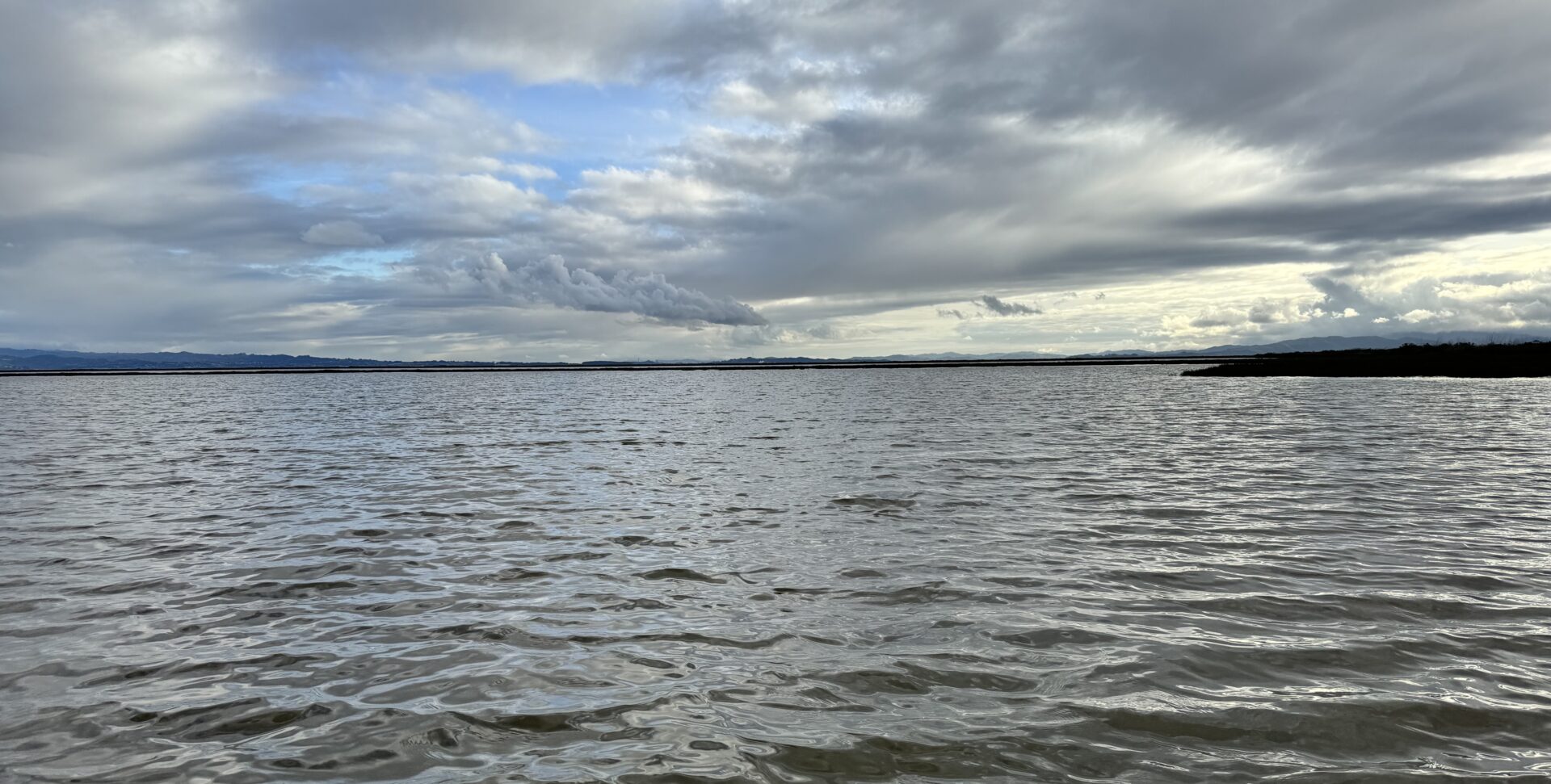
Photo: Stuart Siegel
One key partnership, nascent when Chabot arrived, concerned the newly urgent issue of sea-level rise. Two women, Julie Beagle at the Institute and Laura Tam at SPUR, the San Francisco Bay Area Planning and Urban Research Association, were seeking support to develop what would become The San Francisco Bay Shoreline Adaptation Atlas. Chabot “put his shoulder into this,” trolling for funds and advising on presentation. Published in 2019, the Atlas showed, segment by segment around the tidal rim, just what was likely to happen and what tools were available to deal with it. If the report underlined the potential of “green infrastructure,” like marsh restoration and broad, gently sloping “horizontal levees,” it did not dismiss the role of “gray” infrastructure, like seawalls. A Resilience Metrics Mapbook followed in 2024, the year in which the legislature ordered all the affected local governments to plan for the rising tides.
Beagle (now with the Army Corps of Engineers) and Tam (now with the Bay Planning Coalition) are just two of the women Chabot pegged as important future leaders. “Almost every [important] major climate change meeting I attended was 75% female,” he observes—a proportion roughly echoed in his new SFEI hires.
Chabot’s practice of plain speech, and his insistence on it, could raise some hackles. “Tell me about X so that anyone can understand why it’s important,” Julie Beagle remembers him saying. “When is the two-minute pitch going to be ready?” Often he would try out such a pitch, over and over, on his own staff. “We know, we know!” Beagle would say. “But I realized what he was doing. He was practicing.”
Besides gaining visibility, the Institute added muscle during Chabot’s tenure, nearly doubling its staff. Chabot doesn’t take all the credit for that. “I’m not a great fund-raiser,” he avers. The essential driver was probably a big jump in federal support, through EPA’s San Francisco Bay Program. In a new political and fiscal climate, his successors will have their hands full sustaining that curve.
But that’s not what prompted Chabot to move on. As Laura Tam puts it, “he wants to flex his activist muscle more.” When I last spoke to him, he was driving to a meeting in Sausalito about the proposed resumption of offshore oil drilling, an issue right out of his youth.
“I feel like a salmon swimming back upstream,” he says.
But most all he wants to help goose up the regional response to sea level rise, which he calls “a bomb going off slowly.” Three years ago, the Bay Conservation and Development Commission and the Metropolitan Transportation Commission built a first-cut estimate of the price tag of shoreline adaptation around the lower estuary: $110 billion. “Even if it’s half that,” Chabot says, “that’s $7,000 for every person in the region.” The only scarier number is the cost of not responding. And it is the poorest communities around the Bay that will pay the price first. “There is just a moral imperative to deal with this now,” says Chabot.
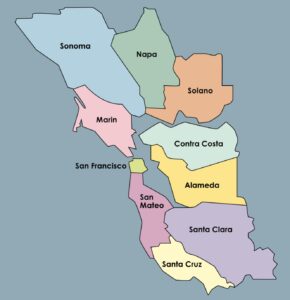
“The Bay Area has thousands of scientists and engineers,” he goes on. “The number of people who are working to fix this problem on a regional scale is tiny.” Can the 50 shoreline cities and 9 counties around the Bay work together well enough, and raise enough money, to get through the unfolding crisis? “We have some incredibly tough decisions ahead of us.”
The Bay Area, Chabot likes to point out, is not alone. Fifty or so metropolitan areas on the planet are threatened by rising tides. He sees the Bay Area as especially well equipped to face this future. “If there is any place on earth that’s ‘up for the challenge,’ it’s here.”
Chabot himself is “up for the challenge,” though he is coy for now about the form his new activism might take. “I just want to be a better catalyst,” he says.
He looks back on his time at SFEI with gratitude. “I was given the privilege of serving 50 brilliant, passionate, public interest scientists. There are now almost 100 of them. It was the best decade of my professional life. So far.”