


East Bay Kids Fight Extreme Heat in their Schoolyards

“Students really feel the heat on a day-to-day basis.”
It was an unusually hot spring day at Livermore High School in the East Bay, the school ground’s mostly asphalt surfaces scorching under the sun, when Robin Deepak was in math class. Suddenly, he heard a thud behind him. A student had fainted. The cause? Extreme heat and dehydration.
“Students really feel the heat on a day-to-day basis,” Deepak says. “Going back and forth to classes for hours-long days has really taken a toll on their health.”
Like most California schools, Livermore’s campus is largely open and barren, with large concrete surfaces that absorb heat. The few trees it has are concentrated on the edge of the property, far from where students walk to their next class or gather with friends in the quad.
When the temperature soars in the Tri-Valley — which has become more frequent due to climate change — school days can feel unbearably hot.
And Livermore isn’t alone. About a third of California kids attend schools in so-called “heat islands,” according to the Trust for Public Land, which occur when a developed area with limited greenery experiences higher temperatures than its surrounding area, as buildings, roads, and other infrastructure absorb and re-emit the sun’s heat. The heat island effect can make urban areas up to seven degrees hotter than outlying areas, according to the U.S. Environmental Protection Agency.
Research from Green Schoolyards America also found that, on a sunny day when the temperature is around 90 degrees, the asphalt that covers many schoolyards can reach a scorching 140.
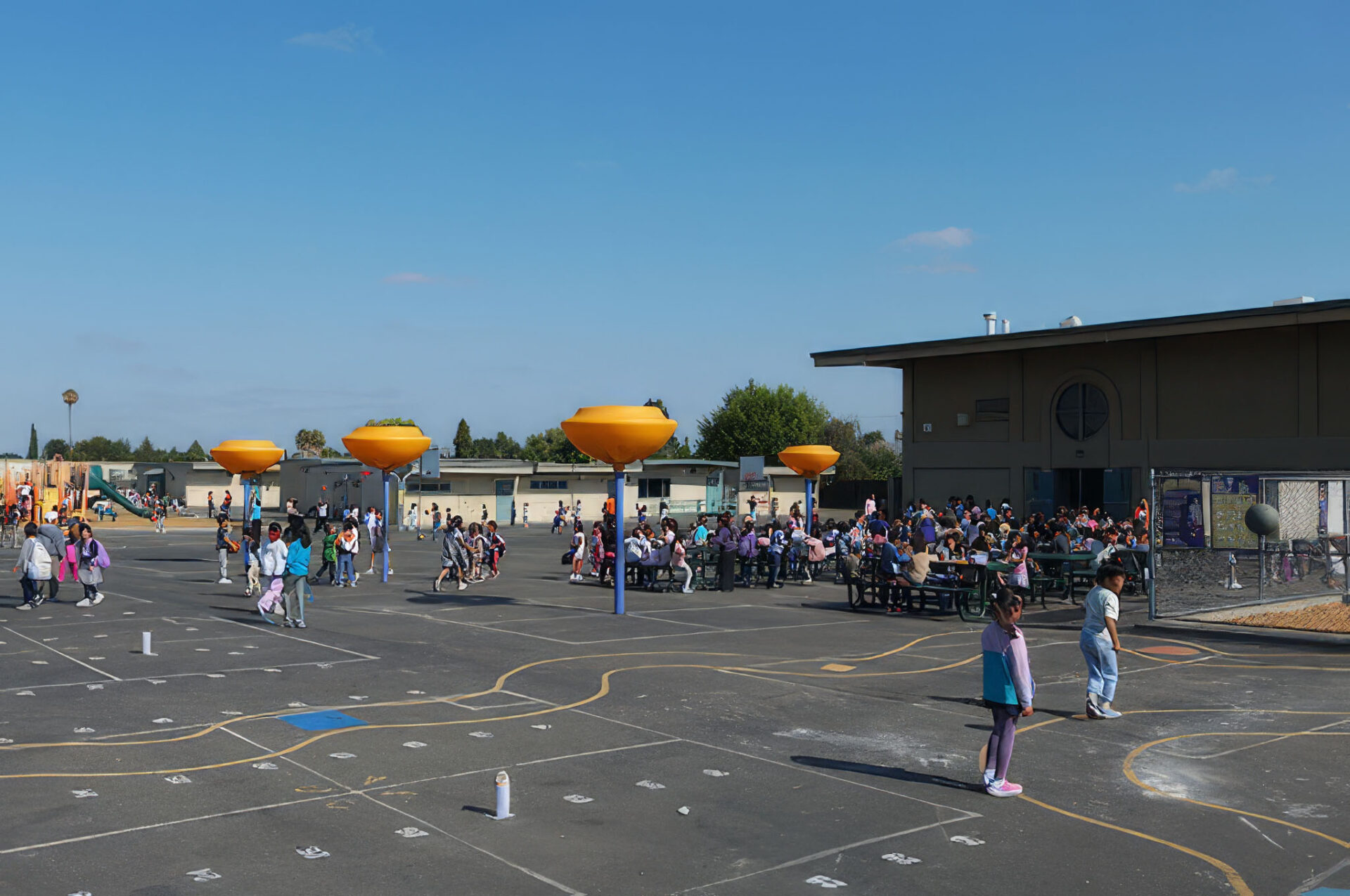
Kids play outside on the blacktop at Warwick Elementary School in Fremont. Photo: Fremont Unified School District
And greenery — which can significantly lower temperatures — is scarce at schools. Urban forestry experts recommend that trees shade at least 30% of neighborhoods and school grounds. But according to a Green Schoolyards America study, trees only cover 6.4% of California school campuses on average.
At many California public schools, air conditioning systems can be outdated or entirely non-existent. A joint UC Berkeley and Stanford study found that 15-20% of California public schools lack air-conditioning entirely, while another 10% need a replacement to run properly — which is likely an underestimate.
California schools are not required to have air conditioning, and the state doesn’t track which schools have functioning AC systems, leading to significant data gaps around heat exposure, according to the UCLA Luskin Center for Innovation.
Kids are also more vulnerable to heat than most adults for a number of reasons, says Nate Ivy, a climate literacy instructional coach at Fremont Unified School District.
“Their surface area to volume ratio is different. Their bodies aren’t fully developed, so they have a harder time regulating heat. They also don’t pay attention as well to how they’re feeling,” Ivy says. “So if they’re next in line for four square, it doesn’t matter if they’re too hot — because they’re next in line for four square.”
As climate change causes more heat waves, emergency rooms are responding to more heat-related illnesses among students, according to a study published in the Environmental Research Health journal. Students — especially Black, Hispanic, and low-income students — are also missing more school days because of heat.
Planting Urban Forests in Schoolyards
After record-breaking heat waves in 2022 and 2024, educators and legislators are beginning to tackle extreme heat in public schools. Signed into law last week amid another heat wave, a new state law will require the California Board of Education to consider teaching students about the symptoms of heat illness. Another law signed in 2024 that goes into effect this summer requires schools to come up with a standard set of rules around outdoor activities during heat waves.
Both bills were prompted by advocacy from Natalie Rubio, a 13-year-old student in Sacramento who experienced a record-breaking heat wave in her elementary school classroom in 2022.
To address one of the biggest causes of urban heat islands at schools — a lack of greenery — CalFire has also given away almost $150 million in grants across California to help convert asphalt blacktops into green outdoor learning spaces.
Using one of those grants, Ivy has led a greening initiative to cool down Fremont schools — especially at the city’s low-income or Title I schools. Currently, 100% of Fremont schools have less shade than the recommended 30% tree canopy cover.
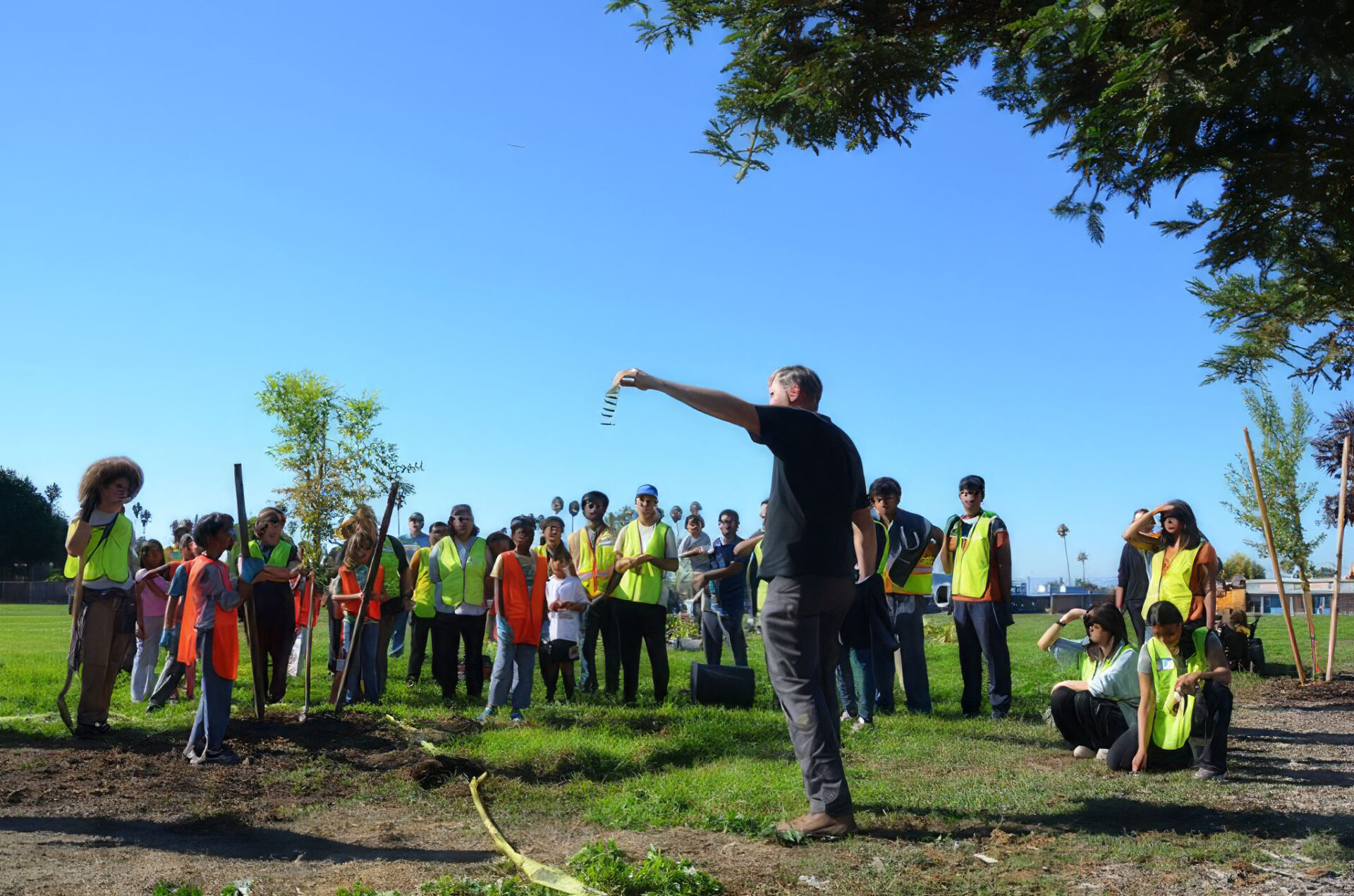
Students come together to plant trees at an elementary school in Fremont. Photo: Fremont Unified School District
So far, Fremont has planted more than 700 trees across 12 schools — including 500 this year alone. It’s a process that begins and ends with students, says Ivy.
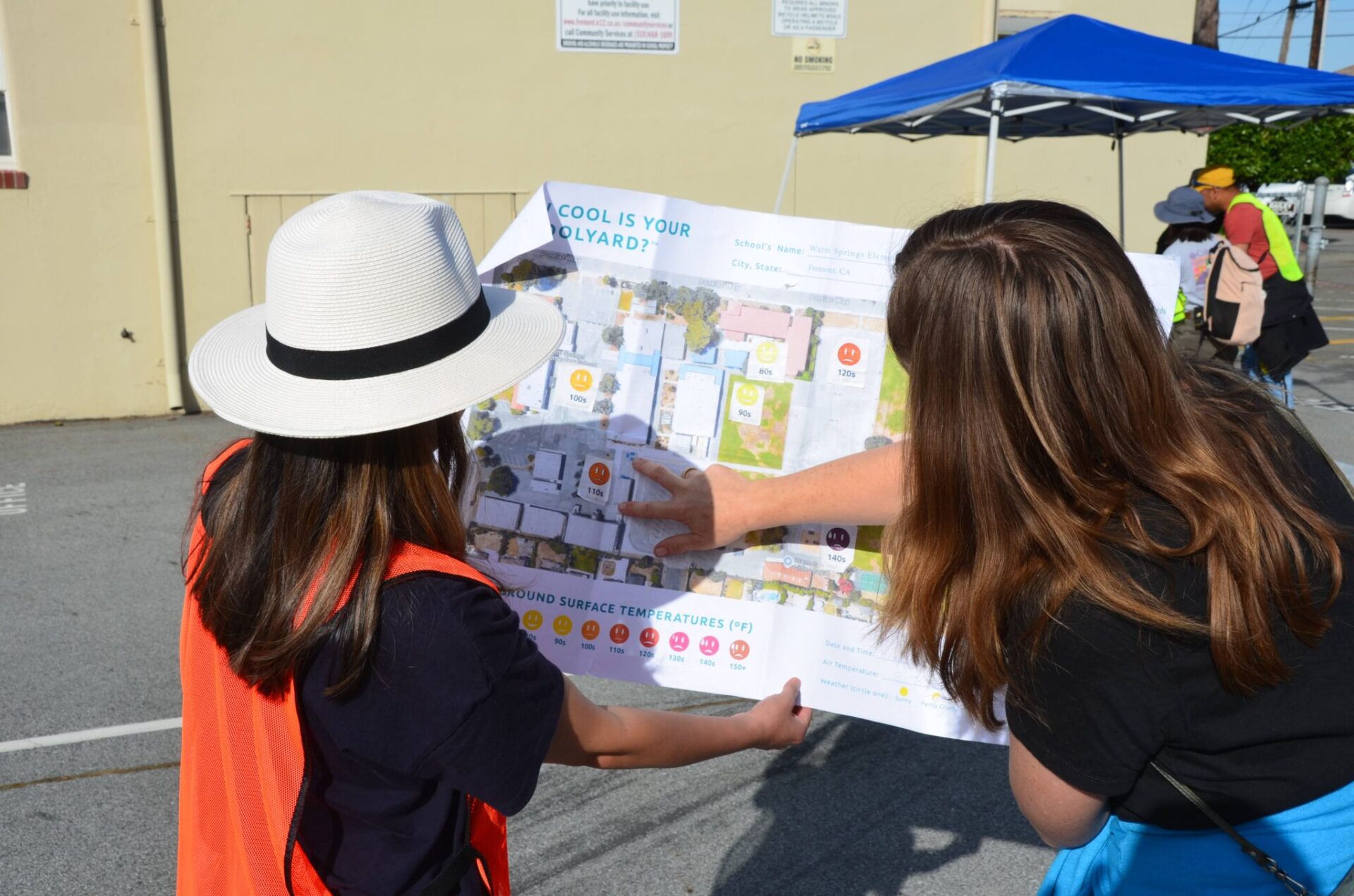
Using a kit of infrared thermometers, teachers and students first collect heat data across their campus to understand how heat islands work at their school. At Cabrillo Elementary, where a fifth-grade class collected samples, “students were really shocked how the asphalt could be 50, 60 degrees hotter than the nearby grass,” says Ivy.
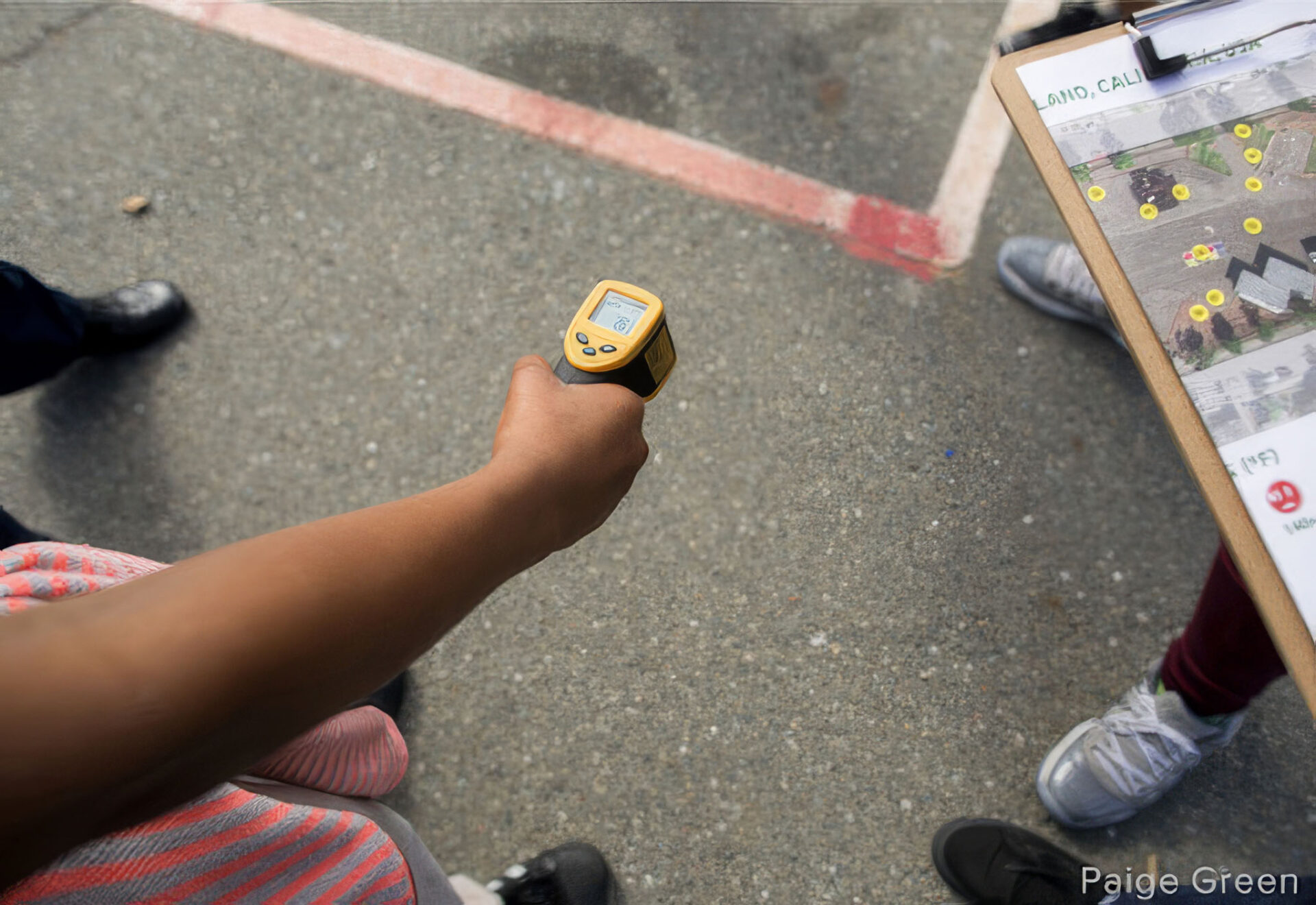
Students use infrared thermometers to measure surface temperatures on their school grounds. Photo: Paige Green, Fremont Unified School District
Only 2% of Cabrillo’s campus has tree canopy, and almost three-quarters of its students qualify for free or reduced-price lunch — which Ivy says made it an important place to begin the tree planting initiative.
Most of Fremont’s tree planting has focused on schools in impacted communities, which are often more susceptible to extreme heat. One study published in SSM Population Health found that Hispanic and Native American students, along with students eligible for free or reduced-price lunch, were significantly more likely than their white or wealthy peers to attend schools at higher risk of extreme heat or without air conditioning.
“Impacted communities are often more vulnerable to health concerns because of a variety of factors,” says Ivy. “It could be access to healthcare. It could be housing and proximity to pollution sources, which makes them more vulnerable to asthma. [There are] all kinds of contributing factors.”
So far, Fremont has planted 70 trees at Cabrillo, largely using temperature data that the fifth-grade classrooms collected.
In addition to cooling schools, the trees also create new educational opportunities for students by establishing new outdoor classrooms: circles of trees where teachers can conduct outdoor lessons, lead students through science exploration, or just connect to nature.
“Schools are public spaces, so if we can get the trees on the campuses in those neighborhoods, it will be good for the students,” Ivy says. “It will be good for the neighborhood.”
Do You Live in a Heat Island?
Farther inland from Fremont in the Tri-Valley, where Deepak saw the impact of extreme heat up close, he and other high school students teamed up with Quest Science Center to design low-cost heat mapping sensors and map urban heat islands across Pleasanton, Livermore, and Tracy.
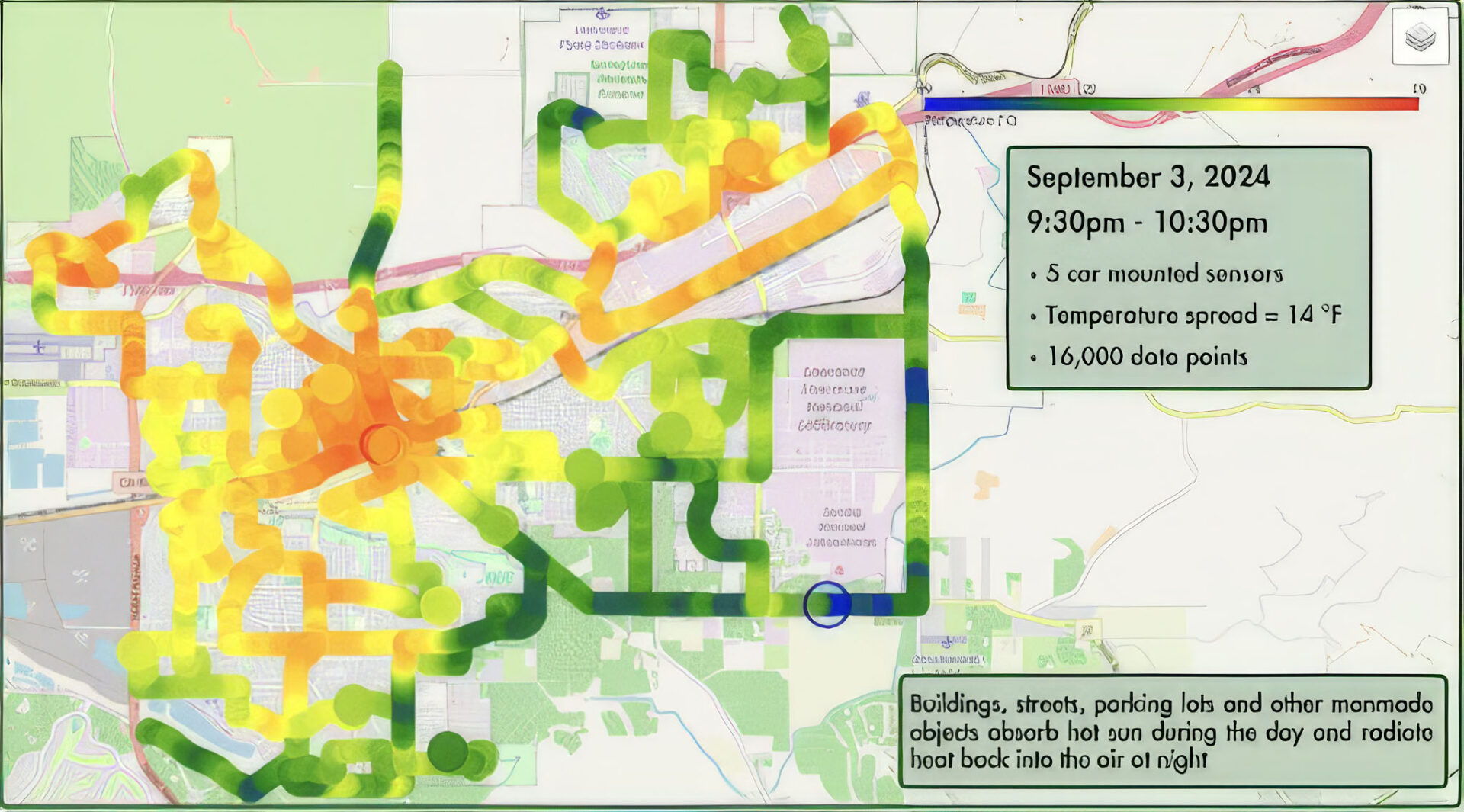
A team of high school students teamed up with the Quest Science Center to build low-cost sensors and map temperatures across Livermore. Graphic: Quest Science Center
They mapped three different high schools — Livermore, Granada, and Kimball — and found the hottest areas, typically unshaded blacktop, could be up to six degrees hotter than the coolest areas.
Kimball High School in Tracy, which was by far the hottest, was “just really open and bare,” Deepak says. “There were no trees, nothing.”
Across Livermore, they found temperature disparities of up to 14 degrees between neighborhoods, with urban heat islands most impacting low-income neighborhoods without sufficient green space to keep the air cooler.
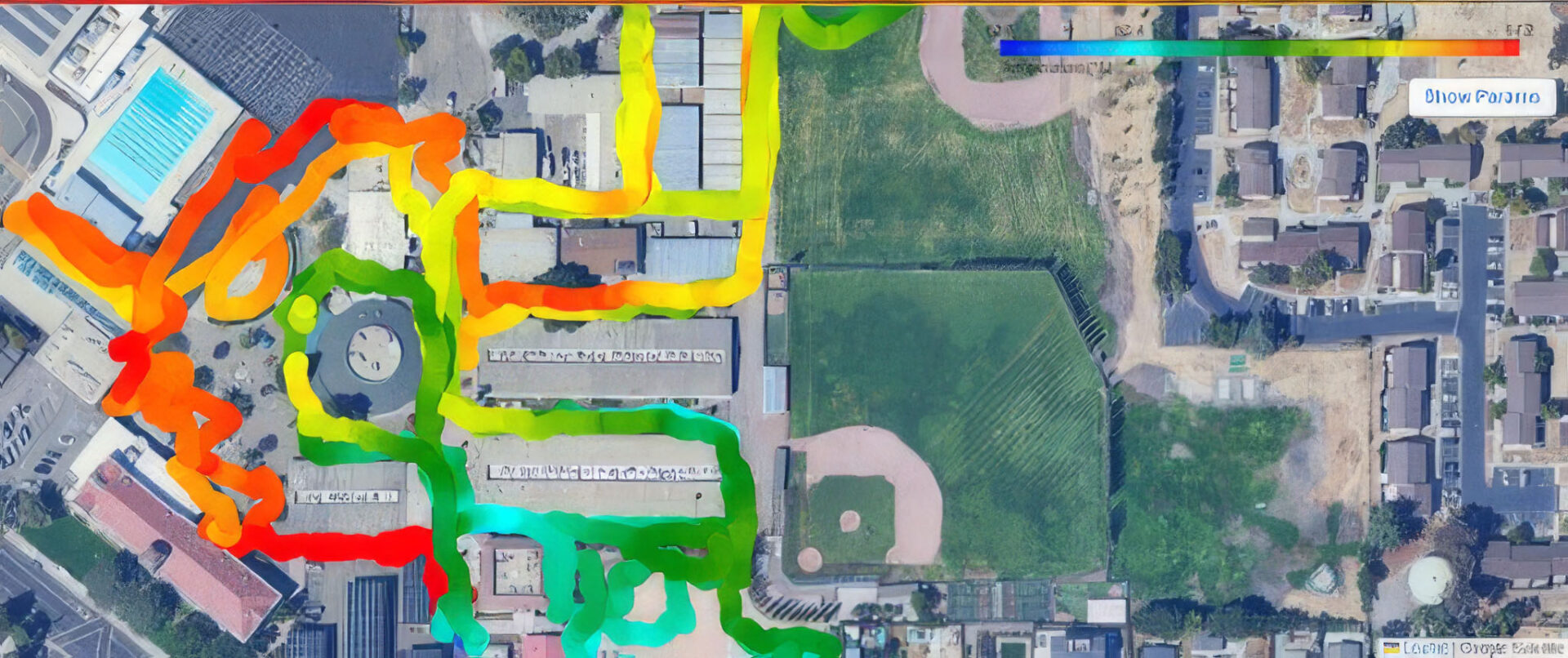
Heat mapping of Livermore High School. Graphic: Quest Science Center
Because the heat mapping sensors are designed to be low-cost, the team hopes students can use them to collect data anywhere. They created an app designed to connect to the sensors to process the data, and built a website for any community member to visualize the heat islands in their neighborhood.
Turning Data into Policy
With their data, Deepak and his peers at Livermore High School have advocated for tree planting and safety standards around heat. Because trees take years to grow — by then, Deepak says, “we’ll have more issues just besides heat” — they worked with the school administration to find a way to relocate fully-grown trees to the school campus. They’re also planning to hang up more than 100 posters detailing heat fatigue and how to avoid it, and to test how a reflective layer of paint on black asphalt could reduce heat.
Their data found the hottest area of Livermore was May Nissen Park — right across from Marilyn STEAM Academy, a Title I school where 57% of students are low-income. After Deepak and his team presented their data to Livermore’s city manager, the city donated 70 trees to families around the park.
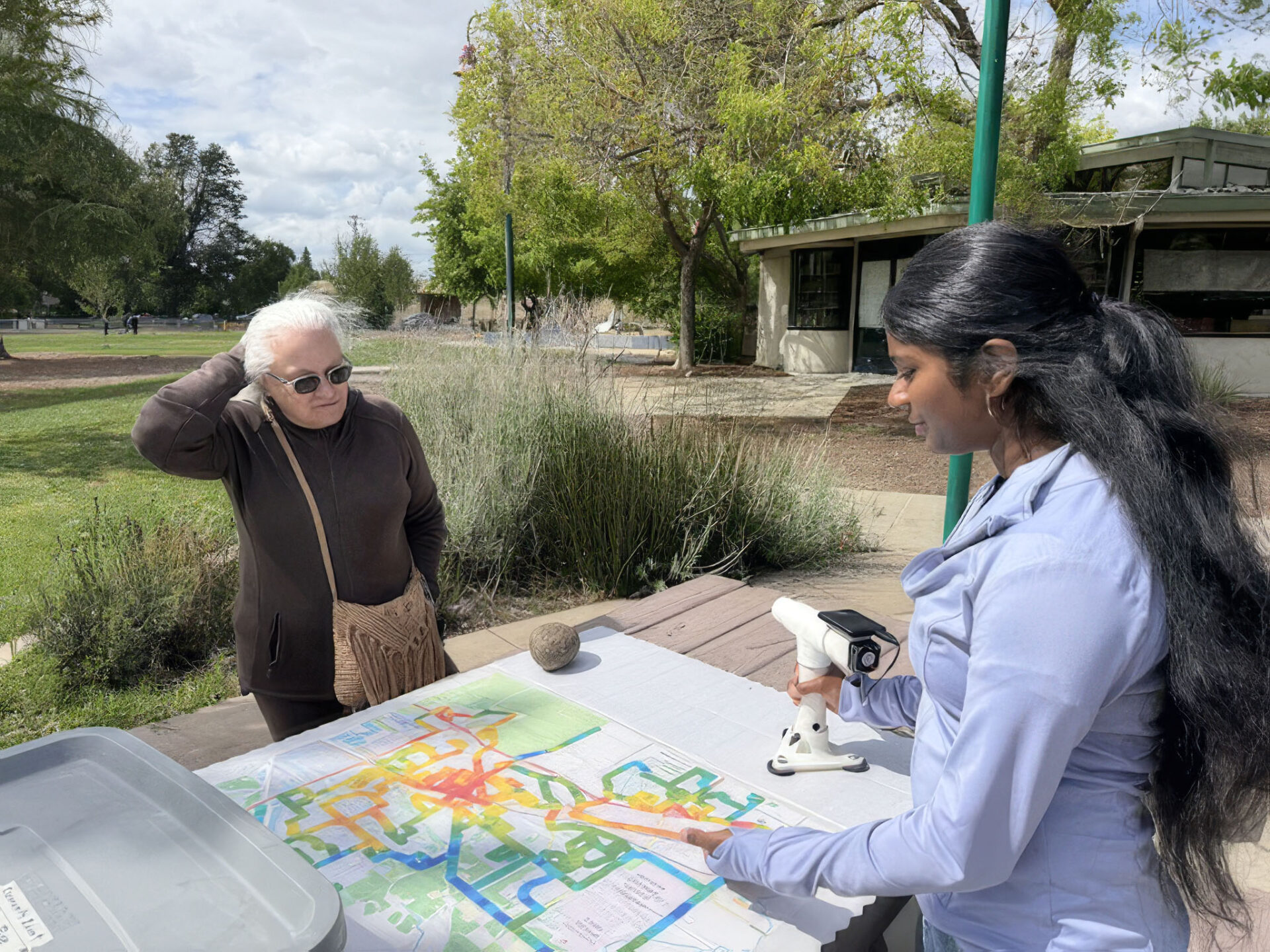
A student explains the heat mapping initiative to a resident at May Nissen Park. Photo: Robin Deepak
Now, the city is using the students’ data to assess heat vulnerability across Livermore and asked the high school team to map heat around bus stops — another area where shade is unequally distributed.
“More adults are willing to listen to us. The students a lot of times have a personal connection and relationship with the admin and with the school district,” Deepak says. “It’s different that we’re youth doing this.”