


Learning the Art of Burning to Prevent Wildfire
For Bryon Cloyd, a chiropractor based in Davis, TV coverage of an elderly homeowner trying to put out fires on his property during the 2017 North Bay firestorms provided the spark to learn how he could help. On a Saturday this November, Cloyd, along with 18 other volunteers from around the Bay Area, participated in a “Learn and Burn” workshop on using fire to minimize the risk of extreme wildfires.
Over the past eight years, extremely hot and fast-moving wildfires that have burned across California were more costly, destroyed more property and caused more fatalities than ever before. Today, more state and county agencies are using prescribed burns to remove wildfire fuel before it can start a blaze, but many people question whether this strategy is safe.
Cloyd, who began learning about prescribed burns this year, grouped himself with people who fear fire. “Most people have been scared to death, because some are enormous, and they’re very worried that any fire that gets lit, it’s just going to race through everything,” he says.
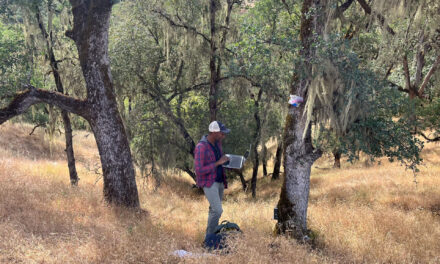
Last fall, Devyn Freidel, who manages Pepperwood Preserve, introduced “Learn and Burn Days” to teach community members safe fire use to reduce fuels in forests and grasslands. No one showed up for the first workshop. Since then, primarily through word of mouth, attendance has grown.
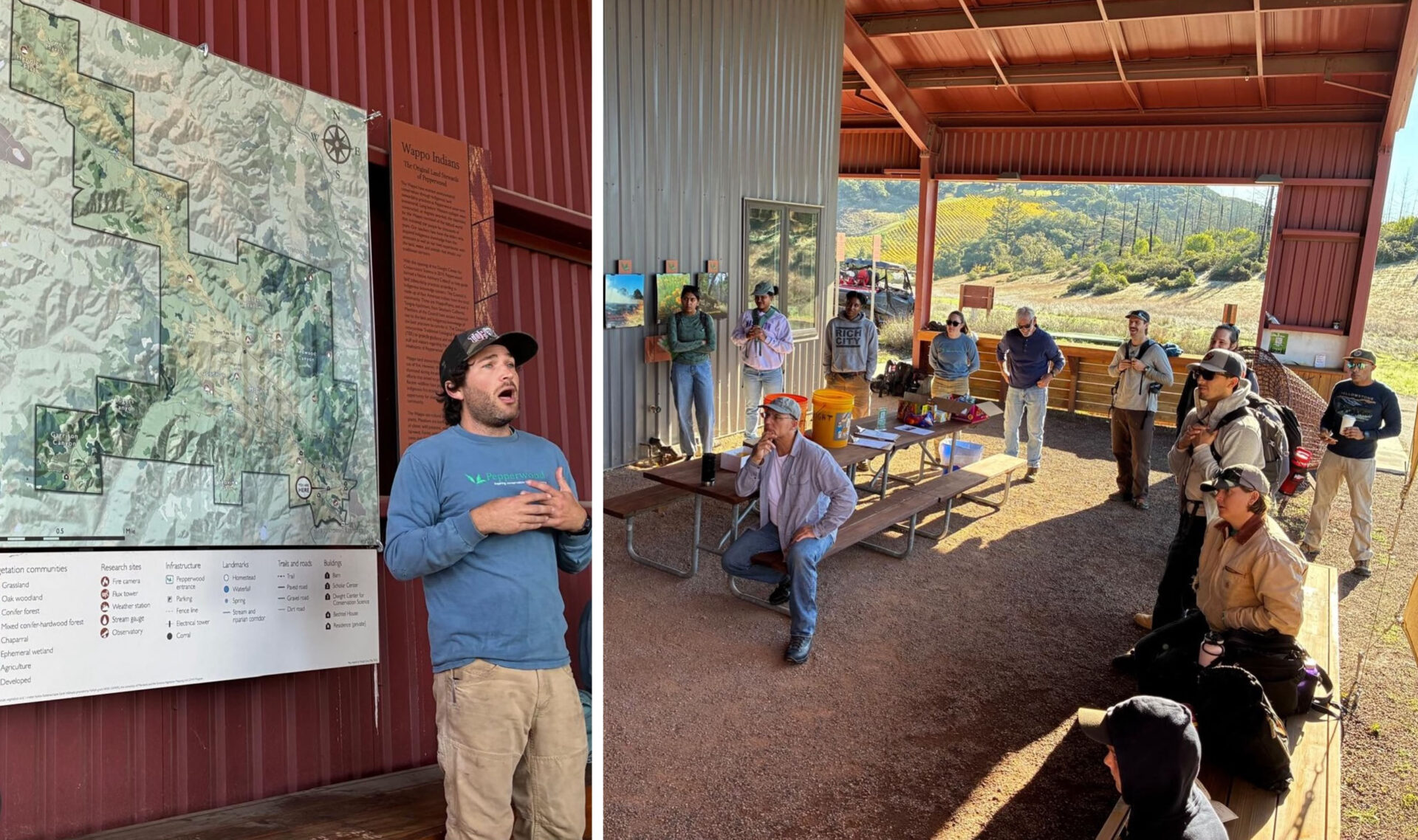
Preserve manager Devyn Freidel kicks off a Learn and Burn Day. Photo: Amy Moore
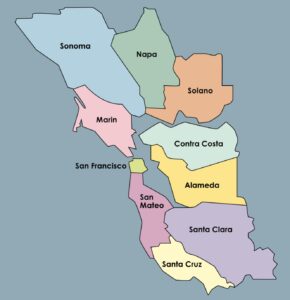
On November 8, the Santa Rosa event drew 19 volunteers from Boonville, Davis, Berkeley, San Francisco, Oakland, Sebastopol, Santa Rosa and Sonoma. Some had fire fighting and prescribed burn experiences. Some had volunteered with prescribed burn associations, community members in a mutual aid society who use fire for vegetation management. Several were undergraduate or graduate students in environmental or ecological studies. Others, such as three California Climate Action Corp members based in Sonoma County, came with no previous experience.
Freidel opened the workshop with a brief history of fires on the preserve that included recent, successive wildfires, post-fire prescribed burning, and cultural burning from the distant past. During the 2017 Tubbs Fire, 95% of the preserve burned.
“That really changed our tune with fire,” Freidel says. He and other land managers learned that to prevent such extreme burns, they needed to go beyond the “lop and scatter” method, which left dead tree matter on the ground. Now, the preserve conducts more frequent prescribed burns when the relative humidity reduces the risk of fires spreading beyond their intended footprint.
Freidel explained that the preserve sits on the traditional homeland of the Wappo people. For thousands of years, the tribe conducted cultural burns, which both reduced fuels and wildfire risk and also created a grassy, oak savannah landscape. But during the 20th century, the federal forestry practice of wildfire suppression created excess fuel across the landscape. Today, the preserve’s goal is to “make the landscape look as it did under Wappo stewardship,” Freidel says. “We need to put fire on the ground.”
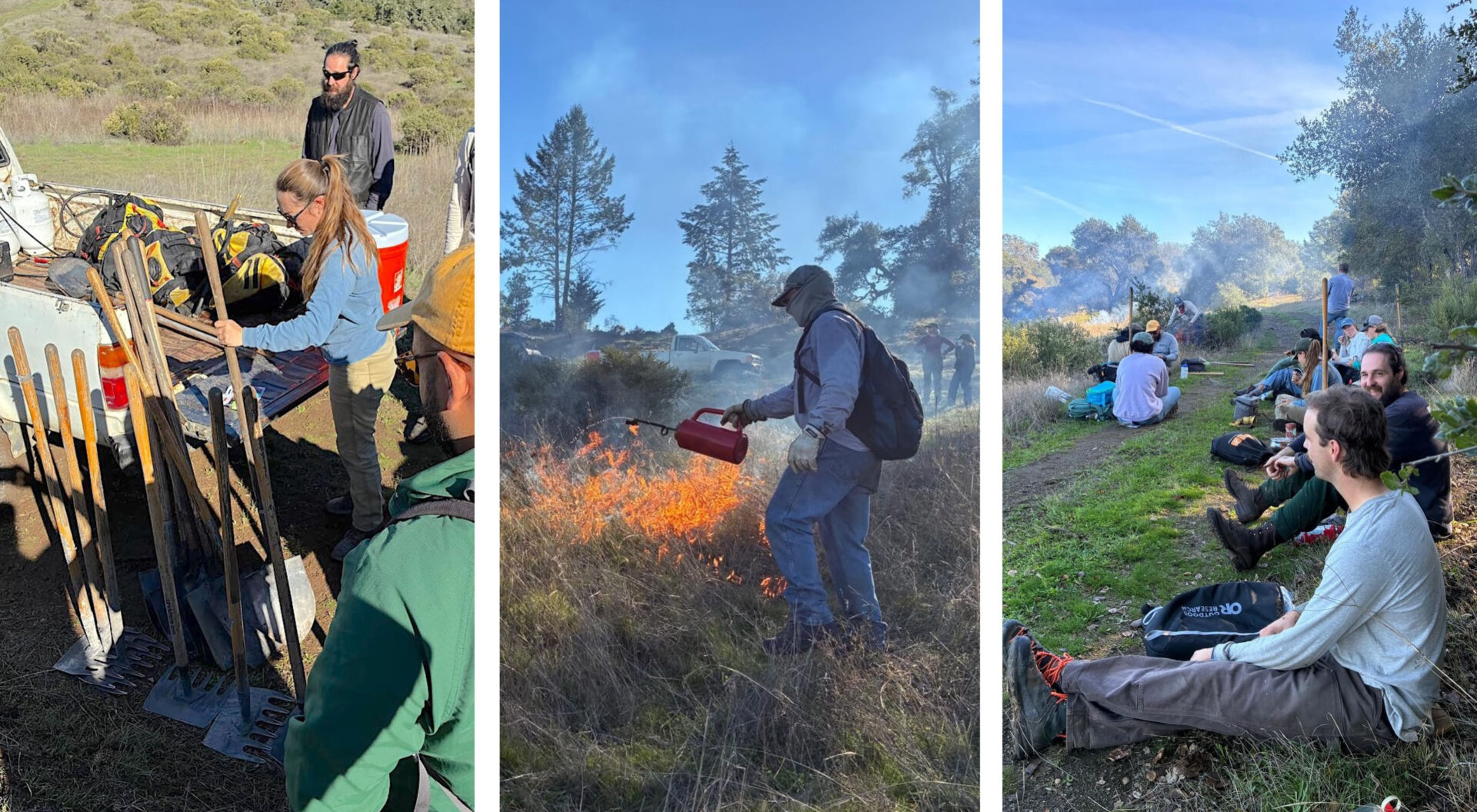
The workshop introduces volunteers to tools, techniques, and a like-minded community. Photo: Amy Moore
At the workshop, Freidel also explained how prescribed burning provides ecological benefits. In addition to reducing fuels on the ground, burning suppresses invasive plant species and minimizes encroachment of Douglas fir. Less competition promotes native grasses, such as purple needlegrass — California’s state grass — and blue wild rye. Purple needlegrass roots can extend as much as 20 feet into the soil; their root systems absorb and retain water, resulting in more moisture later in the season, which helps reduce wildfire spread. Following wildfire, perennial grasses put up shoots that provide forage for wildlife.
“The more the land is burned, the more native [grasses] return, the less [land] will burn subsequently,” Freidel says.
Before Californians try this at home, they must get the required permits from state and county agencies. They should also attend formal learning events, Freidel emphasizes.
At the workshop, Freidel divided the day into three periods: pile burning, broadcast burning, and extinguishing. He and Shae Hopkins, Pepperwood restoration technician, showed volunteers how to use burn tools. “We want to do this in the safest way and to bring everybody with us,” Freidel says. He frequently asked volunteers with experience in burning or firefighting to add their knowledge to the workshop.
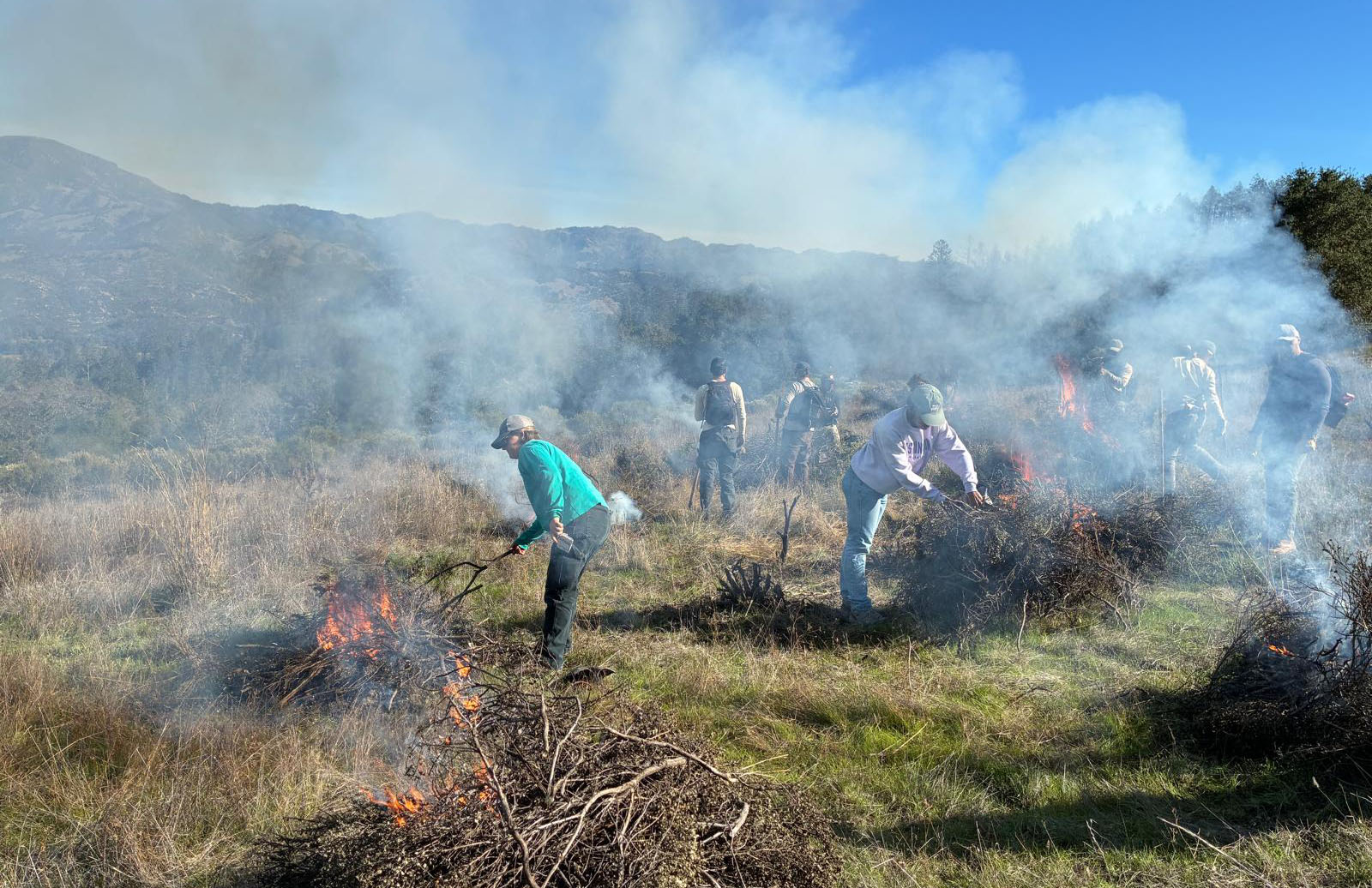
Freidel and Hopkins demonstrated how to light pile burns and how to use a McLeod, a wooden-handled metal tool with a wide-toothed rake on one side and a flat scraping edge on the other. Volunteers used the McLeod to manage “pile creep” — the fire extending too far beyond the pile’s footprint. The black zone created by pile creep creates a safety zone as well as ecological benefits, Freidel explained.
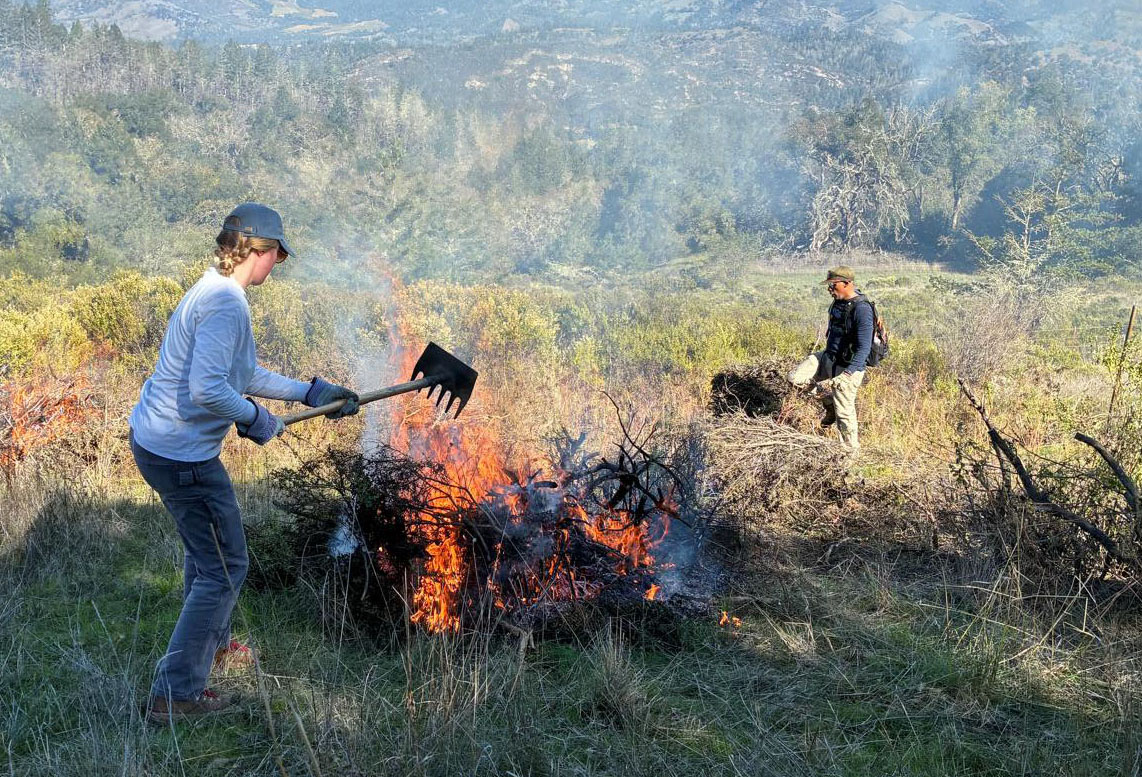
Climate corps fellow Rose Carges uses the McLeod to draw the fuel into her pile burn. Photo: Amy Moore
Cloyd, the chiropractor from Davis, moved methodically from pile to pile, starting the fire and adding more fuel to ensure a hot enough blaze. After the 2018 and 2020 wildfires, he volunteered to repair trails in Mendocino National Forest and learned how to use a chainsaw in a class offered by a prescribed burn association. From there, he began to volunteer for burns. “I’m planning on being a volunteer hopefully for years, because there’s a lot of work to do,” he says.
Once all 20 piles were burning, it was time for lunch. The relaxed pace allowed for a long break while volunteers got to know one another and shared their knowledge.
After lunch, Freidel and Hopkins taught volunteers how to broadcast burn using drip torches. These torches, filled with a mixture of diesel and gasoline, drip flame onto the ground, as if from a watering can.
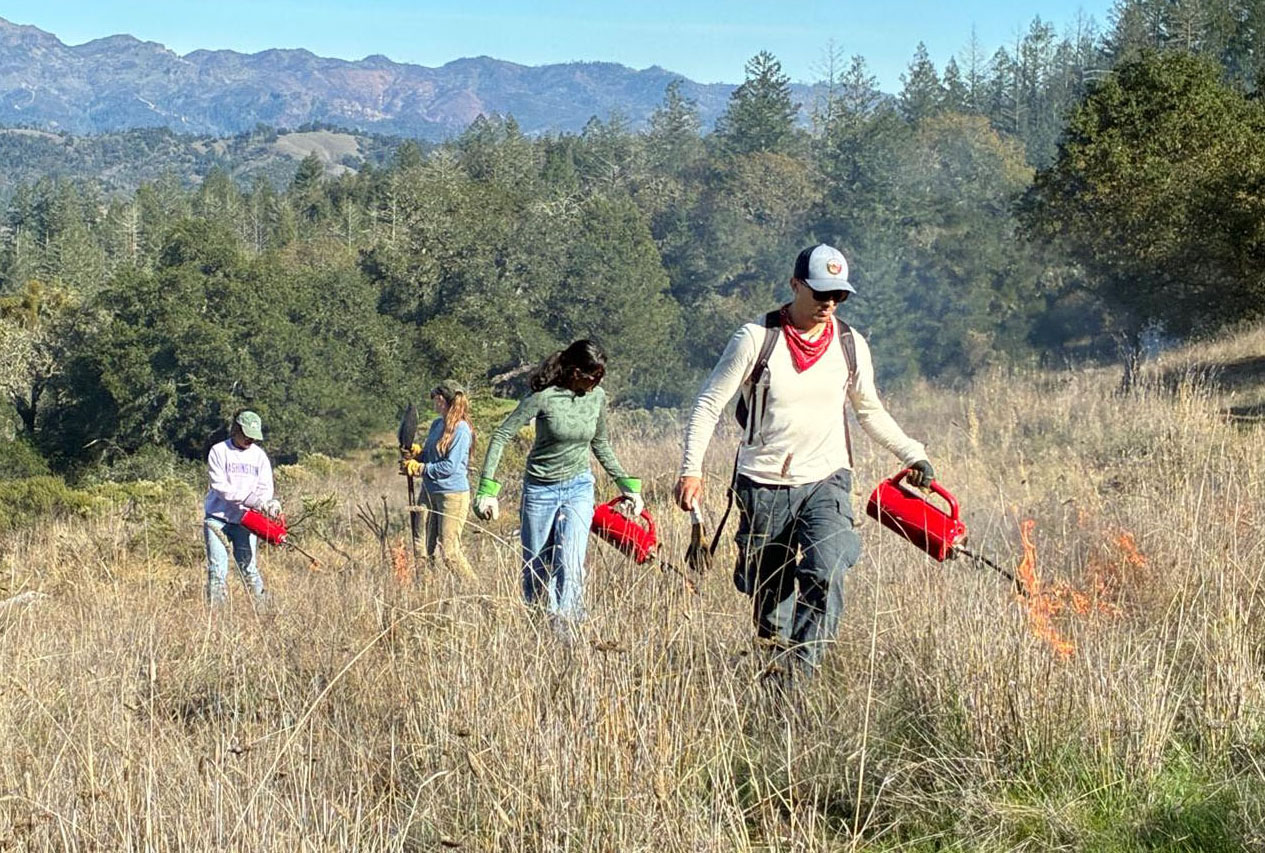
At the workshop, three volunteers used drip torches to launch a broadcast burn on a section of grassland about the size of a soccer field. Hopkins taught them to stagger themselves at intervals so that multiple lines of fire set in proximity could conjoin. Photo: Amy Moore
Emily Altomare, a Sonoma-based Climate Action Corps fellow, says she attended the workshop because she’s “interested in the use of fire to help ecosystems and resilience, and in avoiding major wildfires.” With her background in environmental studies at Sonoma State University, she is familiar with “both sides” surrounding grassland burning: grasses burn fast and hot and can spread, and broadcast burns on grasslands reduce fuels.
“It’s newer to me that fire is a good thing and a healthy thing in the grasslands,” she says. “It’s so fun to see the narrative shifting back.”
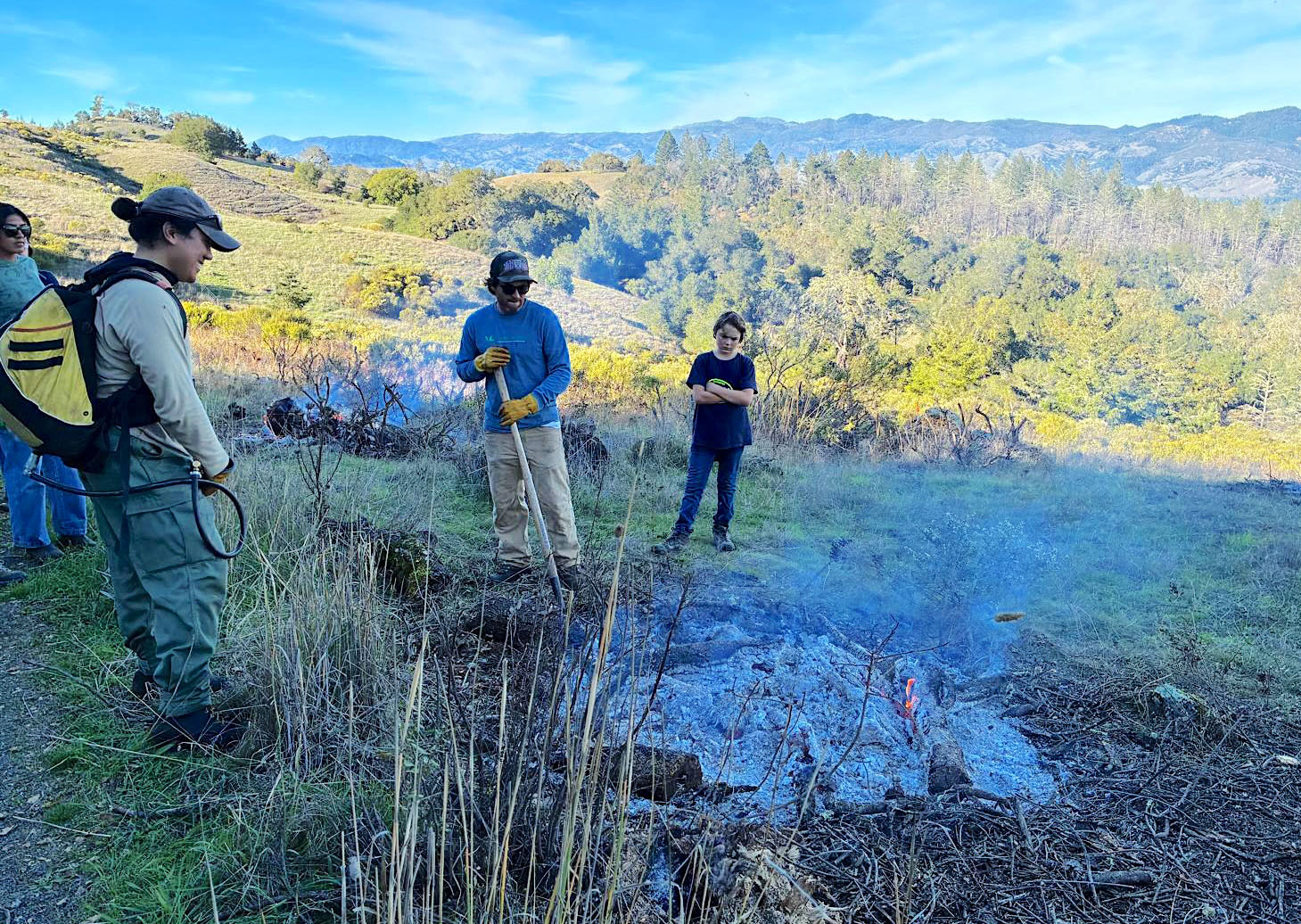
Extinguishing the fires after burning wildfire fuel. Photo: Amy Moore
Late in the afternoon, once the piles had burnt to cinders, Freidel, with the help of another volunteer, A.J. Tarrant of the East Bay Regional Parks Fire District, demonstrated how to “dry mop” to fully extinguish the burn.
Freidel hopes that the workshop volunteers will “take a little piece of this fire out into the community.” This resonates with Altomare, who summarized her volunteer experience as “a way to give me more information to share with people [who] maybe aren’t interested in doing it, but would love to hear about it.”
Rose Carges, another Climate Action Corps fellow, first heard of prescribed burning as an undergraduate in sustainable environmental design at UC Davis. Intrigued by professor Emily Schlickman’s presentation on prescribed burns and what the future of fire might look like in California, Carges threw herself into learning as much as she could before volunteering with prescribed burn alliances.
“Prescribed burning is a way to manage the landscape so we can live more in harmony with it. And returning to a more cultural practice that’s been done here for thousands of years by different Native American groups seems like a way we can be more in touch with the land and try to find a solution [to] this huge problem,” she says.
“I do really want to be more involved going forward and, hopefully for the rest of my life, get to go out on the weekends and do some burning. It’s a great way to be in community.”
MORE
Workshops
- All Hands Ecology, Good Fire Alliance, Pepperwood Preserve, Napa Prescribed Burn Association, and Tending the Land
California PBAs
Community Fire Watch